The BSE BANKEX index is a benchmark for India’s banking sector. It tracks eligible banks from the BSE 500 and weights them using capped, float-adjusted market capitalisation. BANKEX helps traders follow banking shares and serves as the underlying index for BANKEX futures and options.
Its value reflects the combined movement of its constituent banks. A bank with a higher index weight has more influence on BANKEX than a bank with a lower weight, assuming the same percentage price change.
BANKEX stocks list and weightage
BANKEX had 14 constituents as of 31 August 2026. These were its ten largest constituents by weight, according to BSE’s August 2026 BANKEX factsheet.
Top 10 BANKEX constituents by weight
The other four constituents are Canara Bank, Punjab National Bank, Union Bank of India and Yes Bank. Together with the ten banks above, they make up the full BANKEX stocks list.
The table shows weights for the top ten constituents as of 31 August 2026. Weights change with prices and index reviews.
ICICI Bank and HDFC Bank together accounted for 34.95% of BANKEX on that date. Their combined influence helps explain why the index can rise even when several smaller constituents fall.
How is the BANKEX index calculated?
BANKEX uses capped, float-adjusted market capitalisation. Three elements determine the calculation:
Free-float market value: Each bank’s share price is multiplied by its eligible free-float shares. Holdings classified as non-free-float, such as promoter holdings, are excluded.
Weight limits: Capping rules limit concentration in the largest constituents. BANKEX is therefore not an equal-weight index.
Index divisor: The adjusted market values are combined and divided by an index divisor. Divisor adjustments maintain continuity when relevant corporate actions or constituent changes occur.
BSE schedules constituent reviews semiannually, in June and December. Market prices can change the weights between reviews.
A simple BANKEX calculation example
Suppose a bank has a 15% weight in BANKEX and its share price rises 2%. If every other constituent is unchanged, its approximate contribution to the index return is:
15% × 2% = 0.30%
At an index level of 60,000, that would mean an increase of roughly 180 points.
This is an illustrative contribution calculation, assuming no other changes. It is not a forecast or an example using a current bank’s weight.
BANKEX vs BANK NIFTY: what is the difference?
BANKEX and Nifty Bank, commonly called BANK NIFTY, both track Indian banking stocks. They are separate benchmarks with their own selection and weighting rules.
The BANK NIFTY figures above use NSE Indices’ August 2026 Nifty Bank factsheet. On the same date, ICICI Bank had a 14.86% weight in BANK NIFTY, compared with 17.73% in BANKEX.
Different weights mean the same bank’s price movement can affect the two indices differently. Compare percentage returns over the same period rather than their raw index levels. A higher index level does not, by itself, mean an index is more expensive.
Planning a BANKEX options strategy?Start testing for free on AlgoTest and check your entry, exit and risk rules against historical data.
What moves the BANKEX index?
Four factors are useful to watch:
Bank earnings and asset quality: Loan growth, margins, provisions and bad loans affect expectations for a bank’s profitability.
Interest rates and funding costs: RBI policy can affect lending rates, deposit costs and credit demand. The effect depends on how quickly a bank’s loans and funding reprice, so a rate cut does not automatically benefit every bank.
News about large constituents: Results, management changes or regulatory developments at a heavily weighted bank can have a noticeable effect on BANKEX.
Broader market conditions: Investor flows, economic expectations and global risk sentiment can move banking shares together.
Check which banks are contributing to a move. A rise led by one large constituent carries different information from a rise spread across most banks in the index.
Read our BANKEX option chain guideto understand call and put OI, compare trading volume and assess strike prices before placing a trade.
How can traders use BANKEX?
Separate the index from its contracts
The BANKEX index itself does not expire. BANKEX futures and options have contract expiry dates, lot sizes and settlement rules. Use our BANKEX expiry guide to check those details before choosing a contract.
Check the option contract you intend to trade
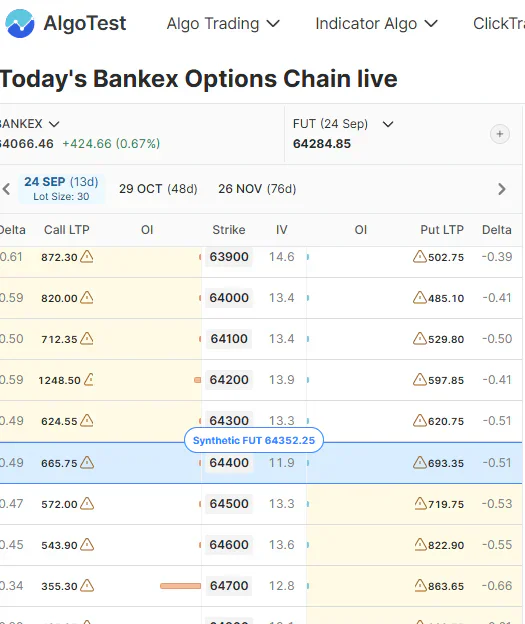
Use the BANKEX option chain to review the relevant expiry and strikes. Before placing an order, check the contract’s bid-ask spread, available quantity and recent trading activity through your trading platform.
Liquidity can differ across strikes and expiries. High open interest alone does not guarantee that your order will fill at the displayed price. Your strike selection should fit the strategy and the premium you are willing to pay or receive.
Account for option pricing
A rise in BANKEX does not guarantee a profit on every call option. The size and timing of the move, implied volatility and time decay also affect the premium.
Understanding how option Greeks interact helps explain why an option can lose value even when the index moves in the expected direction.
Test the strategy on BANKEX data
Test entry and exit rules using BANKEX contracts. A strategy’s BANK NIFTY results do not establish how it will perform on BANKEX.
Include realistic trading costs and slippage assumptions. Review drawdowns and losing periods, then check the rules on data that was not used to develop them. Our guide to backtesting options strategies explains the process.
Conclusion
Understanding the BANKEX index starts with its constituent banks and their weights. For an options trade, also check the chosen contract, how its premium responds to market changes, and the losses your strategy can sustain.
Put those checks into a defined set of trading rules. Start testing your BANKEX options strategy for free on AlgoTest.