What is BTST Trading?
BTST stands for Buy Today, Sell Tomorrow.
As the name suggests, you buy a stock today and sell it on the next trading day. The goal is to benefit from overnight price movements without holding the stock for several days or weeks.
BTST trading is popular among traders who want to capture short term momentum without trading intraday.
For example,
You buy 100 shares of XYZ Ltd. at ₹500 just before the market closes.
The next morning, the stock opens at ₹520 after positive market news.
You sell your shares at ₹520.
Your profit is ₹20 per share, or ₹2,000 before charges.
This simple approach is why many traders use BTST during strong market trends.
How Does BTST Trading Work?
BTST trading follows a simple process.
Identify a stock showing strong momentum before market close.
Buy the stock near the end of the trading session.
Hold the position overnight.
Sell the stock the next trading day based on your target or exit plan.
Unlike intraday trading, you carry the position overnight. This means you can benefit from gap up openings, but you are also exposed to overnight risks.
Related: Best Option Trading Strategies in India: How to Choose the Right Strategy
Benefits of BTST Trading
BTST trading offers several advantages when used correctly.
Capture Overnight Momentum
Many stocks continue their momentum after positive earnings, news, or strong buying activity.
Quick Profit Opportunities
You do not need to wait for weeks to book profits. Most BTST trades last only one trading day.
Less Screen Time
Unlike intraday trading, you do not have to monitor charts throughout the day.
Lower Capital Commitment
Your money is not locked for a long period because trades usually close the next day.
Risks of BTST Trading
Every trading strategy has risks, and BTST is no different. Since you hold your position overnight, it's important to understand what could go wrong before placing a trade.
1. Overnight Risk
Unexpected news, company announcements, or global events can move the market before it opens the next day. Even if your setup looks strong, overnight developments can quickly change market sentiment.
2. Gap Down Openings
A stock can open much lower than your buying price due to negative news or weak market conditions. This may result in losses before you even get a chance to exit the trade.
3. High Volatility
Stocks suitable for BTST often move quickly, which creates both opportunities and risks. Sharp price swings can hit your stop-loss or reduce profits if the trade moves against you.
4. Short Delivery
In some cases, settlement issues can lead to short delivery, where the shares are not delivered on time. While this doesn't happen often, it's a good idea to understand your broker's BTST policy and settlement rules before trading.
Best BTST Trading Setups
Choosing the right setup is more important than simply buying any stock before the market closes.
Here are some of the most reliable BTST trading setups.
1. Breakout Setup
This is one of the most popular BTST strategies.
Look for stocks that close above an important resistance level with strong buying volume.
The breakout often attracts more buyers on the next trading day.
What to look for:
Price closes above resistance.
Strong bullish candle.
Higher than average volume.
Positive market sentiment.
2. High Volume Breakout Setup
Volume confirms whether a breakout is genuine.
If a stock breaks resistance with significantly higher trading volume, it usually indicates strong institutional participation.
This setup often provides better follow through the next day.
3. Moving Average Pullback Setup
This setup works well in trending markets.
Look for stocks trading above the 20 EMA or 50 EMA. Wait for a small pullback during the day and enter when the stock recovers before market close.
This allows you to trade in the direction of the existing trend.
4. Gap Continuation Setup
Some stocks gap up because of earnings, company announcements, or positive sector news.
If buying continues throughout the day and the stock closes near its high, the momentum may continue the next day.
5. Momentum Setup
Strong stocks often remain strong.
Look for stocks making fresh highs with consistent buying throughout the session.
These stocks usually have better chances of continuing their move the following day.
Related: 9 Steps to Build a Profitable Algo Trading Strategy in India
Profit Booking Strategies for BTST Trading
Entering a trade is only half the job. Knowing when to exit is equally important.
1. Set Realistic Profit Targets
Avoid waiting for unrealistic gains.
Many BTST traders aim for small but consistent returns based on the stock's volatility.
2. Use a Trailing Stop Loss
A trailing stop loss helps lock in profits while allowing the trade to continue if the stock keeps moving higher.
3. Move Your Stop Loss to Break Even
Once your trade moves in your favor, shift your stop loss to your entry price.
This protects your capital if the market suddenly reverses.
4. Book Partial Profits
If the stock reaches your target quickly, consider booking part of your position while letting the remaining shares run with a trailing stop loss.
5. Follow the Trend
If momentum starts weakening or selling pressure increases, do not hesitate to exit.
Protecting your profits is often better than waiting for a larger move.
Popular: How to Backtest Algo Trading Strategies: Intraday, BTST, Positional & More (Step-by-Step)
Risk Management Tips for BTST Traders
Even the best setup can fail.
Following basic risk management rules helps reduce losses.
Risk only a small percentage of your capital on each trade.
Always define your stop loss before entering.
Avoid taking BTST positions before major events unless it is part of your strategy.
Focus on liquid stocks with good trading volumes.
Never trade based only on tips or social media posts.
Related: Top 5 Swing Trading Strategies (2026): How to Build, Backtest & Automate Them
How to Find BTST Stocks
Finding the right stock is often more important than finding the perfect strategy.
Here are a few things to check before entering a BTST trade.
Strong closing price near the day's high.
Higher than average trading volume.
Breakout above an important resistance level.
Positive sector performance.
Strong overall market trend.
Stocks trading above key moving averages.
The more conditions a stock meets, the stronger the setup becomes.
How to Build and Backtest a BTST Strategy on AlgoTest
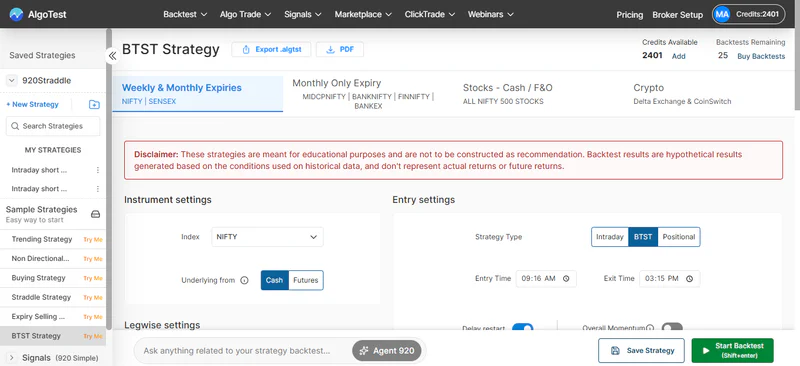
A BTST strategy should be tested before you risk real money.
Instead of relying on intuition, you can create clear entry and exit rules and check how they would have performed on historical data.
Here is one simple workflow.
Step 1. Define Your Entry Rules
For example,
Stock closes above the previous day's high.
Volume is at least 1.5 times the 20 day average.
RSI is above 60.
Price is above the 20 EMA.
Step 2. Define Your Exit Rules
You can exit based on rules such as:
Sell at the next day's market open.
Exit at a fixed profit target.
Exit if the stop loss is hit.
Exit before market close if neither condition is met.
Step 3. Backtest the Strategy
Run the strategy on historical data to understand how it performs across different market conditions.
Look at metrics such as:
Win rate.
Profit factor.
Maximum drawdown.
Average return per trade.
This helps you understand whether the strategy has a real edge before using it in live markets.
Step 4. Paper Trade
Once the backtest results look promising, paper trade the strategy in live market conditions.
This lets you see how the strategy behaves without risking real capital.
Step 5. Automate the Strategy
After validating your rules, you can automate your BTST strategy through AlgoTest and execute trades without manual intervention.
Read the complete setup guide here.
BTST Trading vs Intraday Trading
Conclusion
BTST trading can help you capture short term market moves, but consistent results come from following a clear strategy, managing risk, and sticking to your exit plan.
Before trading with real money, backtest your strategy on historical data and validate it through paper trading. This helps you understand how your setup performs across different market conditions.
Join Us as We Simplify Algo Trading in India
AlgoTest brings backtesting, paper trading, automation, option chain, Greeks, Open Interest, IV analysis, and strategy building together in one platform.
Join 45,000+ traders using AlgoTest to build, test, and automate rule-based trading strategies. Get 25 backtests free and start testing your next BTST strategy today.
Additional Resources
Trading Tools
Disclaimer:This article is for educational purposes only and does not constitute investment or trading advice. Options trading involves risk, and past performance or examples do not guarantee future results. Please evaluate your financial situation and consult a qualified financial advisor if needed before trading.