Call writing means selling a call option in exchange for a premium. As the seller, you must sell the underlying asset at the strike price if the buyer exercises the option before expiry.
That's the short answer. Let's look at how call writing works, why traders use it, and the risks you should know before getting started.
Key Takeaways
Call writing means selling a call option.
The seller receives a premium upfront.
Call writing is commonly used in neutral or mildly bearish markets.
The strategy carries significant risk if the market rises sharply.
What Is Call Writing?
A call option gives the buyer the right to buy an asset at a fixed price, known as the strike price, before or on the expiry date. To get this right, the buyer pays a premium.
Call writing is the opposite side of this trade. Instead of buying the option, you sell it. In return, you receive the premium upfront. If the buyer chooses to exercise the option, you must sell the asset at the agreed strike price.
In simple terms, call writing and selling a call option mean the same thing. It is also a type of option writing, which refers to selling call or put options to earn a premium.
Learn more about Option Trading
How Does Writing a Call Option Work?
Once you write a call, your position works very differently from a buyer's position. Here is the key difference in perspective:
The call buyer has a right. They can choose to exercise it or let it expire.
The call writer has an obligation. If the buyer exercises, the writer must sell the underlying at the strike price.
Because of this obligation, call option writing can happen in two ways:
Covered call writing, where you already hold the underlying asset and write a call against it.
Naked, or uncovered, call writing, where you do not hold the underlying and simply sell the call on its own.
Covered call writing is generally seen as the safer version, since you already own what you may need to deliver. Naked call writing can expose you to larger losses, which we will get to in the risks section.
Here is how the trade plays out step by step.
You pick a strike price and expiry for the underlying, say Sensex or Nifty.
You sell, or write, a call option at that strike and receive the premium in your account right away.
Your broker blocks margin against the position, since you now have an open obligation.
At expiry, one of two things happens, depending on where the price ends up.
Let's use a simple, made-up example to see this in numbers. Suppose Trader A writes one Sensex call option at a strike price of 82,000, and collects a premium of 200 points. For this example, let's assume a lot size of 10, just to keep the math simple.
If Sensex closes at 81,500 on expiry, which is below the strike, the call expires worthless. Trader A keeps the entire premium, which works out to 200 points times a lot size of 10, or 2,000 rupees in profit.
If Sensex closes at 82,600 instead, which is above the strike, the option is in the money by 600 points. Trader A's loss is 600 points minus the 200 point premium already collected, which is 400 points, or 4,000 rupees.
This example shows the basic trade off in call writing. You earn a fixed, capped amount if the market stays below the strike, but your loss grows as the market moves further above it.
Related: Explore the live Sensex Option Chain on AlgoTest to track call writing, Open Interest, Max Pain, PCR, and strike-wise positioning in one place.
Why Do Traders Write Call Options?
Earn Premium Income
Selling a call option allows traders to collect a premium upfront. If the option expires worthless, the premium becomes their profit.
Take a Neutral or Mildly Bearish View
Call writing is commonly used when traders expect the underlying to stay below the strike price or move only slightly.
Generate Extra Income with Covered Calls
Investors who already own stocks can write call options against their holdings to earn additional income while continuing to hold the shares.
Benefit from Range-Bound Markets
When a stock or index is expected to trade within a range, call writing can be a way to earn premium without relying on a strong price move.
Related: Put-Call Parity: What it is, Why it matters, How to use it
Risks of Call Writing
Large Losses in Naked Call Writing
A naked call has significant risk because there is no limit to how high a stock or index can rise. If the market moves sharply above the strike price, your losses can grow quickly.
Margin Requirements
Writing call options requires margin with your broker. The required margin may increase if market volatility rises or the position moves against you.
Assignment Risk
In some cases, you may be assigned before the option expires. If that happens, you must meet your obligation to sell the underlying asset at the strike price.
Limited Upside in Covered Calls
If you write a covered call and the price rises well above the strike price, you still have to sell at the agreed price. This limits the gains you can make on the underlying asset.
Call writing can be an effective strategy when used in the right market conditions, but it also carries meaningful risk. Before writing a call option, make sure you understand the possible outcomes and have a clear risk management plan in place.
Call Writing vs Buying a Call Option
Here is a simple side by side comparison of the two sides of the same contract.
This table shows why the two sides of an option contract can feel like completely different strategies, even though they are linked to the same trade.
How to Identify Call Writing in the Option Chain
Traders often identify call writing by looking at Open Interest (OI) and the option premium together.
OI rises while the premium falls: May indicate fresh call writing.
OI rises while the premium also rises: May indicate fresh call buying.
When many traders write calls at the same strike price, Open Interest builds at that level. This often suggests they expect the market to stay below the strike, which is why heavy call writing can indicate a potential resistance level. It is a useful signal, but not a guarantee.
You can track call writing using a liveSensex Option Chain, where strike-wise Open Interest shows where positions are building. Combining this with indicators like Put Call Ratio (PCR), Max Pain, and whether a strike is ITM, ATM, or OTM gives a clearer picture of market positioning.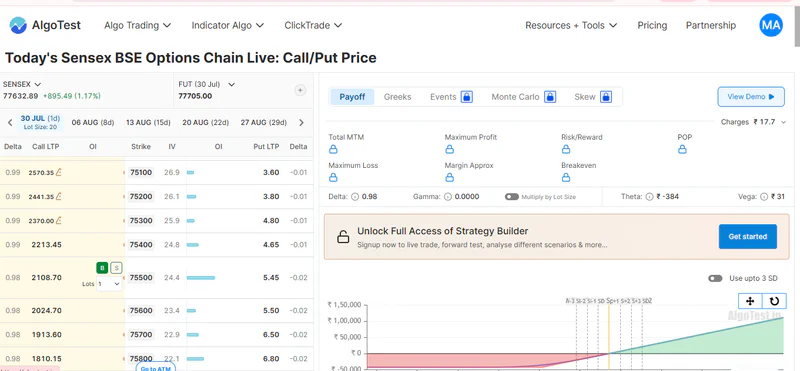
Common Mistakes Beginners Make While Writing Call Options
Writing Naked Calls Without Understanding the Risk
Naked call writing can lead to large losses if the market rises sharply.
Ignoring Margin Requirements
Call writing requires margin, which can increase as market volatility rises.
Not Having an Exit Plan
Know when you'll exit the trade before you enter it to avoid larger losses.
Confusing Covered and Naked Calls
Owning some shares doesn't automatically make your position a covered call. The quantity must match.
Writing Calls Before Major Events
Events like earnings or policy announcements can cause sharp price moves and increase risk.
Assuming the Premium Is Guaranteed Profit
You receive the premium upfront, but you only keep it if the trade works in your favour.
Conclusion
Call writing is a strategy that lets you earn a premium by selling a call option, but it also comes with clear obligations and risks. Understanding how it works, when traders use it, and how to identify call writing in the Option Chain can help you make more informed trading decisions.
Whether you're learning the basics or testing advanced options strategies, AlgoTest helps you analyse, backtest, paper trade, and automate your trades on one platform. Trusted by thousands of traders, it's one of India's leading options trading platforms.
Create your free AlgoTest account and start exploring today.
Additional Resources
🛠️ Trading Tools