What Is the Closing Auction Session?
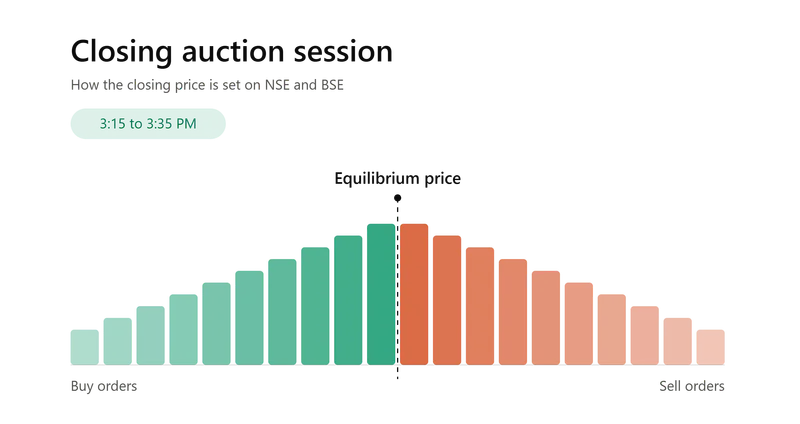
The Closing Auction Session (CAS) is a 20-minute auction from 3:15 PM to 3:35 PM that sets the official closing price for eligible stocks on NSE and BSE. It replaced the old VWAP method on 3 August 2026. The closing price now comes from demand and supply matching during the auction, not from the last traded price.
For eligible F&O stocks, continuous trading ends at 3:15 PM instead of 3:30 PM. The final 20 minutes of the day belong to the auction.
This matters even if you never place an order during CAS. The official closing price feeds expiry settlement, index calculation, mutual fund NAVs and end-of-day risk calculations, so it can affect positions you already hold.
Closing Auction Session Timings
Stocks not covered under CAS continue trading normally until 3:30 PM.
The equity derivatives segment stays open until 3:40 PM. That gives futures and options traders a few extra minutes to react after the official closing price is published.
Key Takeaways
Continuous trading for eligible F&O stocks now ends at 3:15 PM.
The Closing Auction Session runs from 3:15 PM to 3:35 PM on every trading day.
The official closing price is the equilibrium price, not the last traded price or the old 30-minute VWAP.
CAS directly affects stock F&O settlement and indirectly influences index options through the closing value of index constituents.
Most retail traders do not need to change their strategy, but expiry-day traders and algo traders should understand how the new process works.
Why SEBI Introduced the Closing Auction Session
SEBI introduced CAS to make closing prices fairer, more transparent and harder to manipulate.
Under the old method, a stock's closing price came from the volume weighted average price (VWAP) of trades in the last 30 minutes of continuous trading. Large trades placed during that window could move the closing price, particularly in stocks with thinner liquidity.
CAS addresses that by discovering one fair closing price through an auction where every order sits in the same pool.
Benefits of CAS
It reduces price manipulation, because a few large trades near the close can no longer move the closing price on their own.
It improves price discovery by matching all buy and sell orders at a single fair price.
It makes F&O settlement more reliable, since settlement now rests on a transparent auction price.
It keeps index closing values more accurate, because constituent stocks also close through the auction.
It helps mutual funds and ETFs value their portfolios using a fairer closing price.
It brings Indian markets in line with global exchanges such as the NYSE and the London Stock Exchange, which have used closing auctions for years.
Which Stocks Are Covered by CAS?
CAS applies to stocks that have active futures and options contracts.
Stocks without F&O contracts continue using the existing closing price mechanism and trade until 3:30 PM as before.
SEBI may extend CAS to more securities in future.
How Does the Closing Auction Session Work?
CAS runs in four steps.
1. Order collection
After continuous trading ends at 3:15 PM, the exchange calculates the reference price. From 3:20 PM, traders can place eligible auction orders.
During this stage:
Fresh limit and market orders can be placed.
Unmatched limit orders from the regular session are carried forward into the auction.
Stop-loss, IOC (immediate-or-cancel) and disclosed quantity (iceberg) orders are not allowed.
2. Equilibrium price calculation
The exchange compares all buy and sell orders to find the equilibrium price. This is the price at which the maximum number of shares can be matched while leaving as few unmatched orders as possible.
The equilibrium price must stay within a price band of plus or minus 3% around the reference price.
3. Order matching
The order entry window closes at a random moment during the final two minutes of the auction. This prevents traders from timing a last-second order to shift the outcome.
Between 3:30 PM and 3:35 PM, all eligible orders are matched at the equilibrium price.
4. Official closing price
The equilibrium price becomes the stock's official closing price. It is then used for:
Stock F&O settlement
Index calculation
Mutual fund NAVs
End-of-day valuation and risk calculations
Nifty Expiry Day: 7 Rules Every Options Trader Should Follow (2026)
How Is the Closing Price Calculated?
The official closing price under CAS is the equilibrium price, which is the price at which the maximum number of buy and sell orders can be matched during the auction. It can differ from both the reference price and the last traded price.
The calculation works like this:
The exchange calculates the reference price using the VWAP of trades between 3:00 PM and 3:15 PM.
A price band of plus or minus 3% is set around that reference price.
During the auction, the exchange finds the price where the highest number of shares can be matched.
That price becomes the official closing price. If no valid equilibrium price is found, the reference price is used instead.
Worked example
Suppose XYZ Ltd has a reference price of ₹1,000. The auction price band runs from ₹970 to ₹1,030.
During the auction:
Buy orders cluster between ₹1,003 and ₹1,008.
Sell orders cluster between ₹995 and ₹1,005.
The exchange finds that ₹1,006 allows the highest number of shares to be matched. The last traded price before 3:15 PM was ₹998, but ₹1,006 becomes the official closing price because it is the equilibrium price.
This gap between the last traded price and the official close is the part that surprises most traders.
Related: Bank Nifty Expiry Day Explained (2026): Date, Rules & Best Strategies
How to Track the Indicative Closing Price Live


You do not have to wait until 3:35 PM to see where a stock or index may close.
During the auction, the exchange publishes indicative information that updates as orders come in. This includes the indicative equilibrium price, the indicative tradable quantity, and the imbalance between cumulative buy and sell quantities.
You can follow this on the AlgoTest Indicative Price Terminal. It brings indicative prices for NIFTY 50, SENSEX, BANK NIFTY, MIDCPNIFTY, FINNIFTY and eligible stocks onto one searchable screen, alongside the spot last traded price and the difference between the two.
Watching the indicative price move during the auction tells you how far the official close is drifting from the last traded price, which is useful if you hold positions that settle against it.
How Does CAS Affect Options Traders?
CAS changes the official closing price of the underlying stock. You continue trading options in the F&O segment as usual, but the new closing price can influence settlement, end-of-day reporting and expiry outcomes.
Most retail traders do not need to change how they trade. CAS matters most for expiry-day settlement, stock F&O positions and strategies that execute near the close.
Should Options Traders Change Their Strategy?
For most traders the answer is no. Three groups should look more closely.
Intraday traders should check their broker's revised MIS square-off timings, because eligible stocks now stop continuous trading at 3:15 PM.
Expiry-day traders should remember that settlement is based on the CAS closing price rather than the last traded price.
Algo traders should review any closing-time automation, because stop-loss, IOC and iceberg orders are not accepted during CAS.
If you mainly trade index options and exit before the close, the impact is likely to be small.
Does CAS Affect Nifty and Bank Nifty Options?
Not directly. Nifty and Bank Nifty options do not take part in the Closing Auction Session.
The closing value of these indices does depend on the closing prices of their constituent stocks. Since eligible F&O stocks now close through the auction, index values and index option settlement can be affected indirectly.
Closing Auction Session vs Continuous Trading Session
See the Close Before It Is Confirmed
CAS gives you a fairer closing price, but it also hides the last 20 minutes of the day from anyone watching the last traded price. A strategy built on that number can settle somewhere you never saw.
We built the Indicative Price Terminal for exactly this gap, so retail traders can follow where NIFTY, SENSEX, BANK NIFTY and eligible stocks are heading while the auction runs. Open the terminal and stop waiting for the final print.