FINNIFTY is the trading symbol for derivatives on the Nifty Financial Services Index.The name is also commonly used for the index itself, which tracks 20 financial-sector companies listed on the NSE, including banks, NBFCs, insurers and other financial businesses.
If you follow Bank Nifty, the main difference is the range of businesses covered. FINNIFTY includes financial companies beyond banks, so their performance also affects its movement.
For options traders, the FINNIFTY option chain brings together calls and puts across available strikes and expiries. Understanding the underlying index helps put those prices in context.
FINNIFTY Meaning and Key Facts
FINNIFTY refers to Nifty Financial Services. It is a sectoral index maintained by NSE Indices, rather than a company or an individual share.
The index’s launch and the launch of its derivatives are separate events. FINNIFTY futures and options began trading on NSE on 11 January 2021. archives.nseindia.com
Which Stocks Are Included in FINNIFTY?
The index includes businesses involved in lending, deposits, insurance and other financial services. Examples in the official August 2026 factsheet include HDFC Bank, ICICI Bank, State Bank of India, Bajaj Finance, Shriram Finance and BSE.
The FINNIFTY stocks list and weightage shows how these companies contribute to the index. Weights change with share prices and index reviews, so always check the date attached to a weightage table.
Several constituents operate in banking, which creates overlap with Bank Nifty. However, FINNIFTY also responds to developments in its non-bank businesses.
How Is FINNIFTY Calculated?
FINNIFTY uses free-float market capitalisation with periodic weight caps. Free float refers to shares available for public trading, excluding holdings such as promoter stakes.
Larger eligible companies generally have a greater influence, subject to the index’s capping rules. FINNIFTY is therefore not a simple average of its constituents’ share prices.
For example, if a stock has a 10% weight and rises 2%, it contributes approximately 0.2% to the index’s movement, assuming everything else remains unchanged. A stock with a 2% weight making the same move contributes about 0.04%.
Constituents are selected from eligible financial-services companies in the Nifty 500. Scheduled composition reviews take place twice a year. The official Nifty Financial Services index page provides the factsheet, constituent list and methodology.
FINNIFTY vs Bank Nifty vs Nifty 50
These indices can move together because they share some constituents. They will not necessarily move by the same percentage: their stock weights and sector exposure differ.
For example, an earnings surprise at a heavily weighted bank can affect all three. News specific to an insurer or NBFC may affect FINNIFTY differently from Bank Nifty.
Can You Invest or Trade in FINNIFTY?
You cannot buy the index itself like a company share. Exposure comes through a financial product or a portfolio of constituent stocks.
Index funds and ETFs: Products tracking the Nifty Financial Services Index provide exposure to its basket of stocks. Check the exact benchmark, costs and tracking difference.
Individual stocks: You can buy constituent companies, but a few selected stocks will not reproduce the index’s performance.
Futures and options: FINNIFTY derivatives allow trading or hedging based on the index. Their leverage, expiry and margin requirements make them different from holding a fund.
For options, the buyer pays a premium. Sellers must maintain the required margin, and an unhedged short position can carry substantial risk.
Have a FINNIFTY strategy in mind? Test its entry and exit rules before putting money behind it.
FINNIFTY Lot Size and Expiry Rules
The current FINNIFTY lot size is 60 units, following the revision applicable from the January 2026 monthly expiry. These are index units, not 60 shares of a company.
If an option premium is ₹100, one lot costs ₹100 × 60 = ₹6,000, before charges. The Nifty, Bank Nifty and FINNIFTY lot-size comparison is useful when checking quantities across different index contracts.
The FINNIFTY expiry calendar accounts for holiday adjustments. Confirm the date and quantity on the actual contract before placing an order; NSE’s FINNIFTY contract specifications set out the exchange rules.
How to Analyse FINNIFTY Before an Options Trade
Start With the Index Chart
Look at the underlying trend and recent highs and lows. A FINNIFTY live-chart analysis can help you distinguish a directional move from a range before choosing an options position.
When analysing FINNIFTY on TradingView, check whether you have selected the spot index or a futures contract. Their prices can differ. Also check whether the feed is live or delayed before using it for an intraday decision.
Check Which Stocks Are Driving the Move
Look at the higher-weight constituents. Is the move spread across several companies, or driven mainly by one stock? Earnings, RBI announcements and changes in lending conditions can affect financial businesses differently.
Compare the Options Contracts
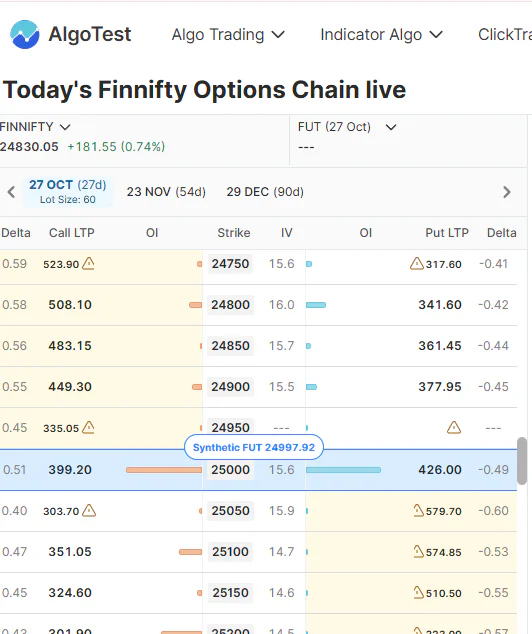
Select an expiry, then review premiums, open interest, volume, implied volatility and bid-ask spreads around the strikes you are considering.
Reading the FINNIFTY option chain involves combining those fields. High OI alone does not guarantee support or resistance, and the last traded price may differ from the price available for your order.
Check Your Rules and Broker Access
Define the entry, exit, position size and maximum acceptable loss. When trading FINNIFTY on AlgoTest, confirm your broker’s current permitted order types and any instrument restrictions before deploying a strategy.
Backtests help assess historical behaviour. They cannot guarantee future results or identical live execution, particularly when spreads and available quantities change.
Turn Your FINNIFTY View Into a Tested Strategy
FINNIFTY covers more than banks, but a few large banks still drive much of its movement. Turn what you see in the index into a strategy: define the context, entry, exit and position risk, then check how it holds up across past market conditions and in live markets.
AlgoTest helps you move from an idea to a strategy you can inspect and test before deciding whether to deploy it.
Join us as we simplify algo trading in India.