The right strike price depends on your market outlook, expected price move, time to expiry, and risk tolerance. Start by identifying the ATM strike, then compare nearby ITM and OTM strikes using premium, Open Interest, Implied Volatility, liquidity, and probability before placing a trade.
Why Picking the Right Strike Price is Important
Let's see why the option strike price matters with a simple example.
Sensex is trading at 82,300. You're bullish and considering three Call options:
82,200 CE (ITM)
82,300 CE (ATM)
82,500 CE (OTM)
At first glance, all three express the same market view. But they don't offer the same probability of profit.
Suppose you buy the 82,500 Call expecting Sensex to rally. By expiry, Sensex reaches 82,400. Your market view was correct, but your option still expires worthless because the strike never moved in the money.
Now compare that with buying the 82,200 Call. The same market move puts you in profit because your strike was already closer to the spot price.
Same market. Same view. Same move. The only difference was the strike price.
That's why experienced traders compare multiple strikes before placing a trade instead of simply buying the cheapest option.
7 Things to Check Before Choosing a Strike Price
Open your Sensex Option Chain and start with the ATM strike. Work through the checks below in order, and by the end you'll have a specific strike, not just a list of things to think about.
1. Start With Your Market View
Before you touch the option chain, decide whether you're bullish, bearish, or neutral on Sensex. Your view drives every other choice you'll make in options trading, starting with the strike.
A bullish view usually means buying Calls or selling Puts. A bearish view means the opposite. A neutral view points you toward strategies like iron condors or short straddles instead of a single directional strike.
Skip this step, and you're choosing strikes at random. Here's a quick way to turn your view into a starting point:
Treat this as a starting point. The checks below narrow it further.
2. Identify the ATM Strike First
Always find the At-the-Money (ATM) strike before comparing anything else. It's your reference point for every decision that follows.
With Sensex at 82,300, the 82,300 strike is your ATM. Everything below that is In-the-Money (ITM) for a Call, and everything above it is Out-of-the-Money (OTM).
The option chain highlights the ATM row automatically, so you don't have to scan the whole chain to find it. If you're still fuzzy on how ITM, ATM, and OTM differ, it's worth a quick read first.
3. Don't Choose Based on Premium Alone
A cheap option isn't automatically a good one. The 82,500 Call might cost half of what the 82,200 Call does, but it also needs a much bigger move to turn a profit.
Say the 82,200 Call costs ₹180 and the 82,500 Call costs ₹90. The cheaper option looks tempting, but Sensex needs to rally past 82,590 (strike plus premium) just to break even. The 82,200 Call breaks even much sooner.
Cheap strikes are cheap for a reason: a lower probability of finishing in the money.
4. Compare Open Interest
Open Interest (OI) tells you where the biggest positions are building up. Strikes with heavy Call OI often act as resistance, while strikes with heavy Put OI can act as support.
If the 82,500 Call has significant OI build-up, that level may be harder for Sensex to cross, making it less suitable if you're expecting only a modest rally.
You can also look at Max Pain, which is the strike where option buyers would experience the maximum loss at expiry. While Max Pain isn't a trading signal on its own, comparing it with OI can help you understand where the market may gravitate as expiry approaches.
Checking OI alongside your strike selection gives you additional context instead of relying only on premium.
Related: Sensex Option Chain Explained: How to Read, Analyse & Trade Using Live Data
5. Check Implied Volatility
Implied Volatility (IV) drives how expensive a strike is, independent of which direction the market moves. High IV means fatter premiums across the chain. Low IV means cheaper premiums, but also a smaller expected move priced in.
If IV on the 82,300 strike is unusually high compared to its own recent range, you're paying more for the same directional bet.
Checking Implied Volatility tells you whether you're buying at a fair price or an inflated one. The Sensex Option Chain lets you compare IV across strikes side by side before you commit to one.
6. Consider Time to Expiry
The strike that works for a weekly expiry often doesn't work for a monthly one. Closer to expiry, Theta (time decay) eats into OTM premiums fast, so ATM or ITM strikes tend to hold up better.
With more time to expiry, an OTM strike has more room to move in your favour before decay takes over. Match how far your strike sits from ATM to how much time you're actually giving the trade.
7. Match the Strike to Your Strategy
There's no single best strike price for options traders across the board. Different strategies call for different strikes by design. Use this as a quick reference:
If your strike doesn't match what your strategy calls for, the strategy stops working the way it's designed to. Check the Option Greeks for your shortlisted strikes too, since Delta and Theta shift meaningfully as you move from ITM to OTM.
How AlgoTest's Sensex Option Chain Helps You Choose Better Strike Prices
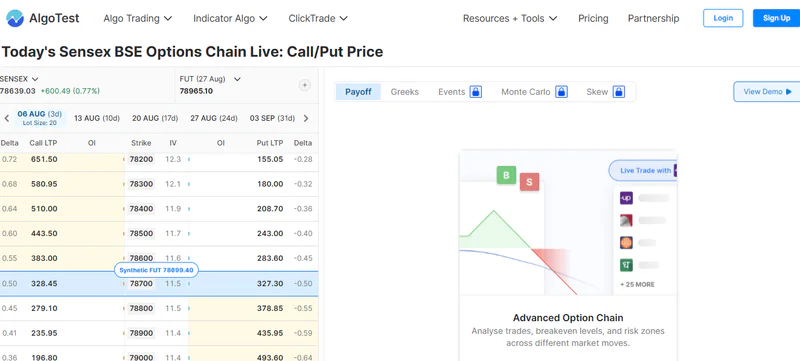
Manually comparing three or four strikes across premium, OI, IV, and Greeks takes time, and the numbers keep moving while you do it.
Everything you've checked here- ATM, OI, IV, volume, liquidity, put-call ratio and Greeks, is available on one screen in AlgoTest's Sensex Option Chain. Instead of switching between tabs or recalculating breakevens by hand, you compare strikes side by side and shortlist the one that fits your trade.
That's less time spent second-guessing your strike, and more time spent actually trading it.
Popular read: Algo trading India: A complete guide
Conclusion
The right strike price can make the difference between a profitable trade and a missed opportunity. Before you buy an option, compare multiple strikes, not just premiums, and use the option chain to find the one that best fits your trade.
Join Us as We Simplify Algo Trading in India
AlgoTest brings your option chain, Greeks, Open Interest, IV, backtesting, paper trading, and automation together in one platform.
Join 45,000+ traders using AlgoTest to trade smarter and get 25 backtests free.
Additional Resources
🛠️ Trading Tools
Disclaimer:This article is for educational purposes only and does not constitute investment or trading advice. Options trading involves risk, and past performance or examples do not guarantee future results. Please evaluate your financial situation and consult a qualified financial advisor if needed before trading.