The BANKEX option chain lists call and put contracts by strike price for a selected expiry. To read it, confirm the expiry, locate strikes near the index level, compare premiums and open interest, then check trading volume and current bid-ask quotes before choosing a contract.
These contracts are based on the BANKEX index, which tracks banking shares listed on BSE. They are separate from options on individual bank stocks and from BANK NIFTY contracts.
Open the BANKEX option chain on AlgoTest to follow the steps below.
BANKEX option chain columns explained
Read call and put data for the same strike and expiry. AlgoTest’s default view displays strikes, call and put LTP, OI, IV and delta, with an expiry selector above the chain. For additional fields such as change in OI, volume and bid-ask depth, check your broker’s terminal where available.
These are the main fields to understand:
Check display units. OI and volume may be shown as contracts, underlying units or abbreviated values. Compare like-for-like figures.
How to read the BANKEX option chain in five steps
1. Select the expiry first
Two options with the same strike but different expiries are different contracts. They have different time remaining and can have different premiums, IV and liquidity.
Select the intended expiry before comparing rows. Our BANKEX expiry and lot-size guide covers the contract schedule and position-size calculations.
2. Locate ATM, ITM and OTM strikes
Using BANKEX’s spot level as the reference:
At the money (ATM): The strike at or nearest the index level.
In the money (ITM): A call strike below the index level, or a put strike above it.
Out of the money (OTM): A call strike above the index level, or a put strike below it.
If BANKEX is at 65,000, the 65,000 strike is ATM. A 64,800 call is ITM, while a 65,200 call is OTM. The relationship reverses for puts.
If your platform identifies ATM using a futures or synthetic-futures reference, check that basis before comparing its highlighted strike with spot-based moneyness.
An ITM option is not automatically a profitable trade. Profit also depends on the premium paid, the exit price and costs. Read how to use strike-selection connect moneyness with your strategy.
3. Compare OI with volume
OI measures positions still open. Volume measures trading activity during a period. A contract can trade repeatedly without producing the same increase in OI.
Look for activity around nearby strikes, then check whether OI is changing. Rising OI alone does not reveal a bullish or bearish view: every outstanding contract has both a buyer and a seller. The Options Industry Council explains this distinction in its open-interest guidance.
For more detail, read OI in options trading and volume in an option chain.
4. Check the available price and quantity
LTP records a completed trade. It is not a promise that you can buy or sell at that price now.
Check the bid, ask and available quantity. A wide spread can add substantial entry and exit costs, particularly across several strategy legs. A limit order controls your acceptable price but may remain unfilled. Our options liquidity guide explains these execution checks.
5. Read IV and delta alongside the premium
IV affects an option’s price without specifying the direction of the next index move. Higher IV generally increases option premiums when other inputs are unchanged. Time remaining and moneyness also affect pricing, as explained in the Options Industry Council’s pricing guide.
A call delta of 0.50 suggests an approximate 0.50-point premium increase for a one-point rise in BANKEX, with other inputs unchanged. Delta itself changes, so this is a local estimate rather than a fixed relationship.
How to Use Option Greeks in Trading explains how delta interacts with time decay and volatility.
BANKEX option chain example
Suppose BANKEX is at 65,000. The table below shows selected strikes from one hypothetical expiry.
All figures are illustrative. Premiums are quoted per index unit; OI and volume are in contracts. This is not live market data.
Here is what the snapshot tells you:
65,000 is ATM on the stated spot reference.
65,200 has the highest call OI among these rows. It identifies a concentration of open contracts.
64,800 has the highest put OI among these rows. That makes it another level to examine alongside the price chart.
The ATM options have the highest volume in this snapshot. Current quotes and available quantity still determine execution conditions.
If OI at the 65,200 call strike increased from 5,200 contracts at the previous close to 6,000 now, the change in OI is +800 contracts. This shows a net increase in outstanding positions. It does not tell you whether those positions express a bullish or bearish view.
Now suppose the 65,000 call has an LTP of ₹245, a bid of ₹244 and an ask of ₹247. A market buy may execute around ₹247 if enough quantity is available, or higher if it consumes additional offers. The ₹245 LTP is not an available offer.
Planning a BANKEX strategy? Sign up for AlgoTest to explore backtesting and evaluate your entry, exit and risk rules.
Can BANKEX OI and PCR identify support and resistance?
Traders often watch high put-OI strikes as possible support areas and high call-OI strikes as possible resistance areas. Treat these as levels to investigate, not guaranteed boundaries. Positions may be hedges or parts of spreads, and concentrations can change during the session.
The OI-based put-call ratio (PCR) compares put OI with call OI:
PCR = Total put OI ÷ Total call OI
Across the three strikes in our example, total put OI is 10,600 and total call OI is 11,000:
PCR = 10,600 ÷ 11,000 ≈ 0.96
This calculation covers only the displayed strikes. A PCR calculated across the full expiry could differ.
Use the same expiry and strike coverage on both sides. A volume-based PCR is a different measure, so check which calculation your platform uses.
PCR above 1 means more put OI than call OI in that dataset. It does not establish whether those puts were bought for protection or sold as part of a strategy. Avoid using a single PCR reading as an entry signal.
Using the BANKEX option chain on AlgoTest
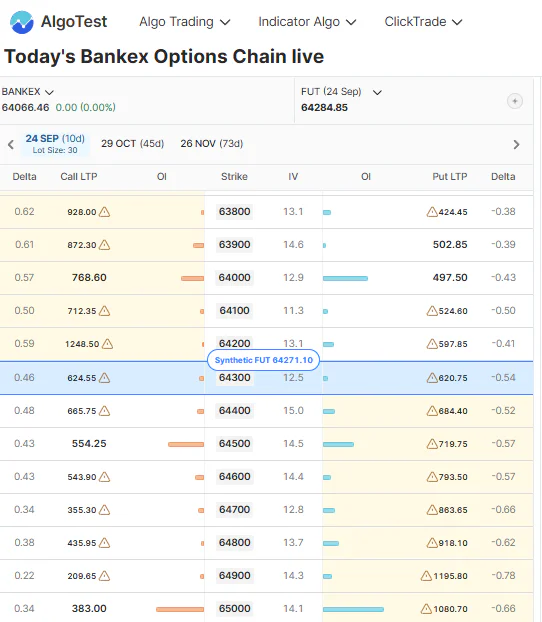
AlgoTest interface captured on 14 September 2026. Select the expiry above the chain, compare calls on the left with puts on the right, and use the central strike column as your reference. The blue marker labels the synthetic futures level. This screenshot is for illustration, not a live quote.
Once you identify a contract, write down the strategy rules: expiry, strike selection, entry condition, exit condition and maximum planned loss. Use those rules to build a test rather than relying on one favourable chain snapshot.
For historical testing, confirm that your data and testing method include the fields your rules require. A price-based backtest cannot validate an OI-based entry rule without historical OI inputs. Our guide to backtesting options strategies explains how to assess results, drawdowns and trading costs.
Conclusion
Read the BANKEX option chain in order: expiry, strike, premium, OI, volume and executable quotes. Use the information to define a trade with clear entry, exit and risk rules. Historical results do not guarantee future performance.
Ready to evaluate your BANKEX strategy? Get started with AlgoTest.