The MIDCPNIFTY option chain is a table of call and put options on the Nifty Midcap Select index for one expiry, arranged by strike price. MIDCPNIFTY is the derivatives symbol for that index.
To read it, select a monthly expiry, find the strike closest to the index level and compare call and put premiums. Then check open interest, volume and bid-ask quotes at nearby strikes. Together, they show how active a strike is, what it costs to enter and the prices you can actually trade at.
Follow along on a live chain. Sign up free on AlgoTest to open the Midcap Nifty option chain and replay past sessions.
Open the Midcap Nifty option chain on AlgoTest alongside this guide to follow the steps.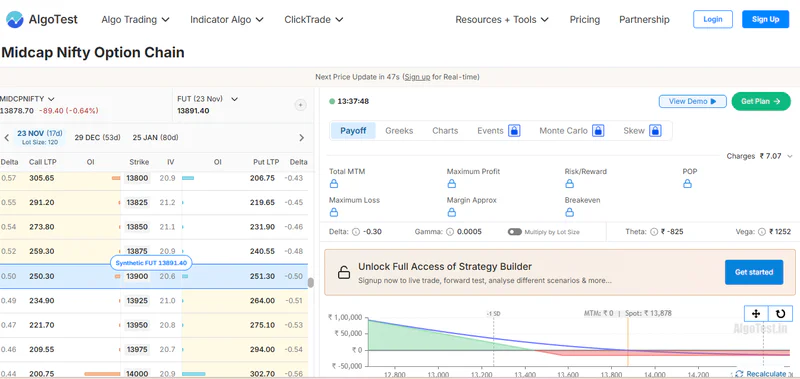
Select the Monthly Expiry First
MIDCPNIFTY options have three consecutive monthly contracts available at any time.
The standard expiry is the last Tuesday of the month. If that day is a trading holiday, expiry moves to the previous trading day.
Weekly MIDCPNIFTY contracts have been discontinued. The last weekly expiry was on 18 November 2024.
Source: NSE contract specifications and NSE weekly-contract update.
Keep the expiry fixed when you compare strikes. Two calls with the same strike but different expiries have different amounts of time left, which changes their premiums and Greeks. For dates and holiday changes, see our Midcap Nifty expiry day guide.
Find the Nearest Strike and Read Both Sides
The chain groups call and put contracts by strike price. CE means a call and PE means a put.
An option is in the money (ITM) when exercising it right now would have value, and out of the money (OTM) when it wouldn’t. The strike closest to the index level is the at-the-money (ATM) reference.
Suppose the Midcap Select index is at 14,010. The nearest available strike is 14,000, which traders commonly use as the ATM reference. Against spot, the 14,000 call has ₹10 of intrinsic value, while the 14,000 put is out of the money.
NSE lists MIDCPNIFTY strikes 25 points apart around the index level, so check which strikes are available for your expiry. Source: NSE MIDCPNIFTY strike scheme.
Read OI and Volume Before Comparing Premiums
Open interest (OI) counts open contracts. Change in OI shows how much that number has risen or fallen since a stated reading. Volume counts the contracts traded during the session.
The NSE option chain shows OI and volume in contracts. At a lot size of 120, 1,000 contracts equal 1,20,000 units. Confirm the units and the reference period on any other platform. A change measured from yesterday’s close answers a different question from a change over the last 15 minutes.
Every open option contract has a buyer and a seller. So rising call OI can mean call buying, call writing or positions that are part of larger strategies. Read it alongside the index price, premium movement and nearby strikes. Our guide on how to read volume in an option chain explains volume in more detail.
Compare Two MIDCPNIFTY Call Strikes
Assume the index is at 14,010, and you’re comparing the 14,000 CE and the 14,050 CE for the same monthly expiry.
The quotes below are only an example from one made-up snapshot. OI and volume are in contracts, and premiums are in rupees per index unit.
The 14,000 call has higher OI and volume.
The 14,050 call added more OI, even though it started from a smaller base.
The 14,050 call’s lower premium means one lot costs less to buy, but its wider spread makes entering and exiting more expensive at these quotes.
Check the bid and ask quantities too. The best price may cover only part of your order. Fields vary by screen, so use NSE or your broker’s market depth when you need volume, change in OI and prices you can trade at.
Calculate the Premium for One Lot
NSE’s lot-size revision set MIDCPNIFTY at 120 units from the January 2026 monthly series onward. The calculations below use that quantity. Our Nifty lot size guide lists the current lot size for each index, but confirm the lot size shown for your contract before you place an order. Source: NSE lot-size revision circular.
Assuming you buy one lot at the displayed ask, before charges:
The 14,050 call costs ₹2,640 less, but its expiry breakeven is 28 points higher.
For a bought call, the expiry breakeven is the strike plus the premium paid, before charges. Before expiry, the option’s value also depends on the time left and implied volatility.
Comparing two strikes? Check each position’s payoff, breakeven and maximum loss in the AlgoTest Strategy Builder before you place the trade.
Account for the Spread
If you bought at the ask and sold straight away at the bid, with quotes and quantities unchanged, the spread would cost:
14,000 CE: (₹91 − ₹89) × 120 = ₹240.
14,050 CE: (₹69 − ₹61) × 120 = ₹960.
These amounts exclude brokerage and other charges. Your actual fill depends on order size, available depth and changing prices.
A limit order lets you set the price you’re willing to pay, but it may not get filled. Check the spread and available quantity before you decide how to place the order. Source: Options Industry Council guide to bid and ask prices.
Practise Strike Selection in the AlgoTest Simulator
Compare two strikes on a past session
Open the AlgoTest Option Simulator, then select MIDCPNIFTY and a past date and time.
Choose one monthly expiry, and note the index level and premiums at two nearby strikes.
Test each strike separately, with the same quantity and the same entry and exit times.
Move the replay forward and compare premium changes and P&L.
Repeat across several sessions, allowing for charges and realistic execution costs.
The Simulator’s Charts tab lets you follow the index and your positions as the session moves forward.
Once you’ve set repeatable rules for entry, strike selection and exit, test them over a longer period with options backtesting on AlgoTest.
Turn your strike rules into a backtest. Sign up to get 100 Backtests free/month
Build a Tested Rule for Picking MIDCPNIFTY Strikes
A useful strike comparison records more than the premium. Keep the expiry, quote time, OI, volume, bid-ask spread and one-lot cost together, then turn your choice into a clear rule for entry, strike and exit. Test that rule across past sessions before you trade it live.
AlgoTest helps you move from an idea to a strategy you can inspect and test before deciding whether to deploy.
Join us as we simplify algo trading in India.
Related Reading
FAQs
What does the MIDCPNIFTY option chain show?
It lists call and put contracts on the Nifty Midcap Select index for a selected expiry. You can compare strikes, premiums and data such as OI, volume, IV and Greeks, though the fields vary by platform.
How do I find the ATM strike in the Midcap Nifty option chain?
Find the available strike closest to the current index level. At an index level of 14,010, the 14,000 strike is the nearest ATM reference. Check whether your platform uses spot or synthetic futures as its reference.
Does MIDCPNIFTY have weekly options?
No. Weekly MIDCPNIFTY options have been discontinued. NSE lists three consecutive monthly contracts, with standard expiry on the last Tuesday of the month.
What is the MIDCPNIFTY lot size?
NSE set the lot size at 120 units from the January 2026 monthly series onward. NSE can revise lot sizes, so check the current contract details before you calculate your trade quantity.
How much does one MIDCPNIFTY option lot cost?
For an option purchase, multiply the premium you pay by the lot size. At a premium of ₹91 and a lot size of 120, the premium paid is ₹10,920 before charges. Option sellers need to meet the margin requirement instead.
How should I compare two MIDCPNIFTY strikes?
Use the same expiry and quote time. Compare distance from spot, premium, OI, volume, bid-ask spread and available quantity. Then calculate the one-lot cost and check how each strike fits your entry and exit rules.