On 28 October 2025, Nifty settled at 25,936.20. An iron condor built around 25,900 would have kept its entire opening credit of 105.10 points. An iron fly centred on the same strike would have earned 128.75 points, or ₹1,773.75 more for one lot, before costs. The fly started with a larger credit, and Nifty finished close enough to its centre for that advantage to hold.
The result changes if you exit as soon as Nifty crosses a short strike. In this example, that decision could come as early as the first trading day after entry.
How do an iron fly and an iron condor differ?
A short iron fly, also called an iron butterfly, sells a put and a call at the same strike. It earns its maximum profit if Nifty settles exactly there. A short iron condor sells the put at a lower strike and the call at a higher one. It earns its maximum profit anywhere between those strikes, including the endpoints.
Both trades buy a put below the short put and a call above the short call to cap the loss. The distance from each sold option to its hedge is the wing width. Here, both trades have 200-point wings, equal quantities on all four legs and the same 28 October expiry.
Nifty closed at 25,891.40 on 23 October. The table uses the call and put prices in Kotak Securities’ 3:30 pm option-chain snapshot for that day. These are published prices. An actual four-leg order could have filled at different premiums.
The fly collected 264.80 points from the options sold and spent 99.85 on its hedges. Moving the two short strikes apart for the condor gave up 59.85 points of credit in exchange for a 200-point range where the trade could earn its maximum profit.
To follow along with the same strikes and dates, sign up free on AlgoTest.
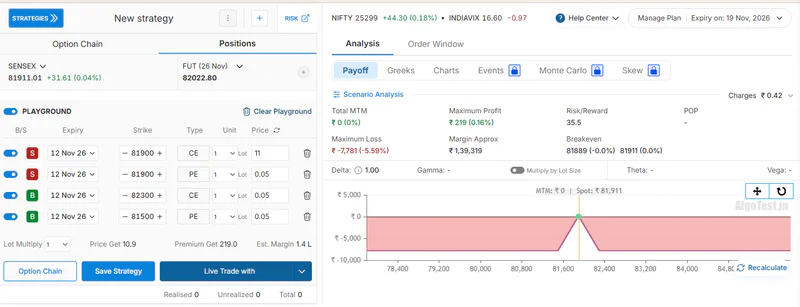

To see what happens when you move a short strike, rebuild the spread in AlgoTest Strategy Builder.
Which trade had the wider breakevens and the smaller maximum loss?
The condor could absorb a bigger move before it started losing money at expiry. The fly had the smaller maximum loss. With equal-width wings, maximum loss = wing width − entry credit. The same 200-point wings therefore left 35.05 points at risk on the fly and 94.90 on the condor.
To find the breakevens, subtract the credit from the short put strike and add it to the short call strike. At those two levels, the trade breaks even before costs.
Within the condor’s full-profit range, the fly could give up its 59.85-point credit advantage one point at a time as Nifty moved away from 25,900. The two trades would tie at 25,840.15 and 25,959.85. Between those levels, the fly would earn more.
Take a hypothetical settlement at 25,980. Only the fly’s short call would expire in the money, by 80 points. The fly would earn 164.95 − 80 = 84.95 points. The condor would still earn 105.10 points.
What happened before expiry?
24 October · The short put was crossed. Nifty closed at 25,795.15, below the condor’s 25,800 short put. Yet both positions showed an open profit at the close. To see why, subtract the price of closing all four legs from the entry credit, using Kotak’s 24 October closing premiums.
For the fly, buying back the 25,900 call cost 58.65 and the 25,900 put cost 147.45 at those marks. Selling the 25,700 put would recover 49.85, and selling the 26,100 call would recover 19.90. That leaves a net closing cost of 136.35 points.
27 October · The short call was crossed. Nifty reached 26,005.95 before closing at 25,966.05. A rule to exit the condor the first time Nifty traded above its 26,000 short call would have triggered on 27 October. A rule to exit when either short strike was crossed would already have triggered on 24 October. The daily high and low tell you which session crossed each level. Calculating the exit P&L requires the four option prices at the time. You can see both crossings in the daily Nifty highs, lows and closes.
28 October · Nifty settled between the condor’s short strikes. The index traded from 25,810.05 to 26,041.70 and closed at 25,936.20. Under NSE Clearing’s final settlement rules, the expiry-day index close determines the final settlement price for index options.
The rupee figures exclude brokerage, taxes, other charges and slippage. The October 2025 Nifty contract had 75 units per lot. NSE revised the Nifty market lot to 65 for monthly expiries from January 2026. Use the lot size for the contract you replay.
To see what the condor cost to close when Nifty crossed a short strike, replay this expiry in the AlgoTest Option Simulator.
How to replay the iron fly and iron condor on AlgoTest
Set the entry. Choose Nifty, start near the close on 23 October 2025, and select the 28 October 2025 expiry. Build the fly from the first table. Write down the entry minute and credit. Your replay price can differ from the published 3:30 pm snapshot.
Match the second trade. Start a separate run for the condor. Use the same entry minute, expiry and number of lots. Keep the 200-point wings on both trades.
Define the exit before pressing play. For an either-strike rule on the condor, watch for Nifty below 25,800 or above 26,000 from the first session after entry. Decide whether a touch counts or whether you require a one-minute candle to close beyond the strike.
Compare the two outcomes. At the first trigger, record the timestamp and the cost to close each spread. Subtract that cost from each trade’s own credit. Then work out what holding each position to settlement would have earned. This shows what the exit rule changed on the same market move.
Related: Nifty Expiry Day: 7 Rules Every Options Trader Should Follow
Which structure fits your expiry view?
If your view was simply “Nifty will settle between 25,800 and 26,000,” the condor paid the same anywhere in that range. Choosing the fly meant making a more precise call. At the actual close, 36.20 points from the centre, that precision paid an extra ₹1,773.75 per lot. At 25,980, it would have cost 20.15 points of profit versus the condor.
For your next replay, write down the settlement range you expect, the maximum rupee loss you can accept and the exact condition that would make you exit early. Try those rules on an expiry whose close you haven’t looked up.
Related reading
How to backtest a strategy on an option simulator, step by step
How to Paper Trade Options Using AlgoTest: Step-by-Step Guide
Frequently asked questions
Does Nifty have to finish at the iron fly’s centre to make money?
No. The centre strike gives the fly its maximum profit. This fly made a gross profit at any settlement above 25,735.05 and below 26,064.95. At either breakeven, its gross profit was zero.
Is an iron condor safer than an iron fly?
Not always. In this example, the condor had a wider profitable range but a maximum loss of 94.90 points per unit, compared with 35.05 for the fly. For a one-lot position, that put ₹7,117.50 at risk on the condor and ₹2,628.75 on the fly before costs.
Can an expiry payoff chart tell me when an intraday stop-loss would trigger?
No. A premium-based stop depends on the price to close the position while the options are still trading. Before expiry, premiums can include time value, the amount above what the option would pay if settled at the current index level. Changes in implied volatility, the expected size of price moves implied by option prices, can also change the cost of closing the spread.