Max pain is the strike price where option buyers, as a group, would lose the most money if the market expired right there. It sits at the centre of one of the most debated ideas in options trading: does price actually get pulled toward this level before expiry?
Most traders learn strikes, premiums, and open interest first. Max pain gets skipped, even though it explains a pattern many traders notice on expiry day without knowing why it happens.
This guide explains what max pain is, how it is calculated, and how traders use it while reading the Sensex Option Chain before expiry.
What Is Max Pain in Options Trading?
Every option has two sides. A buyer pays a premium hoping the option finishes in the money. A writer, or seller, collects that premium hoping it expires worthless.
Max pain looks at every strike price in the chain and asks one question: at which price would option writers, as a group, pay out the least? That price is the max pain strike.
It is also, by definition, the price where buyers as a group collect the least and lose the most. Both descriptions point to the same strike.
Why Is It Called Max Pain?
The name comes from the buyer's side of the trade. At the max pain strike, the largest number of open contracts expire worthless or with the smallest possible value, causing the maximum financial pain to the biggest pool of option buyers.
Some traders believe hedging activity by option writers contributes to prices moving closer to the max pain level as expiry approaches. However, market movements are influenced by many factors, so this should be treated as a tendency rather than a certainty.
How Is Max Pain Calculated? (Keep It Simple)
You do not need to run this maths yourself. A live option chain tool calculates it from open interest automatically. But it helps to know the logic.
For every strike, add up how much writers would owe if the market settled exactly there. This means totalling the in-the-money value of every call and put, weighted by how many contracts are open at each strike. The strike with the smallest total payout is the max pain level.
Max pain is not a separate indicator sitting apart from everything else. It is calculated directly from the option chain, using open interest across every strike. That is why traders usually study max pain and the option chain together, instead of treating them as two separate tools.
A quick example on Sensex (illustrative numbers, not live data):
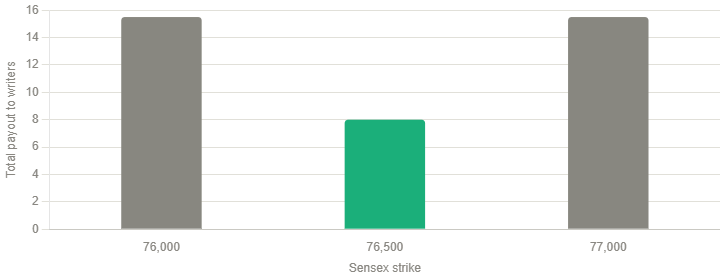
If Sensex settles at 76,000, every call here expires worthless, but a large pool of puts above it still carries value, so writers owe a lot. The reverse happens at 77,000. At 76,500, roughly in the middle, both sides carry the least combined value, which makes it the max pain strike in this set.
Max Pain vs Open Interest
These two terms get mixed up often, but they answer different questions.
Open interest tells you where positions are concentrated across the option chain. A strike with unusually high open interest often acts as support or resistance, since a large number of traders, often institutions, have built positions there.
Max pain uses that same open interest data, but does something different with it. Instead of showing where positions are concentrated, it estimates the one strike where option writers, as a group, would have the smallest total payout.
In short, open interest shows you where the crowd is sitting. Max pain tells you which single strike hurts option buyers the most if the market settles there. They complement each other rather than measuring the same thing.
Related: What is square off in trading
Why Do Traders Track Max Pain?
Max pain becomes more useful as expiry gets closer, especially in the final one or two sessions. Writers hedge harder as time value collapses, and this becomes especially relevant on expiry day itself, when positioning is at its most concentrated.
Traders use it as a reference level, not a signal to buy or sell. It answers "where might this settle" better than it answers "what should I do right now."
Does Max Pain Always Work?
No. Price lands near max pain more often than pure chance would suggest, but it also misses regularly.
Monthly expiries tend to track max pain more closely than weekly ones, since more open interest builds up over a longer window. A level that has stayed stable for a session or two is more trustworthy than one still shifting on the morning of expiry.
Distance matters too. If spot is already close to the max pain strike, expect a tight range. If the gap is wide, a strong trend or an event is usually driving price, and max pain has little pull.
How Traders Use Max Pain With the Option Chain
Max pain works best as one input inside broader option chain analysis, not as a standalone strategy. Pair it with:
Open interest helps you see which strikes are genuinely defended by writers, not just mathematically significant.
The Put Call Ratio helps you check whether sentiment supports a move toward the max pain strike or away from it.
Implied Volatility helps you see whether the market is pricing in a big move that could override the pull of max pain.
Price action helps you confirm whether the market is actually drifting toward the level or ignoring it.
Reading the option chain alongside max pain shows whether a strike is a mathematical midpoint or a level writers are actively defending.
How to Track Sensex Max Pain
The easiest way to track Sensex max pain is through a live Sensex option chain. As open interest data changes throughout the day, the max pain level updates with it.
By watching the option chain, you can also compare max pain with open interest, PCR, and strike-wise positioning, instead of relying on a single number in isolation.
Check it once early in the week to get a baseline, then again closer to expiry once open interest has properly built up. A level that barely moves in the last two sessions deserves more attention than a Monday morning reading.
Related: https://algotest.in/blog/implied-volatility-and-how-to-read-and-compute-iv/
Limitations of Max Pain
Event weeks such as an RBI policy day, the Union Budget, or a global shock can override max pain completely, since directional flows swamp routine hedging.
A single large institutional order can shift the max pain strike sharply, so one reading in isolation is not reliable.
The calculation only looks at the option chain, so futures and cash market hedges stay invisible to it.
Early in the week, open interest is still building, so the level is less stable and less trustworthy.
Strong trending markets can walk straight past max pain, since momentum can outweigh the hedging pull.
Use Max Pain as One More Edge, Not the Whole Plan
Max Pain is most useful when you understand what it can and can't tell you.
It highlights the strike price where option writers have the smallest payout at expiry.
It is calculated using live Open Interest, so the level changes as market positions change.
It tends to be more useful in the final sessions before expiry than earlier in the week.
It should be used alongside the Option Chain, Open Interest, PCR, and price action rather than as a standalone trading signal.
News events, strong trends, and sudden changes in positioning can easily override the Max Pain level.
The easiest way to analyse Max Pain is alongside the data that drives it. A live Sensex Option Chain lets you monitor Max Pain, Open Interest, PCR, and strike-wise positioning together, giving you a more complete view of market sentiment before expiry.
Put these concepts into practice with the live Sensex Option Chain on AlgoTest.
Additional Resources
🛠️ Trading Tools