MTF stands for Margin Trading Facility. It lets you buy shares by paying only part of their value upfront. Your broker funds the rest and charges interest on the funded amount.
The shares are credited to your demat account and pledged in favour of your broker until you repay. You remain the beneficial owner throughout.
In Indian broking, MTF almost always means Margin Trading Facility. In chart analysis the same letters can mean multiple time frame, and in European regulation they stand for multilateral trading facility. We cover India's Margin Trading Facility.
A Quick Example
Say a stock trades at ₹1,000 and you want 100 shares, a ₹1,00,000 position.
Under MTF you might pay ₹30,000 as margin. Your broker funds the remaining ₹70,000. You hold all 100 shares, but ₹70,000 of the purchase is borrowed money.
That borrowed ₹70,000 attracts interest every day the position stays open. At 15% a year, it costs roughly ₹29 per day, or about ₹860 over a month.
So before you make any profit, the stock has to rise enough to cover that interest plus your brokerage, taxes and charges. On a flat stock held for months, MTF loses money.
How MTF Works in the Share Market
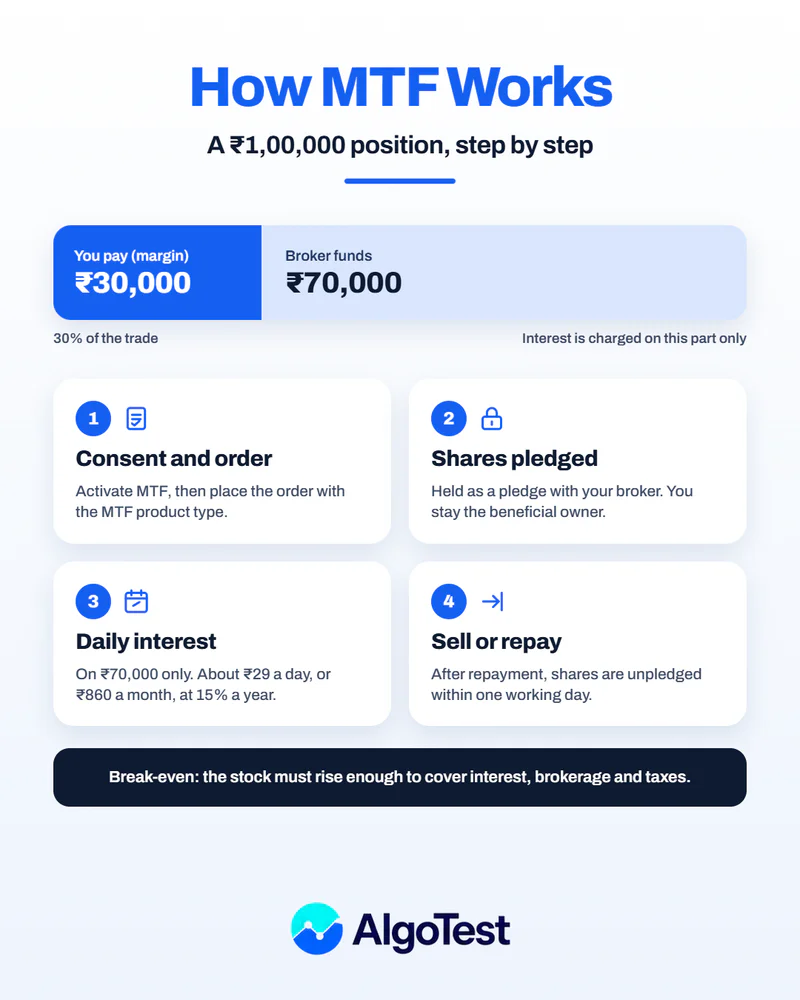
You activate MTF and give consent
NSE requires brokers to take your consent in writing or through an irrefutable electronic method, and to share the rights, obligations and terms with you.
You place the order as MTF
You select the MTF product type instead of a normal delivery order. Your broker funds the balance.
The shares are pledged
Funded shares are held only by way of pledge, in a separate account tagged "Client Securities under Margin Funding Account." They cannot be re-pledged to any other bank or NBFC.
Interest accumulates daily
It is charged on the funded amount only, not the full trade value.
You maintain margin
If the stock falls below its funded cost, your broker collects mark-to-market margin from you.
You exit or repay
Sell the shares, or repay the funded amount. The broker must unpledge the shares within one working day of receiving your payment.
Only corporate brokers with a net worth of at least ₹3 crore, and prior exchange approval, can offer MTF.
How Much Margin You Need
There is no single percentage. The minimum is set per stock, using the risk measures NSE already applies in the cash segment.
Group I stocks that trade in F&O: VaR plus three times the extreme loss margin (ELM).
Group I stocks outside F&O, and equity ETFs: VaR plus five times ELM.
Floor: never less than 20% of the transaction value, whichever is higher.
NSE's own example uses a stock with 12.5% VaR and 5% ELM. The MTF margin works out to 12.5% plus 15%, or 27.5%.
Two practical takeaways:
Stocks outside F&O need more margin, because the ELM multiplier is higher.
The 20% floor caps leverage at roughly 5x. Brokers can ask for more than the minimum, and many do.
Read more: MIS vs NRML: Which Product Type Should You Use?
What MTF Costs
Interest is the main cost. Rates vary by broker and plan, and some brokers quote a daily rate instead of an annual one.
When comparing, convert to the same basis. A daily rate of 0.04% works out to about 14.6% a year, and 0.05% to about 18.25%. A 10% annual rate is closer to 0.027% a day.
Your full cost of holding includes:
Interest on the funded amount, for every day the position is open.
Brokerage and statutory charges on both the buy and the sell.
Any pledge or unpledge charges your broker levies.
Longer holding periods raise financing costs in a straight line. Whether that is worth it depends on the return you expect, and whether dividends offset part of the interest.
Which Stocks Are Eligible for MTF
Only equity shares and equity ETFs classified as Group I securities qualify.
Group I classification is based on how frequently a stock trades and its impact cost, which measures how much a trade moves the price. It is a liquidity test. Market capitalisation and index membership are not the criteria.
NSE publishes the list monthly as the "CM-Security Category Impact Cost" report on its reports page. Your broker may offer a narrower approved list than the full Group I set.
If a stock drops out of Group I, the broker has to act on existing positions under exchange rules, so eligibility today is not permanent.
Margin Calls and Liquidation
This is the part people underestimate.
If your stock falls and your margin drops below the required level, your broker issues a margin call.
If you do not meet it, the broker may liquidate some or all of your pledged shares under its disclosed MTF terms and risk policy. NSE's MTF framework allows this within a maximum of five working days from the margin call. Your broker's terms can set a shorter window.
Brokers must list the situations in which they may liquidate in their terms and Rights and Obligations document. Read that document before your first MTF trade, not after your first margin call.
Leverage means a smaller price fall triggers the call. A dip you could have waited out on a normal delivery trade can become a forced exit under MTF.
Read More: Top 5 Swing Trading Strategies (2026): How to Build, Backtest & Automate Them
MTF vs Futures
Both give exposure larger than your capital. They work differently enough that the choice matters.
MTF may suit you if you want to own the shares, the stock has no futures contract, or you need a position size lot sizes do not allow.
Futures may suit you if you are trading a view rather than investing, want no separate interest charge, and are comfortable with expiry and fixed lots.
Read more: Nifty Lot Size Explained
Risks and Common Mistakes
Traders treat MTF as free leverage and forget that interest accumulates every day the position stays open.
Traders use the maximum leverage available, leaving no buffer before a margin call.
Traders assume they will always get days to respond to a margin call, when broker terms can allow a much shorter window.
Traders hold MTF positions for months without comparing the interest cost against the return they expect.
Traders pick a stock first and check Group I eligibility later, then find it does not qualify.
Traders compare brokers on a daily rate against an annual rate without converting them to the same basis.
Traders forget that losses are magnified in exactly the same proportion as gains.
Comparing MTF With Futures? Test the F&O Strategy First
AlgoTest does not provide margin funding for delivery shares. But if you are weighing MTF against a futures or options approach, you can define the F&O rules and test how they behaved historically before risking capital.
A backtest shows past drawdowns, losing streaks and the effect of different exit rules. It does not guarantee future results, but it tells you what you would have lived through.
Related reading: Is Backtesting Actually Helpful for Indian Retail Traders?
Conclusion
Work out the interest on your funded amount for your expected holding period before placing the trade. Confirm the stock is Group I, keep a buffer above the minimum margin, and read your broker's liquidation terms rather than assuming you will have time to respond.
If you are comparing leverage in the derivatives segment instead, AlgoTest lets you build an F&O strategy without code, backtest it on years of data, and paper trade it before going live through your broker.
Sign up for free and get 25 backtests every Monday.
Disclaimer: This article is for educational purposes only and is not investment, tax or legal advice. MTF rates, margins, eligible securities and liquidation terms vary by broker and can change.