An option premium calculator helps you estimate the theoretical value of an option using inputs such as the underlying price, strike price, expiry, volatility, and interest rate. Instead of calculating the price manually, you can enter the required values and get an estimate in seconds.
This can be useful when you want to compare an option’s market premium with its theoretical value, check different strike prices, or understand how changes in volatility and time to expiry can affect the premium.
Let's take a look at what an option premium calculator does, how it calculates the price, and how you can use the AlgoTest option premium calculator to calculate the theoretical value of Call and Put options.
What Does an Option Premium Calculator Calculate?
An option premium calculator calculates the theoretical price of an option.
For example, suppose Nifty is trading at ₹24,500 and you want to check the theoretical value of a 24,600 Call.
You would enter the relevant market data into the calculator. It then uses those inputs to estimate the option premium.
The same process works for a Put option.
The calculator can also help you understand how the estimated premium changes when you change the inputs.
For example, you can see what happens to the option price when.
Volatility increases
Time to expiry decreases
The strike price changes
The underlying price moves
This makes an option premium calculator useful when you are comparing different strikes or analysing an option before taking a trade.
How Does an Option Premium Calculator Calculate the Price?
An option premium calculator uses an option pricing model to estimate the theoretical value of an option.
One commonly used model is the Black Scholes model. It uses factors such as the underlying price, strike price, time to expiry, volatility, interest rate, and dividend yield to calculate the theoretical Call or Put premium.
In simple terms, the calculation works like this.
Spot price, strike price, time to expiry, volatility, interest rate, and other relevant inputs are used by the pricing model to calculate the theoretical option premium.
You do not need to work through the formula manually. The calculator performs the calculation for you.
The Black Scholes model is explained in more detail in the blog - Black Scholes option pricing model.
How to Use an Option Premium Calculator
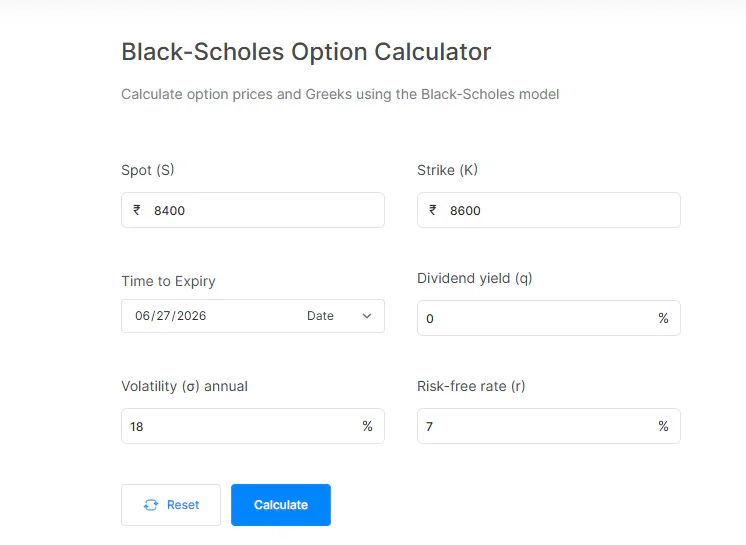
Using an option premium calculator is simple. You need to enter the inputs used to calculate the theoretical option price.
1. Select the option type
Choose whether you want to calculate the premium for a Call or Put option.
2. Enter the spot price
Enter the current price of the underlying asset.
For example, if Nifty is trading at ₹24,500, your spot price is ₹24,500.
3. Enter the strike price
Enter the strike price of the option you want to analyse.
For example, you may want to calculate the theoretical premium of a 24,600 Call.
4. Enter the expiry
Enter the time remaining until the option expires.
Time to expiry matters because an option with more time remaining can have more time value than a similar option that is close to expiry.
5. Enter volatility
Enter the volatility used for the calculation.
Volatility is important because higher expected price movement generally leads to a higher theoretical option premium.
6. Enter the interest rate
Enter the relevant interest rate used by the calculator.
You may also need to enter dividend yield, depending on the underlying and the calculator.
7. Calculate the premium
Once you enter the inputs, the calculator estimates the theoretical option premium.
You can then compare the result with the premium currently available in the market.
What Are the Benefits of Using an Option Premium Calculator?
You can use an option premium calculator for several practical reasons.
1. Estimate theoretical option value
The calculator gives you a theoretical premium based on the inputs you provide. This gives you another reference point when analysing an option.
2. Compare market price with theoretical price
Suppose an option is trading at ₹120 and your calculator gives a theoretical value of ₹110.
The two prices are different, but that does not automatically mean the option is overpriced. It gives you a starting point for understanding the difference between the market price and the theoretical value.
3. Compare different strikes
You can enter different strike prices and see how the theoretical premium changes.
This can help when you are comparing ITM, ATM, and OTM options.
4. Understand the effect of volatility
You can change the volatility input and see how the estimated premium changes.
This is useful when you want to understand why option premiums can change even when the underlying does not move much.
5. Save time
Calculating option premium manually can be difficult, especially when you want to compare several options.
A calculator lets you change the inputs and get the result quickly.
Market Price vs Theoretical Option Premium
The price you see in the option chain and the value calculated by an option premium calculator can be different.
The market premium is the actual price at which the option is trading. The theoretical premium is the estimated value calculated by the pricing model based on the inputs you provide.
For example, suppose an option is trading at ₹125 in the market, but the calculator estimates its theoretical value at ₹115.
This difference is normal. Market prices can change based on demand and supply, volume, liquidity, volatility, and market expectations. The calculated value also depends on the assumptions and inputs used.
So, use the calculator as a reference to understand option pricing and compare it with the market premium. It should not be treated as a prediction of the price the option will trade at.
Related: Option Chain Analysis: How to Read OI, PCR and Max Pain
Option Premium Calculator for Nifty and Other Options
You can use an option premium calculator to analyse options by entering the relevant inputs for the underlying you are trading.
For example, if you are analysing a Nifty option, you can enter the Nifty spot price, strike price, expiry, volatility, and other required inputs to estimate the theoretical premium.
The same approach can be used when analysing other eligible index or stock options, as long as the required inputs are available.
An option calculator and an option pricing calculator are often used to describe the same type of tool. The key purpose is to estimate the theoretical price of the option.
Related: Nifty Expiry Days Rules Traders must Follow
Join Us as We Simplify Algo Trading in India
You don't need to solve the Black-Scholes formula by hand or guess whether an option is priced fairly. AlgoTest's Black Scholes calculator does that work for you, so you can focus on the trade itself.
Sign up for free and get the full AlgoTest toolkit built for Indian options traders:
→ Backtesting: test your strategy against years of historical data before you risk real money
→ Forward testing: validate the strategy on live market data without any capital at risk
→ Strategy builder: build and customize strategies with a no-code interface
→ Simulator: practice execution in real market conditions using virtual capital
From pricing a single option to running a full strategy, AlgoTest gives you the tools to trade with more confidence and less guesswork.
Other tools