Nine out of ten individual traders lost money in India's F&O segment in FY 2024-25, and net losses widened 41% year-on-year to cross ₹1.05 lakh crore, according to SEBI's July 2025 study on India's equity derivatives segment.
Paper trading is the step that can close that gap. It lets you build, run, and stress-test an options strategy in real market conditions using virtual capital instead of your own, so the mistakes that would otherwise cost you money happen for free instead.
Let's find out what paper trading actually means, why it matters more in India's options market than in most others, and exactly how to start practicing on AlgoTest today, no broker account required. If you're exploring other ways to build market experience before you commit capital, our guide on how to start trading without investment in India covers the wider picture beyond paper trading alone.
What Is Paper Trading?
Paper trading means running a trading strategy in real or historical market conditions using simulated money instead of your own. You take the same trades, in the same instruments, at the same prices you'd see live. The only difference is that nothing is actually at risk.
It's easy to lump paper trading in with backtesting, but they answer different questions. Backtesting compresses years of historical data into a single report on how a strategy would have performed.
Paper trading puts that same strategy in front of you trade by trade, so you build a feel for entries, exits, and mid-trade adjustments the way you would in live markets.
For the full breakdown of how these phases connect to each other, including where live execution fits in, see our guide on the difference between backtesting, forward testing, and live execution.
A quick note on terms: what the industry broadly calls "paper trading," AlgoTest calls Forward Testing. You'll see "Forward Test" as the feature name across the platform, and we'll use that term for AlgoTest's tool specifically for the rest of this guide.
Check out the 10 Best Algo trading Softwares in India (Free & Paid)
Why Every Beginner Should Paper Trade Before Going Live
→ Paper trading lets you experience live Nifty and Bank Nifty price action without a single rupee of real capital on the line.
→ It builds the discipline to actually follow your entry, exit, and stop-loss rules before real money adds pressure to break them.
→ It shows you how an options strategy behaves in practice, instead of how it looks on a payoff chart before you've traded it once.
→ It surfaces the small execution habits — hesitating on entries, exiting winners too early, holding losers too long — that only show up once you're watching a position move.
→ It gives you room to make every beginner mistake for free, so the expensive version of that mistake doesn't happen with real capital behind it.
Given that SEBI's own data shows roughly nine in ten individual F&O traders finishing the year in the red, treating paper trading as optional isn't a shortcut. It's usually the difference between a strategy that survives contact with the market and one that doesn't.
Related: Best paper trading websites in India
What to Look for in a Paper Trading Platform for Options
Options trading in India isn't the same as paper trading equities, and a platform built for stock paper trading rarely handles multi-leg options the way an options trader actually needs. Before you commit to one, check for:
→ Real NSE/BSE data drives the simulation, not delayed or synthetic prices that quietly make your strategy look better than it is.
→ The platform supports multi-leg option structures like straddles, strangles, and iron condors, not just single-leg buy or sell trades.
→ Slippage and brokerage are factored into the results, so your paper P&L roughly matches what you'd see once real money and real order fills are involved.
→ You get more than a P&L number at the end — drawdown, win rate, and trade-by-trade breakdowns tell you why a strategy worked, not just whether it did.
Related: Best options simulators available today
How to Start Paper Trading on AlgoTest (Step-by-Step)
AlgoTest gives you two tools for this: the Simulator and Forward Testing. Most beginners get the most out of using both, in that order.
Step 1: Learn the mechanics with the Simulator
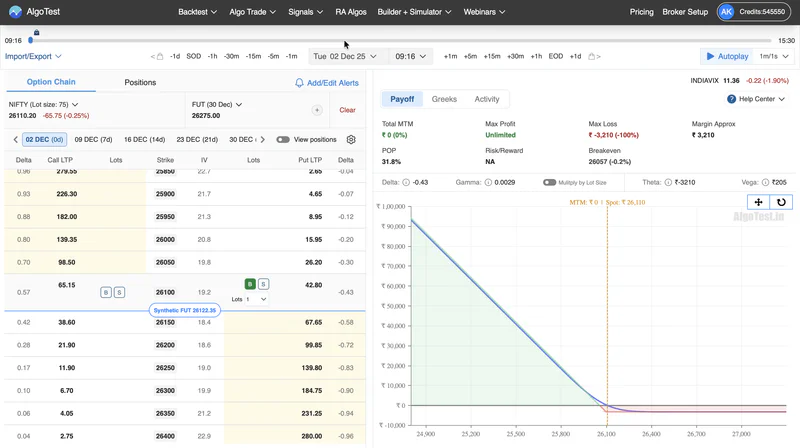
The Simulator runs on historical option chain data, which means you don't have to wait for market hours to start practicing. It's the fastest way to learn how an options strategy actually behaves.
Sign up for a free AlgoTest account and log in. No broker connection is required to start.
Open the Simulator from your dashboard.
Select the index you want to trade — Nifty, Bank Nifty, Finnifty, Sensex, or another supported underlying — and choose an expiry. This loads the historical option chain for that date.
Build your strategy by adding legs directly from the option chain. For example, sell an ATM call and put and buy an OTM call and put to construct an iron fly.
Review the payoff graph, max profit, max loss, breakeven, and the Greeks (Delta, Theta, Gamma, Vega) before you decide the structure is worth testing further.
Use AutoPlay to replay the position across time and see how it would have moved, without waiting for the next trading session.
Step 2: Validate against live markets with Forward Testing
Once a strategy holds up in the Simulator, the next step is Forward Testing — AlgoTest's paper trading feature. It runs the same strategy against live market data in real time, still without any capital at risk.
This is the closest you can get to live trading conditions before you actually go live, and it's the stage that tells you whether your strategy survives real-time volatility and not just historical replay. You can read more about how this works in Forward Testing is Live on AlgoTest.
Read the doc for a detailed walkthrough of AlgoTest Simulator
Mistakes Beginners Make While Paper Trading
Sizing positions in the simulator far beyond what your real capital and margin would actually allow, which makes the results meaningless the moment you go live.
Reading paper P&L at face value without accounting for brokerage, STT, and slippage, all of which quietly narrow a strategy's edge in the real world.
Testing a strategy in only one type of market. A setup that looks strong in a trending market can fall apart the moment the index goes sideways.
Moving to live trading after a handful of lucky trades instead of a large enough sample to actually trust the result.
Related: Why is there a difference between backtest, forward test and live results
When Should You Move From Paper Trading to Live Trading?
There's no fixed number of days, but there is a rough floor: most traders need at least 50 to 100 trades, or a few full expiry cycles, spread across trending, sideways, and high-volatility conditions, before the results are reliable enough to act on.
If your paper trading results are wildly better or worse than your backtest, that gap is worth understanding before you risk capital, not after.
Our full breakdown of when to switch from paper trading to live trading walks through the complete checklist, including the psychological and cost-side factors that only show up once real money is involved.
Join Us as We Simplify Algo Trading in India
Sign up for free and get the full AlgoTest toolkit built for Indian options traders:
→ Backtesting lets you test your strategy against years of historical data before you risk real money.
→ Forward testing lets you validate the strategy on live market data without any capital at risk.
→ Strategy builder lets you build and customise strategies with a no-code interface.
→ Simulator lets you practice execution in real market conditions using virtual capital.
From pricing a single option to running a full strategy, AlgoTest gives you the tools to trade with more confidence and less guesswork.