RBI policy and Fed dates are the days when the Reserve Bank of India and the US Federal Reserve announce their interest rate decisions. Indian traders feel both, even though only one is set in India.
The RBI decides the cost of money at home. The Fed decides the cost of money for global investors, many of whom trade Indian stocks.
Quick answer
RBI and Fed decisions affect Indian traders in four ways: through rate-sensitive stocks, foreign investor flows, the rupee and bond yields. The biggest market moves usually come from surprises in the message, not from the expected rate decision. In December 2026, both decisions fall within the same week: the RBI announces on 4 December at 10:00 am IST, and the Fed decision arrives at 12:30 am IST on 10 December.
Two policy decisions in one week. Sign up free on AlgoTest and see how your strategy handled the last ones.
How RBI Policy Affects Indian Traders
The RBI’s Monetary Policy Committee (MPC) is the six-member panel that sets the repo rate. The repo rate is the rate at which the RBI lends to banks, so it sets the base cost of loans across India.
When the repo rate rises, banks pay more for funds and usually charge more on loans. That hits sectors that depend on borrowing first: banks, NBFCs, real estate and autos. A cut works the other way.
Traders watch two more things besides the rate:
The stance: the RBI’s signal about which way its next move is likely to go. A change in stance can move the market more than the rate itself.
Liquidity steps: how much cash the RBI leaves in the banking system. Less spare cash usually means tighter conditions for banks and bonds.
RBI Policy Time: How the Day Unfolds
The decision lands in the middle of the trading day, so the whole reaction happens during market hours.
The market opens at 9:15 am, and option premiums still include the cost of the coming event.
At 10:00 am, the Governor reads the statement with the rate, the stance and new inflation and growth forecasts.
At 12:00 noon, the press conference can start a second move.
See how the option chain moved at 10 am on the last RBI day. Replay the session minute by minute in the free AlgoTest Option Simulator.
How Fed Decisions Affect the Indian Stock Market
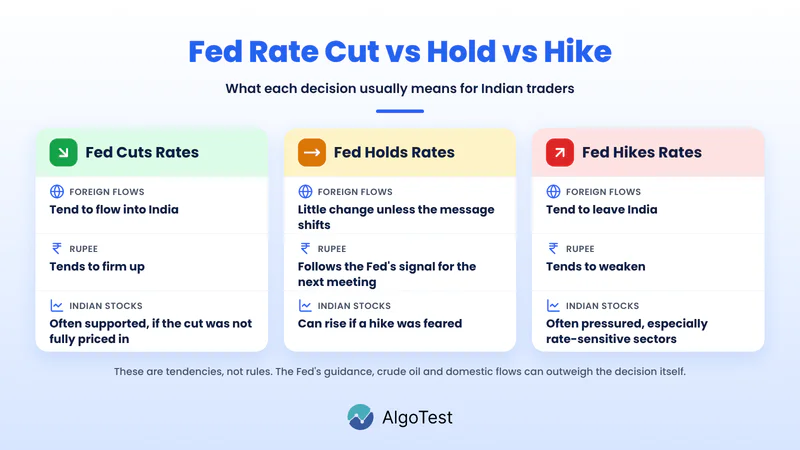
The Federal Open Market Committee (FOMC) sets US interest rates. Its decisions reach India through four channels.
Foreign money: Higher US rates make US bonds more attractive, so foreign investors may pull money out of India. Lower US rates can bring it back. You can track this in the daily FII and DII data.
The rupee: A hawkish Fed, meaning one leaning towards higher rates, usually lifts the dollar and weakens the rupee. A weak rupee also makes crude oil imports costlier.
Bond yields: When US yields rise, Indian bonds have to offer more to stay attractive, which pushes Indian yields up.
The overnight gap: The Fed announces at 2:00 pm New York time, which is night in India. Open positions can gap at 9:15 am, and a stop loss only triggers after the open, often at a worse price.
These are tendencies, not rules. Crude oil, domestic buying and the Fed’s guidance for the next meeting can outweigh the decision itself.
Holding a position into a Fed night? Check its payoff, breakevens and margin in the AlgoTest Strategy Builder before the decision lands.
The 2026 Double Squeeze: Both Central Banks Are Tightening
Traders are dealing with an unusual setup this year: both central banks are raising rates. On 16 September 2026, the Fed raised its range to 3.75% to 4.00%, its first hike since 2023, and held it there on 28 October. The rupee slipped past ₹96 to the dollar after the hike.
The RBI followed on 7 October with a 25 basis point hike to 5.50% and a new stance of “calibrated tightening”. It has also tightened the cash supply: banks must now keep at least 99% of their required cash reserve (CRR) with the RBI each day, up from 90%. That pushed overnight rates above the RBI’s 5.75% ceiling, and the RBI had to add ₹1 lakh crore through a repo auction.
Part of the reason the RBI watches the Fed is the rate gap: how much more Indian rates pay than US rates. One estimate put the gap at about 1.63 points through July, and the Fed’s September hike squeezed it to about 1.38. The RBI’s October hike took it back to roughly 1.63 points.
The next test comes in one week. The RBI decides on 4 December, and markets are watching whether the Fed hikes again on 9 December.
RBI and Fed Dates 2026-27
RBI Monetary Policy Next Date and Time
The next RBI decision is on Friday, 4 December 2026, at 10:00 am IST. The full calendar comes from the RBI’s published schedule.
Fed Meeting Dates in Indian Time

The Fed’s decision comes in the middle of the US trading session, late at night in India.
The India time shifts by an hour when US clocks change in March and November. The Fed confirms each date at the meeting before it, so check the Fed calendar closer to the day.
What Recent Policy Days Did to Nifty and Bank Nifty
Three lessons come out of these days.
The message moved the market more than the decision. On 7 October, the hike was expected. The reaction came from the change in stance.
Volatility did not always drop after the news.India VIX rose about 2.3% on 7 October. Traders who sold options expecting premiums to deflate after the announcement did not get that drop.
The Fed’s hold moved Nifty more than its hike. Other drivers, like crude and domestic buying, mix into each reaction, so don’t put every move down to the central bank. Bank Nifty also didn’t behave like the “RBI index” on 7 October, so test both indices.
Read more: Trade US Stocks on Delta Exchange India with RWA Tokens
The Morning After a Fed Decision: What to Check Before 9:15 am
To judge the Fed’s impact on the next Indian session, run through this list before the open.
Read the Fed’s signal, not just the decision. Talk of more hikes is hawkish, and talk of cuts is dovish.
Check the US 10-year bond yield and the dollar. Rising yields and a firmer dollar usually weigh on emerging markets like India.
Look at GIFT Nifty. It trades overnight and hints at the opening gap.
Check the rupee and Brent crude. A weaker rupee and costlier oil add pressure.
Note the previous day’s FII and DII figures. They show whether foreign money was already leaving.
Watch the pre-open session and India VIX before you place trades.
Read more: Top 8 Indian Brokers to Invest in US Stocks (2026)
How to Test Your Strategy on RBI and Fed Days
Step 1: Mark the Event Sessions
List the RBI decision days from the calendar above. For Fed days, use the first Indian session after each decision.
Step 2: Backtest Your Rules Across Years
Build your strategy in AlgoTest Backtest with your usual entry time, strikes and stop loss. Then find each policy date in the date-wise P&L and compare it with an average day.
AlgoTest has a ready-made Budget Day filter, and the date-wise results do the same job for RBI and Fed days. Check the worst losing stretch, not just the total profit.
Step 3: Replay the Worst Days in the Option Simulator
Pick a policy date and a 9:20 am start, choose Nifty or Bank Nifty, and build your position from the historical option chain. Press Autoplay to watch the trade run through the 10:00 am announcement, with India VIX shown above the chain.
Step 4: Change One Rule, Then Paper Trade
If policy days hurt your results, change one rule at a time and test again:
Enter after 10:15 am, once the decision is out.
Swap a short straddle, whose losses have no cap, for a defined-risk iron fly or iron condor.
Trade fewer lots on policy days, or skip them.
Then run the updated rules on 4 December with paper trading before you risk real money.
Make the December Policy Week Your Test Run
Policy dates are published months ahead, so they are some of the few market events you can fully prepare for. Write down how you will trade the RBI morning and the Fed gap, check those rules on past policy days, then rehearse the toughest sessions.
AlgoTest gives you the historical data, the replay and the paper trading to do this before you decide whether to deploy.
Join us as we simplify options trading in India.
Related Reading
All Index Expiry Day: Calendar and How to Test an Expiry Day Strategy
How to Backtest a Strategy on an Option Simulator: Step by Step
IV Percentile vs IV Rank: Use IVP and IVR to Identify Cheap vs Expensive Options
Implied vs Realized Volatility: The VRP Edge Every Options Trader Must Understand
Trading Risk Management: Rules, Examples and a Practical Plan
FAQs
Will the Fed meeting affect the Indian market?
Yes, mainly through foreign investor flows, the rupee and bond yields. Because the decision comes out at night in India, the effect shows up at the next morning’s open.
What happens to the Indian stock market if the Fed cuts interest rates?
A cut usually makes Indian assets more attractive to foreign investors and eases pressure on the rupee, which tends to support stocks. How much it helps depends on whether the cut was expected and what the Fed signals next.
Do stocks usually go up after a Fed rate cut?
Often, but not always. A cut made because the US economy is slowing can come with falling markets, and a fully expected cut may already be in prices.
Which stocks benefit from an RBI rate cut?
Rate-sensitive sectors usually react first, such as NBFCs, real estate and autos, because cheaper loans can lift demand. Banks can see mixed effects, since a cut can also shrink the margin they earn on loans.
What happens to the Indian stock market if the Fed keeps rates unchanged?
An expected hold removes one risk, so stocks can rise if other cues help. The Fed’s signal for its next meeting usually matters more than the hold itself.
How will a Fed decision impact the Indian stock market tomorrow?
Check GIFT Nifty, US bond yields, the dollar-rupee rate and crude before 9:15 am. Together, they show whether the Fed’s message helps or hurts the open.
How do US Fed rate hikes affect India’s economy?
They tend to weaken the rupee, which makes imports like crude oil costlier and can push up inflation. That can force the RBI to keep rates higher, which raises borrowing costs for companies and households.
When is the next RBI monetary policy, and what time is it announced?
The next decision is on Friday, 4 December 2026, at 10:00 am IST, followed by a press conference at noon. The one after that is on Friday, 5 February 2027.
What time is the Fed decision in India?
The Fed announces at 2:00 pm New York time. That is 12:30 am IST from November to March and 11:30 pm IST from March to November.