A scalping strategy aims to capture small price movements through multiple short-duration trades. A position may remain open for a few seconds or several minutes.
While scalping looks simple, frequent trades increase the effect of brokerage, slippage and delayed execution. One large loss can also cancel several profitable trades.
You therefore need clear entry and exit rules, suitable indicators and strict risk management. In this guide, you’ll learn how scalping works, explore practical 1-minute and 5-minute setups, and see how to backtest and automate them.
The strategies and settings in this article are educational examples. They do not guarantee returns and should be tested before using real capital.
What Is a Scalping Strategy?
A scalping strategy is a short-term trading method that tries to capture small price changes. Instead of waiting for a large intraday move, a scalper may enter and exit several trades during the same session.
A typical scalping trading strategy has:
A holding period of a few seconds or minutes
A small target and predefined stop-loss
Clear entry and exit conditions
Multiple possible trading opportunities
A focus on liquid instruments
Strict control over trading costs
Scalping can be used in stocks, futures and options. The exact setup depends on the instrument, liquidity, volatility and timeframe.
How Does Scalping Trading Work?
A scalping setup looks for a small but repeatable market condition. The trade is closed quickly when the target, stop-loss or exit condition is reached.
Common scalping setups include:
Moving-average crossovers
VWAP pullbacks
Opening-range breakouts
Momentum trades
Support and resistance reversals
Volume breakouts
For example, a trader may enter when the 9 EMA crosses above the 21 EMA while the price is above VWAP. The position may be closed when the EMAs cross in the opposite direction or the stop-loss is reached.
The rules must be objective. Instructions such as “enter when momentum looks strong” cannot be tested accurately. You need measurable conditions such as indicator values, candle closes, entry time and stop-loss distance.
Best Indicators for Scalping
No indicator can make a scalping strategy profitable by itself. Each one measures a different part of the market.
EMA
Short combinations such as 5 and 20 EMA or 9 and 21 EMA react quickly to recent price movements. A faster EMA crossing above a slower EMA may signal bullish momentum.
EMA crossovers can create false signals in sideways markets. Combining them with VWAP or volume may help filter some trades.
You can explore this educational 5 EMA scalping strategy to understand how EMA-based rules can be structured.
VWAP
Price above VWAP can indicate a bullish intraday condition, while price below VWAP can indicate a bearish condition.
VWAP is commonly used as:
A trend filter
A pullback level
An entry or exit condition
A mean-reversion reference
RSI and MACD
RSI can help confirm momentum or identify stretched price conditions. MACD can help identify shifts in trend.
Both indicators can give delayed or false signals on very short charts. Test their settings with the complete strategy rather than using them alone.
Read our guide to the best indicators for intraday trading for a detailed comparison.
1-Minute Scalping Strategy
A 1-minute scalping strategy provides frequent signals but also contains more market noise. Spreads, slippage and execution delays can have a major effect on the result.
Here is a simple example using VWAP and EMAs.
Chart setup
Timeframe: 1 minute
Indicators: VWAP, 9 EMA and 21 EMA
Optional confirmation: Volume
Instrument: A liquid stock, future or option
Bullish entry
Price is above VWAP.
The 9 EMA crosses above the 21 EMA.
The candle closes above both EMAs.
Enter after the signal candle closes.
Bearish entry
Price is below VWAP.
The 9 EMA crosses below the 21 EMA.
The candle closes below both EMAs.
Enter after the signal candle closes.
Exit
You can test one of the following:
Exit on the opposite EMA crossover.
Exit when price closes on the other side of VWAP.
Use a fixed target and stop-loss.
Place the stop beyond the signal candle.
Exit all positions at a fixed time.
Start with one exit method. Test alternatives separately so you can see which rule affects performance.
Iron Condor Strategy Explained: How It Works, Payoff & Example
5-Minute Scalping Strategy
A 5-minute scalping strategy generates fewer signals but can remove some of the noise found on a 1-minute chart.
Here is an example based on a VWAP pullback.
Chart setup
Timeframe: 5 minutes
Indicators: VWAP, 20 EMA and volume
Market condition: Clear intraday trend
Bullish entry
Price is above VWAP and the 20 EMA.
The 20 EMA is rising.
Price pulls back towards VWAP or the EMA.
A bullish candle closes after the pullback.
Enter above the confirmation candle’s high.
Reverse these conditions for a bearish trade.
Exit
Place the stop beyond the pullback swing.
Use a fixed risk-to-reward target.
Exit if price closes on the opposite side of VWAP.
Close any open position at a predefined time.
These settings are examples. Test different parameters before deciding whether the setup suits your instrument and risk level.
1-Minute vs 5-Minute Scalping Strategy
A shorter timeframe is not automatically better. Choose the timeframe on which you can define and execute consistent rules.
Covered Call Strategy: How to Use It with an Example
Options Scalping Strategy
An options scalping strategy tries to capture short-term movements in option premiums. These premiums can change because of movements in the underlying asset, implied volatility, time decay and the option’s Greeks.
Before selecting an option contract, check:
Trading volume
Bid-ask spread
Market depth
Distance from the ATM strike
How the premium responds to the underlying
ATM and near-ATM index options generally offer better liquidity than far OTM contracts, but you must still check the individual strike.
If your signal comes from the Nifty chart but the trade is taken in a Nifty option, test the actual option trade. The premium will not always move in the same proportion as the index.
You can use the AlgoTest Options Simulator to test options strategies using historical option-chain data for indices such as Nifty, Bank Nifty and Sensex.
Risk Management for Scalping
Scalping produces frequent trading opportunities, which makes risk control especially important.
Set the following rules before entering a trade:
Maximum risk per trade
Position size
Stop-loss and target
Maximum number of trades per day
Daily loss limit
Trading start and end time
Rules for stopping after consecutive losses
Avoid moving your stop-loss further away after entering. One uncontrolled loss can offset several small winning trades.
You should also include brokerage, taxes, spreads and slippage when calculating results. A strategy that looks profitable before costs may produce a loss after them.
How to Backtest a Scalping Strategy
Backtesting shows how your rules would have performed on historical data. It does not predict future returns, but it can help you find weak rules before using real capital.
1. Define objective rules
Write down the exact:
Instrument and timeframe
Entry and exit conditions
Stop-loss and target
Position size
Trading hours
Maximum number of trades
Cost and slippage assumptions
2. Test different market conditions
Do not judge a strategy using only a few favourable sessions. Test it across:
Trending markets
Range-bound markets
High- and low-volatility periods
Expiry and non-expiry days
Different parts of the trading session
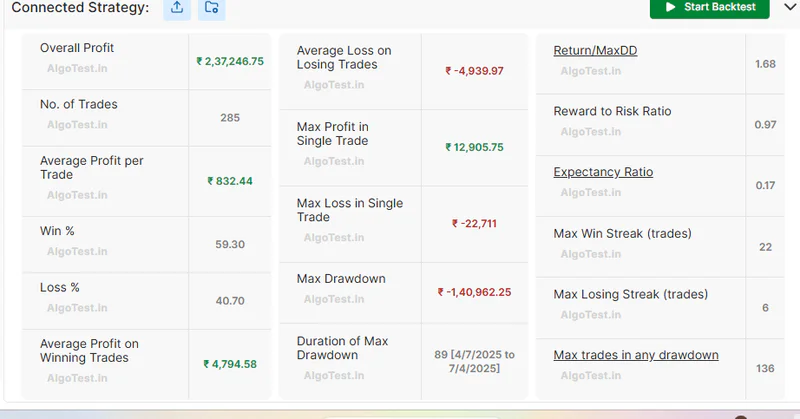
3. Review the right metrics
Look beyond total returns. Review:
Maximum drawdown
Win rate
Average profit and loss
Profit factor
Consecutive losses
Number of trades
Performance after charges
Time-of-day performance
A high win rate does not always mean the strategy is good. Frequent small profits can be cancelled by a few large losses.
4. Avoid overfitting
Do not keep changing the settings until they match past data perfectly. Test the final rules on a separate historical period and then forward test them in live market conditions.
Read our detailed guide on how to backtest options strategies in India before testing an options-based setup.
How to Automate a Scalping Strategy Without Coding
Scalping requires quick and consistent execution. Manual trading may lead to missed signals, delayed orders and emotional decisions.
With AlgoTest Signals AI, you can convert an indicator-based idea into a rule-based strategy without coding.
The workflow includes:
Describe your strategy in plain English.
Select the instrument and timeframe.
Add indicators such as EMA, VWAP, RSI or MACD.
Define the entry, exit and risk conditions.
Verify the signals on a chart.
Backtest the strategy on historical data.
Forward test it using live market data.
Deploy it through your connected broker when ready.
For example, you could ask Signals AI to create a 5-minute strategy that enters when the 9 EMA crosses above the 21 EMA while price is above VWAP.
You can then review the visual conditions, change the settings and test the strategy before considering live deployment.
Learn more about building, backtesting and automating trading signals.
Common Scalping Mistakes
Avoid these common errors:
Trading without fixed entry and exit rules
Ignoring brokerage and slippage
Using too many indicators
Entering before the signal candle closes
Increasing position size after a loss
Overtrading during sideways markets
Using a strategy without backtesting it
Assuming one setup will work in every market condition
Keep each setup separate when reviewing results. This will show whether the 1-minute strategy, 5-minute strategy or options setup is actually contributing to performance.
7 Bollinger Bands Strategies for Indian Traders: Intraday, F&O and Swing
Build and Test Your Scalping Strategy
A scalping strategy needs more than a fast timeframe. It requires measurable entry rules, clear exits, position sizing and firm risk limits.
Write down every condition, include realistic trading costs and test the strategy across different market phases. Forward test it before using real capital.
With AlgoTest, you can build indicator-based setups, backtest them, test them on live market data and automate execution without coding.