The current Sensex lot size is 20 units for futures and options. One lot represents 20 units, two lots represent 40 units, and five lots represent 100 units.
However, the price of one Sensex option lot is not fixed. It depends on the premium of the specific call or put you choose. At a premium of ₹150, buying one lot costs ₹3,000 before brokerage and other charges: ₹150 × 20.
Contract details checked on 28 September 2026. Confirm the selected contract’s lot size in your broker’s order window before trading.
What Does Sensex Lot Size Mean?
Lot size is the number of units in one futures or options contract. BSE standardises this quantity so Sensex derivatives trade in whole lots.
The Sensex option lot size applies to both calls and puts. Buying one call lot and one put lot creates two separate positions of 20 units each.
These are contract units, not shares delivered from the index’s constituent companies. For the distinction between the benchmark and its derivatives, read our guide to Nifty and Sensex.
Sensex 1 Lot Price: How Much Does It Cost?
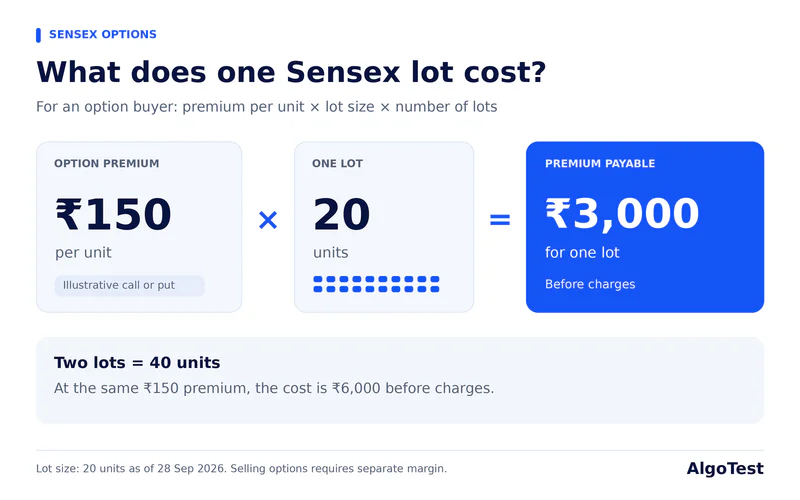
For an option buyer:
Premium payable = Option premium per unit × 20 × Number of lots
Here is how the cost changes at different premiums:
Illustrative premiums, excluding brokerage, taxes and other charges.
The premium varies with the strike, expiry, underlying index level and market conditions. A ₹50 option and a ₹250 option have the same lot size, but different purchase costs and risk characteristics.
Use the Sensex option chain to compare contracts for your chosen expiry. Check the available bid and ask quotes before calculating the trade cost. The last traded price may not be the price at which your order fills.
How Does Lot Size Affect Sensex Options P&L?
For a bought option that you later sell:
Gross P&L = (Exit premium − Entry premium) × 20 × Number of lots
Suppose you buy one Sensex call lot at ₹150:
If you instead hold the option until it expires worthless, its settlement value is ₹0 and you lose the full ₹3,000 premium, plus charges.
Actual net P&L includes trading charges. Exiting at the entry premium therefore still produces a net loss after costs.
For an option seller closing the position, reverse the premium difference: entry premium minus exit premium. The premium received does not cap the seller’s potential loss.
A one-point move in the option premium changes one lot’s value by ₹20. This does not mean a one-point move in the Sensex index always changes the option’s value by ₹20. Options respond to the underlying through Delta, while time and volatility also affect their prices.
Test your Sensex strategy before increasing your lots
Backtest your entry, exit and stop-loss rules, then review losing periods and drawdowns before deciding your position size.
Lot Size, Contract Value and Margin Are Different
Knowing the lot size alone does not tell you how much capital every Sensex trade needs.
For example, if a Sensex futures contract trades at 80,000, its notional value for one lot is:
80,000 × 20 = ₹16,00,000
This hypothetical ₹16 lakh value is not the option premium or a fixed margin requirement.
An option buyer pays the premium plus charges. Futures traders and option sellers must meet applicable margin requirements. These depend on the position, volatility, hedges and broker requirements, and can change.
Check margin for the complete strategy before placing orders. A lower premium or smaller lot count does not automatically make a trade low risk.
Why Are Index Derivatives Contracts Sized Around ₹15–20 Lakh?
Under SEBI’s index-derivatives framework, a new index derivative contract must have a value of at least ₹15 lakh when introduced. Lot sizes are set so the contract value falls between ₹15 lakh and ₹20 lakh on the day of review.
This is a sizing rule, not a requirement for contract value to stay inside that range every trading day. Market movements can take it outside the range between reviews. SEBI sets the framework; the exchange determines the applicable lot size.
The ₹16 lakh example above illustrates the scale of exposure. It does not mean an option buyer must pay ₹16 lakh upfront.
Related reading: How to Analyze the Sensex Option Chain for Maximum Profitability
When Did Sensex Lot Size Change from 10 to 20?
BSE notice 20241021-13, dated 21 October 2024, announced the increase from 10 to 20 units for newly introduced contracts after 20 November 2024.
The transition was phased. Existing weekly and monthly contracts initially retained their old lot sizes, while longer-dated options followed a separate transition schedule. Every live contract did not switch on the announcement date.
This explains why older articles, screenshots and backtests may show a 10-unit Sensex lot. Check the quantity assumptions when comparing historical rupee profits or losses with a current strategy.
Did Sensex Lot Size Change in January 2026?
No. Sensex remained at 20 units. The January 2026 lot-size changes concerned specific NSE index derivatives, not BSE Sensex contracts.
NSE circular FAOP70616, dated 3 October 2025, revised Nifty 50 to 65 units, Bank Nifty to 30, FINNIFTY to 60 and Midcap Select to 120. The revised sizes first applied to Nifty’s weekly expiries and all four indices’ monthly expiries in January 2026. Existing Nifty quarterly and half-yearly contracts and Bank Nifty quarterly contracts were adjusted after trading on 30 December 2025.
An NSE revision does not automatically change a BSE contract. For the NSE figures and their history, see our Nifty and other NSE index lot-size guide.
Is Sensex Option Lot Size Different for Weekly and Monthly Contracts?
The current Sensex lot size is 20 units for both weekly and monthly options. The expiry changes the time remaining in the contract, not its current lot multiplier.
Two options with the same strike but different expiries can have different premiums. Their one-lot purchase costs can therefore differ even though both represent 20 units.
For dates and expiry rules, see our Sensex expiry-day guide.
How Many Sensex Lots Should You Trade?
Start with the loss you can afford and the risk of the complete position, rather than the maximum quantity your balance allows.
For a simple long-option trade, suppose:
Entry premium: ₹150
Planned stop-loss exit: ₹100
Lot size: 20
The planned loss per lot is ₹50 × 20 = ₹1,000, before charges and slippage. Two lots would mean a planned loss of ₹2,000 on the same assumptions.
However, a stop-loss does not guarantee that exit price. The full premium paid for two lots is ₹6,000, which the buyer could lose if the options become worthless. Keep planned stop-loss risk separate from the maximum premium at risk.
For multi-leg positions, assess the combined payoff and execution risk. Before increasing quantity, use options backtesting to examine drawdowns, losing streaks and sensitivity to trading costs. Historical results do not guarantee future outcomes.
Related: Sensex OI Data Explained | Call, Put OI & OI Analysis
Conclusion
One Sensex lot currently represents 20 units. Multiply the option premium by the full quantity to calculate purchase cost, and use premium changes to calculate P&L. Check margin separately when trading futures or selling options.
Want to start Algo Trading?
Join 35k+ traders using automation to save time, reduce errors and trade smarter with AlgoTest!
Get 25 free time-based strategy backtests every week to test your Sensex trading rules.
Additional Resources
Trading Tools
Disclaimer: This article is for educational purposes only and is not investment advice. Futures and options trading involves risk, and historical results do not guarantee future returns.