Synthetic futures can refer to two related but different concepts in options trading.
A trader can create a synthetic long futures position by buying a call and selling a put. In AlgoTest, Synthetic Future also refers to a derived futures-like price used for chart data and option strike selection.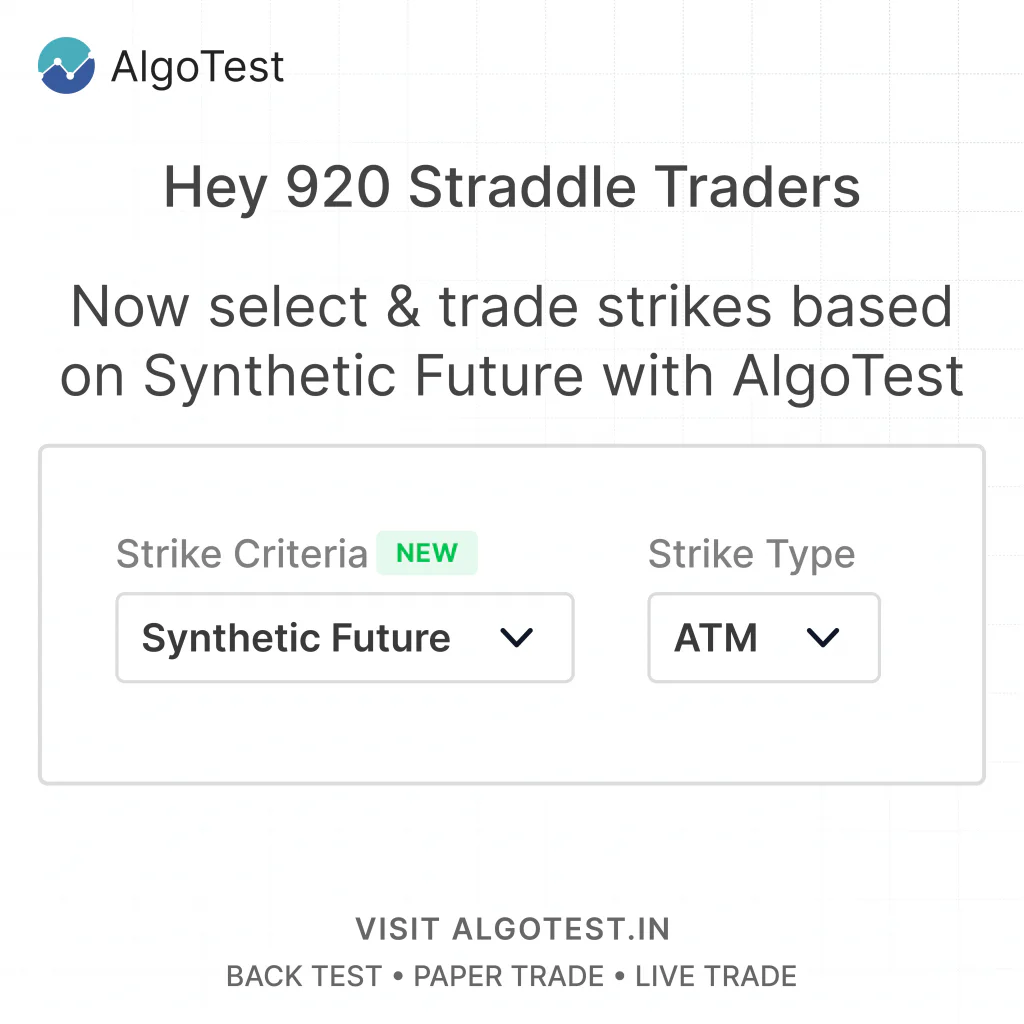
The AlgoTest feature does not automatically create a long or short futures position. Instead, it calculates a reference price using ATM call and put premiums. You can then select option strikes relative to this price rather than relying only on the spot index.
This guide explains the synthetic future formula, how the calculation works and how you can use synthetic futures in AlgoTest.
What Is a Synthetic Future Price?
A synthetic future price is a futures-like value calculated from the prices of a call and put with the same:
Underlying instrument
Strike price
Expiry date
In AlgoTest, the platform begins with the ATM strike closest to the current spot price. It then uses the call and put premiums at that strike to calculate the synthetic future value.
The feature can help you identify an ATM reference that reflects the difference between call and put premiums.
This matters because the spot price and the option market’s futures-like value may not always be the same. Futures can trade at a premium or discount to spot, and the call and put premiums at the spot ATM strike may not be equal.
Synthetic Future Formula
AlgoTest uses the following formula:
Synthetic Future = ATM Strike + ATM Call Premium − ATM Put Premium
It can also be written as:
Synthetic Future = Spot ATM Strike − Spot ATM PE + Spot ATM CE
Where:
ATM Strike is the strike closest to the current spot price.
ATM Call Premium is the premium of the call option at that strike.
ATM Put Premium is the premium of the put option at the same strike and expiry.
The call and put must use the same underlying, strike and expiry. Mixing contracts from different expiries would produce an invalid comparison.
This relationship comes from the principle of put-call parity, which connects European call prices, put prices, the underlying value and the present value of the strike price.
Synthetic Future Calculation Example
Suppose Bank Nifty has the following values:
Apply the synthetic future formula:
Synthetic Future = 45,000 + 550 − 275
Synthetic Future = 45,275
The synthetic future value is 45,275. If the available strikes are placed at 100-point intervals, the closest strike would be 45,300.
AlgoTest can treat 45,300 as the Synthetic Future ATM for strike selection.
This differs from the spot ATM strike of 45,000. The difference arises because the call premium is higher than the put premium in this example.
If the put premium were higher than the call premium, the calculated synthetic future value would be below the selected ATM strike.
Why Use Synthetic Futures for Strike Selection?
Options traders frequently select strikes relative to the spot ATM value. However, spot-based strike selection may not reflect the pricing difference visible in ATM calls and puts.
Synthetic future strike selection provides another reference point.
More Comparable Straddle Premiums
A straddle contains a call and put at the same strike and expiry. Selecting the strike closest to the synthetic future may result in call and put premiums that are closer to each other than those at the spot ATM strike.
This does not guarantee equal premiums. Implied volatility, market demand, liquidity and price movement can still create a difference between the two legs.
Futures-Like Market Reference
The derived value can help you view the market from a futures-like reference without depending only on the cash index or stock price.
This can be useful when the futures market is trading at a premium or discount to spot.
Consistent Rule-Based Selection
Manually comparing several call and put premiums can be slow and inconsistent. Synthetic future selection gives you a defined calculation that can be applied across entries and historical tests.
You can use the same rule during backtesting, forward testing and live execution.
Want to test a strike-selection rule before trading? Get 25 free backtests every week.
How Synthetic Futures Work in AlgoTest
Synthetic futures can be used in more than one AlgoTest workflow.
Synthetic Future as a Strike-Selection Criterion
In a time-based options strategy, you can select strikes relative to the calculated synthetic future rather than the spot price.
The platform follows this general process:
It checks the current spot value.
It identifies the closest spot ATM strike.
It reads the ATM call and put premiums for the selected expiry.
It calculates the synthetic future value.
It identifies the closest available strike to that value.
It selects ATM, ITM or OTM strikes relative to the synthetic future ATM.
For example, if the synthetic future ATM is 45,300:
Synthetic Future ATM refers to 45,300.
Synthetic Future OTM1 Call refers to the first call strike above 45,300.
Synthetic Future OTM1 Put refers to the first put strike below 45,300.
Synthetic Future ITM1 Call refers to the first call strike below 45,300.
Synthetic Future ITM1 Put refers to the first put strike above 45,300.
The exact strike distance depends on the strike interval available for the selected instrument.
Read the AlgoTest strike-selection glossary for the available selection methods.
Synthetic Futures as Signals AI Chart Data
AlgoTest Signals AI allows you to calculate indicators using different chart-data sources:
Spot
Futures
Options
Synthetic futures
Combined premiums
When you choose Synthetic Futures, your indicators run on a futures-like price series derived from call and put options.
For example, you could calculate an EMA crossover, RSI or SuperTrend signal using synthetic futures data instead of the spot-index chart.
The general workflow is:
Select an index or F&O stock.
Open the chart-data menu.
Choose Synthetic Futures.
Apply the selection.
Add your indicator and entry conditions.
Add your exit conditions.
Preview the signals on the chart.
Connect the signal to an execution strategy.
Backtest or forward test the complete setup.
The Signals AI chart-data guide explains how synthetic futures differ from spot, futures, option-premium and combined-premium charts.
Synthetic Future Price vs Futures Contract
A synthetic future price and an exchange-traded futures contract are not the same.
The synthetic future price is a calculated reference. It does not receive orders and does not have its own bid, ask, volume or open interest.
An actual futures contract trades on the exchange and has its own market price, liquidity and margin requirement.
Synthetic Future Price vs Synthetic Long Strategy
The term “synthetic future strategy” is also used for an options position that replicates a futures payoff.
A synthetic long futures position usually involves:
Buying one call
Selling one put
Using the same underlying
Using the same strike
Using the same expiry
A synthetic short position reverses the legs:
Selling one call
Buying one put
Using the same strike and expiry
The AlgoTest reference calculation does not place these two option orders. It only derives a price from option premiums.
If you create an actual synthetic long or short position, you take directional market risk. The sold option also creates margin requirements and potentially significant losses if the market moves against the position.
The relationship between calls, puts and futures is based on put-call parity.
When Can Synthetic Future Strike Selection Be Useful?
Synthetic future-based selection may be useful when:
You want to select a straddle around a futures-like price.
ATM call and put premiums appear significantly different.
Futures are trading away from the spot price.
You want a repeatable strike-selection rule.
You are testing an ATM, ITM or OTM options strategy.
You want to generate indicator signals from a synthetic futures chart.
You want consistent strike logic across backtesting and execution.
It can be applied to indices and supported F&O stocks available on AlgoTest.
However, you should compare the results with spot-based and actual futures-based selection. A method that works for one strategy may not improve another.
Limitations of Synthetic Futures
Synthetic future calculations have several limitations.
Premiums Can Change Quickly
Call and put premiums can move rapidly when the underlying price, implied volatility or time to expiry changes. This means the synthetic future value can also move.
Liquidity Affects the Calculation
Wide bid-ask spreads or low trading activity can make option premiums less reliable. A stale last-traded price may not represent the current executable value.
Strike Selection Can Change
If the synthetic value moves closer to another strike, the calculated ATM strike may change. Understand whether your strategy fixes the strike at entry or recalculates it later.
The Premiums May Still Be Unequal
Selecting the synthetic future ATM does not guarantee that the call and put premiums will match. Volatility skew and market demand can keep them different.
It Does Not Predict Direction
A synthetic future value above the spot ATM strike does not guarantee that the market will rise. It is a pricing reference, not a trading signal.
It Does Not Guarantee Better Performance
Synthetic future strike selection does not automatically reduce losses, slippage or drawdown. Strategy performance still depends on entry rules, exits, market conditions, execution and risk management.
How to Test a Synthetic Future Strategy
Before using synthetic futures in live trading, compare them with other price references.
You can test:
Spot ATM versus Synthetic Future ATM
Synthetic Future ATM versus futures-based ATM
Fixed versus rolling strike selection
Different entry and exit times
Weekly versus monthly expiries, where supported
ATM, ITM and OTM positions
Stop-loss and target variations
High and low volatility periods
Review more than the final profit. Check:
Maximum drawdown
Average profit and loss
Win rate
Number of trades
Risk-to-reward ratio
Slippage and brokerage
Performance around expiry
Results during trending and range-bound markets
The most useful test is whether synthetic future strike selection performs differently from spot-based selection. Create one version of the strategy using Spot ATM and another using Synthetic Future ATM. Keep the dates, entry time, exits and risk controls unchanged so you can compare the results fairly.
Follow this step-by-step guide to backtesting for free to set up and review both versions.
Which strike-selection method fits your strategy better? Run both versions with 25 free backtests on AlgoTest.
Conclusion
AlgoTest’s Synthetic Future feature calculates a futures-like reference using the ATM strike and the premiums of its call and put options.
You can use this value to select option strikes relative to the synthetic future instead of the spot price. In Signals AI, you can also use synthetic futures as the chart-data source for indicator conditions.
The feature can make strike selection more systematic, but it does not predict market direction or guarantee balanced premiums and better returns. Compare it with spot and futures-based selection through backtesting before deciding whether it fits your strategy.
Ready to test your options strategy? Sign up for AlgoTest and get 25 free backtests every week.