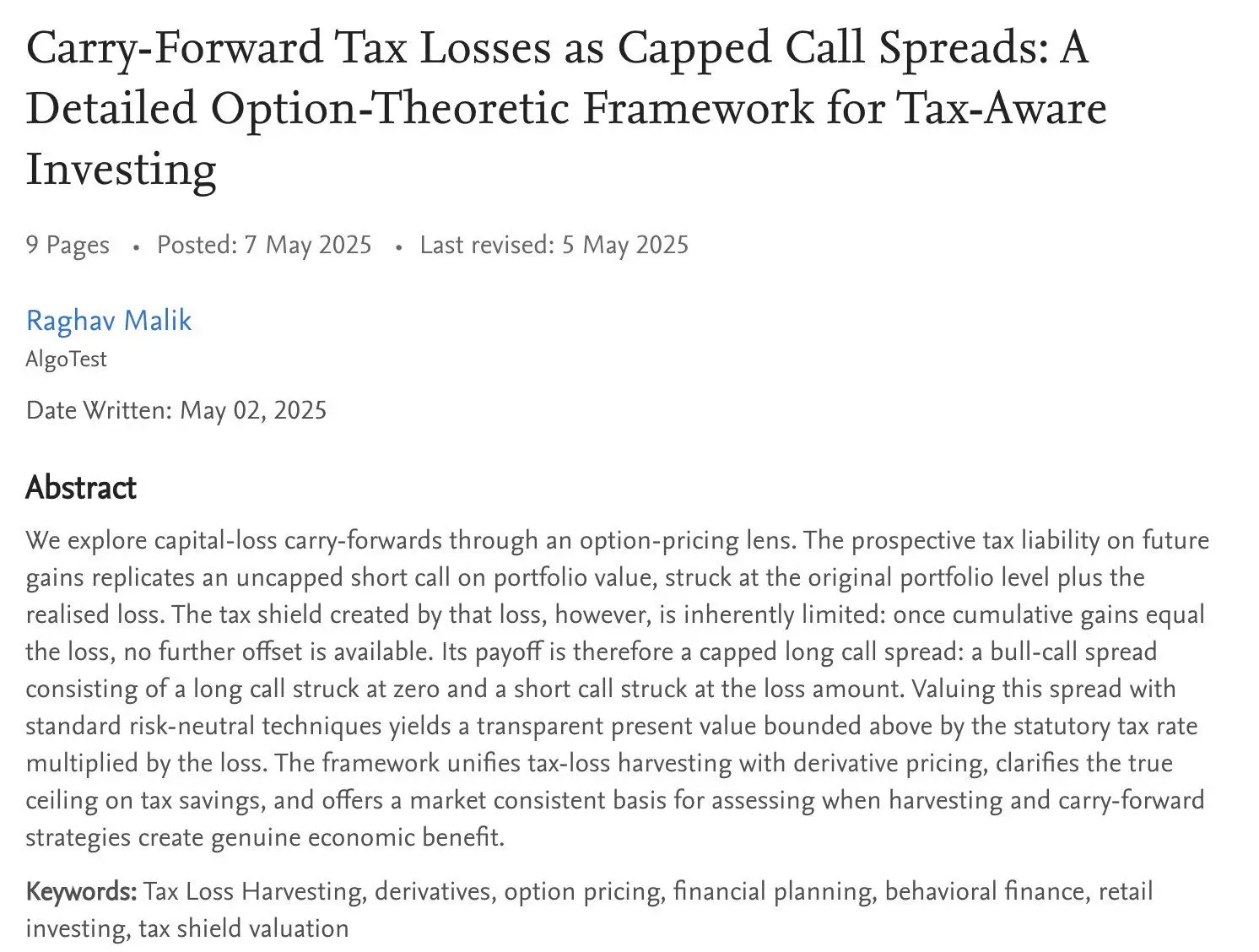
This paper came out of a rabbit hole while we were building the Tax Impact module at InvestHQ.
We asked a simple question: If you rebalance frequently, does the tax drag end up offsetting the better Sharpe ratio from rebalancing?
That one question ended up in a paper: Applying Options Pricing to Tax Loss Harvesting in Indian Markets.
Here’s the TLDR version, and why it might actually change the way you think about your unrealised losses.
The Government Already Owns a Call Option on Your Portfolio

Sounds dramatic? It’s not. It’s just how capital gains tax works.
Say you bought stocks, ETFs, or mutual funds with a base cost of ₹12L. Fast-forward one year, and three scenarios play out:
Portfolio value = ₹20L → Govt payoff = (20 – 12) × tax_rate
Portfolio value = ₹1L → Govt payoff = 0
Portfolio value = ₹12L → Govt payoff = 0
See the payoff shape?
Government payoff = max(0, gains × tax rate).
That’s literally the payoff of a call option.
So yes, by law, the gormint is long a call on your capital gains. You’re short it.
Turning Unrealised Losses into a Tax Shield
Here’s the twist: Indian tax law allows you to carry forward booked losses for up to 8 years.
That means if you’re sitting on an unrealised loss near FY-end, you can book it and convert it into a future tax shield.
Example:
Portfolio cost = ₹12L
Current value = ₹10L
Unrealised loss = ₹2L
If you book the loss, that ₹2L can offset any future gains for the next 8 years.
So what’s that shield worth today?
Enter Options Pricing
Think about the tax shield as an option:
If your portfolio recovers from ₹10L to ₹12L, those gains are shielded.
Beyond ₹12L, the shield expires, you’re back to paying tax.
That’s nothing but a bull call spread:

Long call from 10L to 12L (you’re shielded up to ₹2L gain)
Short call beyond 12L (no shield after breakeven)
The maximum value of this spread is τ × L (tax rate × loss).
You can price it today using Black–Scholes.
Formula for the present value (PV):
Tax shield PV = τ × [C(0) – C(L)]
Where:
τ = tax rate
L = loss amount
C(·) = call option price under Black–Scholes
A Quick Example
Tax rate (τ) = 12.5%
Loss booked (L) = ₹2L
Max shield = 12.5% × 2L = ₹25k
But Black–Scholes PV comes to only ~₹10k.
Why? Because there’s a risk your portfolio never recovers to ₹12L within the horizon.
So… Should You Book the Loss?
That depends. The trade-off is simple:
If transaction costs + slippages < shield PV → book the loss.
If not → don’t bother.
It’s literally a trade decision.
Why This Matters
For most retail investors, tax loss harvesting feels like a boring compliance hack. But seen through the volatility/option pricing lens, it’s actually a structured trade.
You’re monetising the optionality built into Indian tax law.
That optionality isn’t unlimited — it has an expiry (8 years), a strike (your purchase price), and a cap (loss booked × tax rate).
And like any other option, it can be priced, compared against costs, and executed rationally.
Closing Thought
At InvestHQ, our goal isn’t to drown you in spreadsheets. It’s to show you the real tradeoffs in investing — where costs, taxes, and volatility actually drive outcomes.
This is one of those rabbit holes where finance theory and Indian regulation collide in an oddly beautiful way.
Because sometimes, tax law = options pricing.