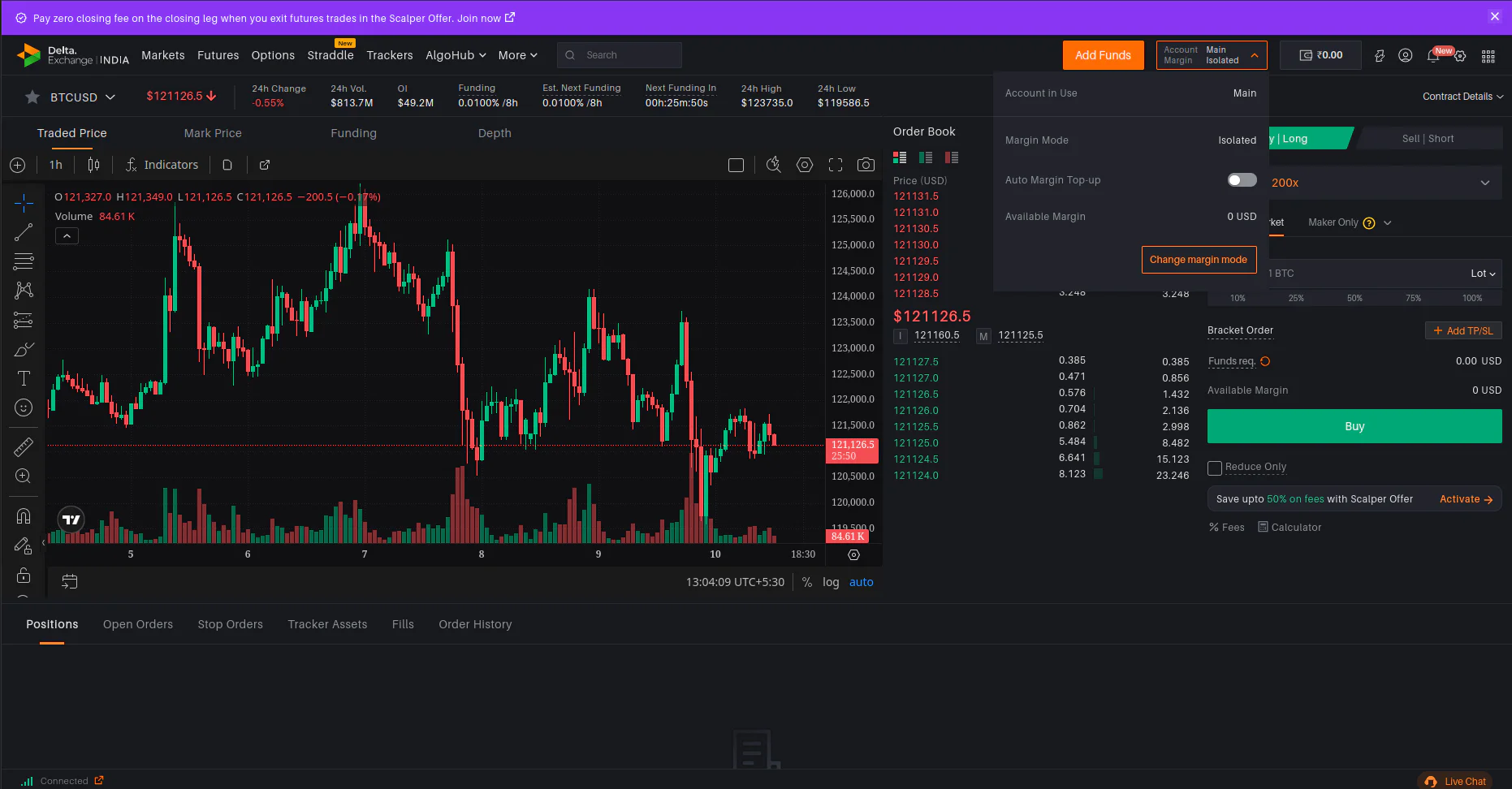
Delta Exchange is a crypto derivatives trading platform offering futures and options on Bitcoin, Ethereum, and other major altcoins. It is known for its robust risk engine, institutional-grade APIs, and support for advanced trading strategies.
What You Can Do with Delta Exchange on AlgoTest
With Delta Exchange integration on AlgoTest, you can:
- Execute crypto strategies on BTC, ETH, and other altcoins
- Use options and futures for directional or hedged trades
- Monitor and automate your crypto trades
- Backtest your crypto F&O strategies
Brokerage Charges
Delta Exchange charges trading fees based on a maker-taker model:
- Maker Fee: 0.02%
- Taker Fee: 0.05%
Fees may vary based on your VIP level or trade volume. Please refer to Delta Exchange Fees for detailed breakdown.
Today, we are talking about margin and margin modes on Delta Exchange.
What is Margin?
Margin is the collateral you need to post when entering into a leveraged derivatives contract.
Acts as security for your trades.
Required upfront before opening a position.
Protects the exchange/broker against losses.
Example:
You want to buy a futures contract worth ₹1,00,000. Instead of paying the full amount, you just need to post a margin of ₹10,000.
What is Initial Margin?
The minimum margin required to open a new position.
Paid at the time of entering the trade.
Calculated based on risk and volatility of the instrument.
Example:
If the initial margin is 10%, and you want to take a position worth ₹50,000, you must deposit ₹5,000 as collateral.
What is Maintenance Margin?
The minimum margin you must maintain to keep your position open.
If your unrealised loss reduces the margin below this level, liquidation begins.
Protects against excessive losses.
Example:
If your maintenance margin is ₹3,000 and your position drops in value so that only ₹2,800 is left in your margin, liquidation will be triggered.
What is Liquidation?
When your margin balance falls below the maintenance margin, the exchange automatically closes your position.
Prevents your account from going negative.
Loss is limited to the margin you posted.
Example:
You had ₹10,000 margin. Losses reduce it to ₹2,800 while maintenance margin is ₹3,000. Your position is force-closed to avoid further losses.
Understanding Margin Modes
Here we are talking about Delta Exchange margin modes and their use-cases while trading Futures & Options (F&O) on Delta Exchange.
Isolated Margin Mode
Each position has its own separate margin (collateral).
Loss is limited to that specific position only.
If the margin for that position is exhausted, the position gets liquidated, but other positions remain unaffected.
Best suited for traders who want to manage risk separately for each trade.
Example:
You open two positions with ₹1,000 margin each. If one trade goes into loss, the maximum loss will be ₹1,000, while the other position remains safe.
Cross Margin Mode
All your positions share the same wallet balance as margin.
Profit or loss from one position affects the entire account margin.
More efficient use of capital and better leverage, but carries higher risk.
If one position incurs heavy loss, it can affect all other trades as well.
Example:
You have ₹5,000 in your wallet. All your open positions draw a margin from this ₹5,000. If one trade incurs a large loss, other trades can also get liquidated.
Portfolio Margin
An advanced version of cross margin that uses statistical models to assess the risk of your entire portfolio.
Well-hedged positions may require even less margin.
Best suited for professional or high-volume traders.
Example:
An advanced version of cross margin that calculates risk based on your entire portfolio rather than individual positions.
Margin requirement is lower if your positions are hedged (for example, futures + options that offset each other’s risk).
PNL offsetting: profit from one leg can absorb the loss of another.
Risk offsetting: opposite positions reduce overall exposure, so less margin is needed.
Best suited for experienced traders building multi-leg strategies (spreads, straddles, covered calls).
Example:
You go long 1 BTC futures and simultaneously sell 1 BTC call option (a covered call strategy).
If BTC price rises: futures give you profit, but the call option creates a loss.
If BTC price falls: futures lose money, but the short call reduces the impact.
Since risks are offset, the exchange charges you much less margin compared to isolated margin. So, let's say, instead of needing, ₹3,000 margin in isolated mode, you may only need ₹1,600 in portfolio margin because the positions balance each other.
Tip: Before placing a trade, choose your preferred margin mode based on your strategy and risk profile on Delta Exchange.