# Algo Trading India: Complete Guide for Retail Traders (2026)
Author: AlgoTest
Author URL: https://algotest.in/blog/author/algotest/
Published: 2026-03-20
Category: General
Category URL: https://algotest.in/blog/category/general/
Meta Description: Learn how algo trading in India works for retail traders. Explore SEBI rules, strategies, brokers, backtesting, and how to start without coding.
Tags: algo trading, algo trade, algo trading india
Tag URLs: algo trading (https://algotest.in/blog/tag/algo-trading/), algo trade (https://algotest.in/blog/tag/algo-trade/), algo trading india (https://algotest.in/blog/tag/algo-trading-india/)
URL: https://algotest.in/blog/algo-trading-india/
Algo trading in India is growing rapidly as more retail traders move from manual execution to systematic, rule-based trading. With better tools, clear SEBI regulations, and no-code platforms, algo trading in India is no longer limited to institutions or quant funds.
But the real question is:
Is there a more consistent way to trade?
That’s exactly what algorithmic trading solves.
Let's take a look at:
- What [algorithmic trading in India](https://algotest.in/?utm_source=blog&utm_medium=internal&utm_campaign=seo&utm_content=main-page&utm_term=algotest&utm_source=blog&utm_medium=internal&utm_campaign=seo&utm_term=algotest&utm_content=main-page) really means
- How it works across F&O, equities, and crypto
- SEBI rules and what’s allowed
- How to start step-by-step
- Risks to watch out for (and how to manage them)
If you’re looking to move from random trades to a structured approach, this guide will show you how.
## **What is Algo Trading?**
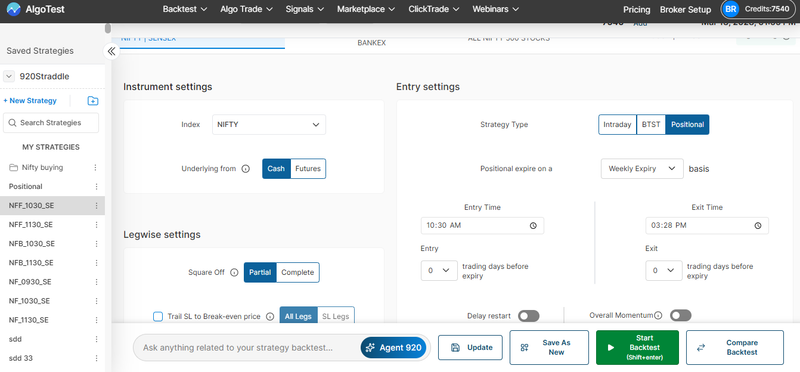
Algo trading (algorithmic trading) uses predefined rules to execute trades automatically.
Instead of placing orders manually, you:
- Define entry conditions
- Set exit rules
- Add risk management
- Decide position sizing
The system executes trades the moment conditions are met.
You define the rules.
The system follows them, every time.
In India, algo trading runs across:
- NSE and BSE (equity, F&O)
- MCX (commodities)
- Crypto platforms like Delta Exchange
The system reads live market data and places orders within milliseconds.
No hesitation. No delay. No second-guessing.
Now, retail traders can access the same execution framework through platforms like AlgoTest — without coding.
Related: [Learn how you can build, backtest and deploy trading signals without coding or TradingView](https://algotest.in/blog/trading-signals/)
## **How Algo Trading Works**
Every algo setup, whether simple or complex, has four components working together.
### Strategy logic (your rules)
Entry conditions, exit conditions, position size, risk parameters. The clearer these are, the more reliably the algo executes them.
### Market data feed
Real-time price data, option chain updates, and indicator values. The algo reads this and decides whether conditions are met.
### Broker API
The bridge between your strategy and your broker. When conditions are met, the API sends the order directly to the exchange.
### Risk controls
Stop-losses, maximum daily loss limits, and position-sizing rules. These run alongside the strategy and stop a bad day from becoming a catastrophic one.
The entire cycle — data in, decision made, order placed — happens in milliseconds. That's the edge. Not a better indicator. Faster, cleaner execution of a well-defined strategy.
→ _Related:_ [_How to do Algo Trading in India - Step-by-Step guide_](https://algotest.in/blog/how-to-do-algo-trading-step-by-step-beginner-checklist)
## **Is Algo Trading Legal in India?**
Yes, and the framework matters.
[SEBI](https://www.sebi.gov.in/sebiweb/home/HomeAction.do?doListing=yes&sid=1&ssid=3&smid=0) introduced algorithmic trading in India for institutions in 2008 via Direct Market Access. Retail participation was largely unregulated until SEBI's 2021 circular brought third-party algo platforms under a formal framework. The 2024–25 updates added a further requirement — each strategy now needs a unique algo ID registered with the exchange before it can go live.
**What the current framework requires:**
- All algo orders must go through a SEBI-registered broker's approved API
- Each strategy must carry a unique algo ID registered with the exchange
- Brokers are responsible for risk controls before any algo goes live
- Traders must stay within the prescribed margin and position limits
You always trade in your own account. The platform executes — it doesn't touch your funds. Your broker is the accountable party at the exchange level.
Spoofing, layering, or any strategy designed to manipulate prices is not allowed. SEBI's surveillance systems flag these patterns, and the consequences are serious.
[AlgoTest](https://algotest.in) is officially empanelled with NSE and BSE and operates in compliance with all regulatory frameworks.
→ _Related:_ [_Is SEBI banning algo trading — What Retail Traders Need to Know_](https://algotest.in/blog/is-sebi-banning-algo-trading-in-india)
## **Algo Trading vs Manual Trading**
Manual trading isn't bad. Algo trading isn't automatically better. The difference is in what each approach demands from you.
**Manual Trading**
**Algo Trading**
Execution speed
Seconds to minutes
Milliseconds
Emotional influence
High
None
Consistency
Varies by day/mood
Identical every trade
Strategy validation
Intuition-based
Backtested, data-driven
Scalability
Limited by screen time
Multiple strategies simultaneously
Best for
Discretionary, news-driven
Rule-based, systematic setups
Most experienced traders don't fully abandon discretion. They automate the parts of their process where discipline breaks down, and stay manual where judgment adds value.
_Read more:_ [_Manual Trading vs Algo Trading_](https://algotest.in/blog/manual-trading-vs-algo-trading-in-india-which-is-better-for-retail-traders)
## Types of Algo Trading Strategies in India
Algorithmic trading in India typically falls into these major strategy types:
### 1\. Trend Following
Trades in the direction of market momentum using signals like **breakouts or moving average crossovers**.
Works well in **trending markets (indices, large-cap stocks)** but generates fewer signals.
→ Read more: [Swing Trading Strategies in Algo Trading](https://algotest.in/blog/swing-trading-strategies)
### 2\. Mean Reversion
Assumes price will return to its average after sharp moves.
Common in [**options trading**](https://algotest.in/blog/options-trading-a-comprehensive-guide-with-algorithmic-strategies), especially after sudden spikes in Nifty or BankNifty.
Performs best in **range-bound markets**.
### 3\. Options Selling Strategies
Focuses on capturing time decay (theta) using strategies like short straddles, strangles, and iron condors.
Widely used in India due to weekly expiries.
High win rate, but requires strict risk management.
→ Read more: [Options Selling Strategies in Algo Trading India](https://algotest.in/blog/what-is-option-selling)
### 4\. Options Buying Strategies
Directional trades using **calls and puts** based on momentum or breakout signals.
Lower win rate but offers **high reward potential** with controlled risk.
→ Read more: Options Buying Strategies Guide
### 5\. Intraday and Scalping
Involves multiple trades within a day using setups like opening [range breakout](https://docs.algotest.in/sample-algo-trading-strategies/range-breakout-strategy/) or VWAP strategies.
Requires fast execution, low latency, and strict discipline.
→ Read more: [Intraday Algo Trading Strategies](https://algotest.in/blog/best-intraday-trading-strategies-rules-tips)
### 6\. Momentum Strategies
Trades instruments showing strong price strength, such as stocks making new highs with volume.
Works well during strong market trends.
### 7\. Volatility-Based Strategies
Uses implied volatility (IV) as the main signal.
Examples include selling options during IV spikes before events.
Common in Indian markets around expiry and news events.
### 8\. Multi-Strategy Portfolios
Combines multiple uncorrelated strategies (e.g., **options selling + trend following**) to improve consistency.
Helps reduce **drawdowns and smooth returns** across different market conditions.
→ Read more: [Popular Algo Trading Strategies for Retail Traders in India](https://algotest.in/blog/6-popular-algo-trading-strategies-for-retail-traders-in-india/)
## Benefits of Algo Trading
Algo trading helps you trade with **discipline and consistency.**
• **Removes emotions** – Trades are executed based on rules, not fear or greed
• **Consistent execution** – Every signal is followed exactly as defined
• **Faster decision-making** – No manual delays in entry or exit
• **Backtesting before risk** – Test strategies on historical data before going live
• **Time-saving** – Strategies run automatically without constant screen monitoring
• **Scalability** – Run multiple strategies simultaneously without added effort
Overall, algo trading helps you move from guesswork to a structured, data-driven approach.
## **Why You Should Backtest and Paper Trade**
Going live without [backtesting](https://algotest.in/blog/step-by-step-guide-on-how-to-backtest-for-free) is gambling. But backtesting is also where most traders fool themselves. Here's how to do it right.
**What to look for:**
**CAGR** — annualized return. Looks good in isolation, means nothing without context.
[**Max drawdown**](https://docs.algotest.in/Time-Based-Algo-Trading/portfolio/optimiser/#maximum-drawdown)— the largest peak-to-trough loss. This tells you whether you'd actually survive the strategy in real life. A 40% drawdown strategy is almost impossible to hold, regardless of CAGR.
**Sharpe ratio** — return per unit of risk. Above 1 is acceptable, above 1.5 is good.
[**Win rate**](https://docs.algotest.in/Time-Based-Algo-Trading/portfolio/optimiser/#win-) **and payoff ratio** — a 40% win rate with 3:1 payoff beats a 70% win rate with 0.8:1 payoff. Look at both together.
**Number of trades** — 12 trades over 3 years isn't statistically meaningful. You need enough trades across different market conditions to draw any conclusion.
### Three mistakes that traders make while Backtesting
**1\. Overfitting**
This happens when you tweak a strategy too much just to make past results look perfect.
It may work beautifully in backtests but usually fails in live trading because it’s fitted to past data, not real market behaviour.
**2\. Ignoring slippage**
Backtests often assume you get perfect prices, which doesn’t happen in reality.
In live markets, especially in far OTM options, you may enter or exit at worse prices.
If [slippage](https://docs.algotest.in/product-blogs/difference-backtest-forward-live/#slippages) isn’t included, your results will look better than they actually are.
**3\. Testing only one type of market**
A strategy that works in one market condition (like a strong trend) may fail in others.
Always test across different phases, **trending, sideways, volatile, and crash periods**.
### Final step: Paper trading
Before using real money, run your strategy in **paper trading (simulated live trading)**.
This shows how it behaves with:
- Real market data
- Actual execution delays
- Realistic slippage
If it doesn’t work here, it shouldn’t go live.
_Read More:_ [_Best paper trading websites in India_](https://algotest.in/blog/paper-trading-websites-india)
## **How to Start Algo Trading in India**
**Step 1: Learn the instrument first.**
Understand F&O basics, how options are priced, what leverage means, and how margin works. Automate only what you already understand.
**Step 2: Pick a broker with API access.**
Not every broker supports algo trading in India. You need one with a stable, [SEBI-approved trading API broker.](https://algotest.in/blog/trading-api-brokers-india)
**Step 3: Choose an algo trading platform.**
Look for tick-level backtesting, paper trading, a no-code builder, and solid broker integration. AlgoTest covers all of these, built specifically for the Indian markets.
**Step 4: Start simple.**
Don't begin with a [6-leg options](https://docs.algotest.in/Time-Based-Algo-Trading/how-to-backtest/positional/#adding-a-leg) structure. Start with something you fully understand — a basic straddle or a simple breakout strategy. Add complexity only after you've validated the full workflow.
**Step 5: Backtest properly.**
Fewer than 100 trades in the backtest, or less than 2 years of data, doesn't give you enough signal. Understand what conditions the strategy needs and what will break it.
**Step 6: Paper trade for 2–4 weeks.**
API delays, partial fills, fast-moving strikes — these show up in paper trading (also called [forward testing on AlgoTest)](https://algotest.in/blog/forward-testing-is-live), not in backtests. If live behaviour diverges significantly from the backtest, investigate before going live.
**Step 7: Go live small.**
For most F&O strategies, start with ₹1–2 lakh. The first month is about validating execution, not generating returns. Scale capital only after live performance tracks the backtest.
**Step 8: Review monthly.**
Markets evolve. Track live performance against backtest benchmarks every month. Persistent divergence means review, not more capital.
## **Best Brokers for Algo Trading in India**
Your broker is the infrastructure layer. An excellent strategy can still fail because of API instability.
**What to evaluate:**
**API reliability** — does it hold up on expiry days and during major announcements? That's when most brokers struggle, and when reliable execution matters most.
**Order types supported** — market, limit, SL, SL-M at a minimum. Some strategies need bracket or cover orders.
**API approval status** — SEBI requires brokers to have algo strategies exchange-approved. Confirm your broker actively supports third-party platform integrations.
**Brokerage costs** — F&O brokerage compounds fast at scale. Flat-fee brokers work better for frequent algo setups.
**Margin framework** — understand peak margin requirements. An unexpected shortfall can force an unwanted exit at the worst moment.
AlgoTest integrates with 60+ brokers — Zerodha, Upstox, Fyers, Angel One, Dhan, Finvasia, and more.
→ _Related:_ [_Best Brokers for Algo Trading in India — Detailed Comparison_](https://algotest.in/blog/best-brokers-for-algo-trading-in-india)
## Best Algo Trading Platforms in India — How to Choose
AlgoTest
Streak
Tradetron
No-code builder
✓
✓
✓
Tick-level backtesting
✓
Limited
Limited
Options strategy support
Strong
Moderate
Moderate
RA marketplace (SEBI-registered)
✓
✗
✗
Broker integrations
55+
~5
35+
Pricing model
Usage-based
Subscription
Subscription
The single most important factor when choosing an [algo trading app](https://algotest.in/blog/want-the-best-algo-trading-app-in-india-heres-how-algotest-can-help) or software in India is backtesting quality.
Daily OHLC data for options backtests gives you inaccurate results. Tick-level data is the difference between a strategy that looks good on paper and one that behaves predictably live.
AlgoTest's pricing is usage-based — 25 free backtests per week, additional backtests at ₹1 each. No subscription before you've validated anything.
→ _Related:_ [_Best Algo Trading Platforms in India - Detailed comparison_](https://algotest.in/blog/8-best-algo-trading-platforms-in-india-2026)
## **Risks of Algo Trading and How to Manage Them**
Systematic doesn’t mean safe. Algo trading shifts risk it doesn’t remove it.
### Overfitting
The most common risk. A strategy looks great in backtests because it’s over-optimized on the same data. Live performance falls apart.
**Fix:** Use out-of-sample testing. If results drop significantly, the strategy isn’t robust.
### Technology failure
APIs fail. Servers restart. Data lags — often during peak market activity.
**Fix:** Always have a manual fallback. Be ready to exit positions if the system goes offline.
### Market regime change
Strategies are built for specific conditions. When those conditions change, performance breaks.
**Fix:** Compare live performance with historical expectations. Persistent deviation = review, not more capital.
### Overleveraged multi-strategy setups
Running multiple algos can lead to hidden, correlated risk.
**Fix:** Track total exposure across strategies, not just individually.
**Stopping mid-drawdown** The biggest behavioural risk. Turning off a strategy too early locks in losses and misses recovery.
**Fix:** Define acceptable drawdown in advance and stick to it.
Read more: [Algo Trading risks, AI and SEBI rules](https://algotest.in/blog/algo-trading-profitable-india-2026)
## **How AI is Changing Algo Trading in India**
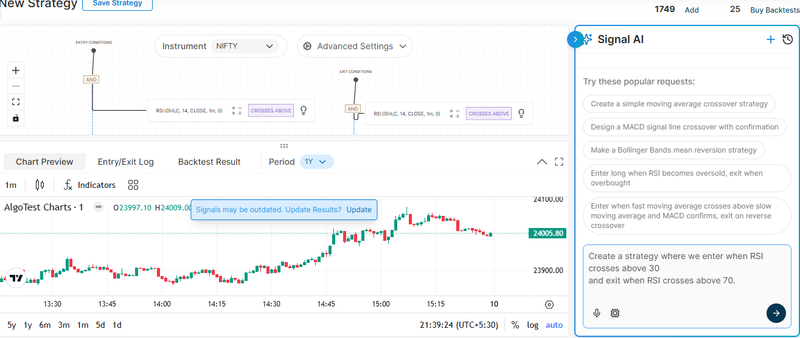
AI is making **algo trading in India** more accessible for retail traders.
Instead of manually defining every rule, traders can now use [AI-powered tools](https://algotest.in/blog/ai-algo-trading-india/) to create indicator-based strategies faster.
With [**Signals AI by AlgoTest**](https://algotest.in/feature/signals/indicators?utm_source=blog&utm_medium=organic&utm_campaign=seo&utm_source=blog&utm_medium=organic&utm_campaign=seo), traders can build rule-based strategies using indicators like:
- RSI
- EMA
- Bollinger Bands
- ADX
- breakout logic
without coding.
This reduces setup complexity and helps traders move from idea to backtest faster.
This is huge.
## **Algo Trading for F&O and Why AlgoTest is Built for It**
F&O is unforgiving. A few seconds of delay, one manual error, one emotional exit — and a good strategy becomes a losing trade.
**Why timing matters more in F&O**
Options premiums don't wait. A 10-second delay on a BankNifty ATM straddle during a volatile session means you're already in at a worse price. On a ₹2 lakh position, even a ₹10 shift per lot across both legs adds up fast.
Now try doing that manually on a 4-leg iron condor. By the time you place the third and fourth orders, the market has moved your entry prices are inconsistent; your risk profile has shifted. An algorithm places all four legs simultaneously, the moment your conditions are met.
India's weekly expiry cycle makes this even more critical. Thursday on BankNifty, Tuesday on Nifty MidSelect, Wednesday on FinNifty — each creates a narrow entry window. Miss it by minutes, and the opportunity is gone.
_New to options trading? Start with our_ [_options basics_](https://docs.algotest.in/financial-education/options/options-trading-terms/#basic-option-terms) _guide._
**What AlgoTest is built for**
Feature
What it means for you
Tick-by-tick NSE data
Backtests reflect real intraday behaviour — not daily approximations
No-code multi-leg builder
Build straddles, condors, ratio spreads — no coding required
Paper trading
Test in live conditions before risking real capital
55+ broker integrations
One-click deployment — no manual order placing
RA marketplace
SEBI-registered strategies you can backtest before deploying
**One thing to watch**
Not all options are equally liquid. Far OTM strikes mid-week can carry wide bid-ask spreads — wide enough to turn a profitable-looking strategy into a losing one. A strategy that looks clean with market order fills may need limit order logic in practice. AlgoTest lets you model realistic fill assumptions in the backtest before it costs you live.
**The numbers**
SEBI's FY24 study found only 9% of individual F&O traders made a profit. In the same period, 45% of AlgoTest users ended the year in profit — five times the national average. Systematic execution that removes emotion from the equation is what explains that gap.
## What is an Algo Strategy Marketplace?
At [the Algo Strategy Marketplace](https://algotest.in/blog/algo-trading-marketplace-india) you can access ready-built trading strategies without having to build one from scratch.
Think of it like an app store for trading strategies. Strategies are listed with their logic, risk parameters, and backtest performance.
You review them, backtest them yourself, paper trade them and only deploy what you're confident in. Your capital stays in your own account throughout.
At AlgoTest's [RA Algos,](https://algotest.in/blog/what-is-ra-algos-and-how-it-works-on-algotest) every strategy is built by a SEBI-registered Research Analyst, meaning the person behind it has a regulatory licence, is accountable to SEBI, and can't just disappear after a bad month.
**What you get with AlgoTest's RA marketplace:**
- **Verified creators** — every strategy is built by a SEBI-registered RA, not an anonymous user
- **Full transparency** — you see the logic, the rules, and the historical performance before committing
- **Backtest first** — run the strategy on your own before paper trading or going live
- **Your capital, your control** — the RA never touches your funds; execution happens in your own broker account
It's the fastest way to [start algo trading in India](https://algotest.in/login).
**Crypto Marketplace** \- Just like the RA marketplace, at the Crypto Marketplace, you can access strategies created by expert traders, backtest, forward test (aka paper trade), and execute them via Delta exchange.
[Start crypto trading today.](https://algotest.in/login)
## **Conclusion**
Algo trading in India gives retail traders a more structured way to trade.
It replaces guesswork with rules, emotions with discipline, and inconsistent execution with a clear, repeatable process.
But tools alone don’t create results.
Your edge still depends on the strategy you choose, how well you test it, and how consistently you follow it.
Ready to start [algo trading in India?](https://algotest.in/?utm_source=blog&utm_medium=internal&utm_campaign=seo&utm_content=main-page&utm_term=algotest&utm_source=blog&utm_medium=internal&utm_campaign=seo&utm_term=algotest&utm_content=main-page) Build, backtest, paper trade, and deploy strategies without coding using AlgoTest.
Free Sign Up
Read More: [Best Algo Trading Courses in India](https://algotest.in/blog/5-best-algo-trading-courses-in-india-to-learn-in-2025/)
[How AlgoTest is Simplifying Algo Trading in India](https://algotest.in/blog/how-algotest-is-simplifying-algo-trading-in-india/)
[FAQs about Pricing \| Algo Trading Software India](https://algotest.in/blog/faqs-about-pricing-algo-trading-software-india/)
[Advantages of Algo Trading Software in India](https://algotest.in/blog/benefits-of-algo-trading-platforms-india/)
[5 Mistakes Traders Make in Algo Trading](https://algotest.in/blog/5-mistakes-traders-make-in-algo-trading/)
## FAQs
Q: Is algo trading legal in India?
A: Yes. SEBI has a formal framework — trades go through broker-approved APIs, strategies need unique exchange IDs, and risk controls must be in place. You trade in your own account at all times.
→ Read: SEBI Algo Trading Rules — What Retail Traders Need to Know
Q: How much capital do I need?
A: For equity intraday, ₹50,000–₹1 lakh is workable. For F&O strategies like straddles or iron condors on Nifty, ₹2–5 lakh gives you proper position sizing with room to manage risk. Start small — the first goal is validating execution, not generating returns.
Q: Can beginners do algo trading in India?
A: Yes. AlgoTest is no-code — the technology isn't the barrier. The real risk is automating a strategy you don't fully understand. Learn the instrument first, understand what your strategy does and why, then automate it.→ Read: Algo Trading for Beginners — Where to Start
Q: Do I need to know coding?
A: No. AlgoTest's no-code builder lets you define entry, exit, and risk rules using a visual interface — no Python required. Coding adds flexibility if you want to go beyond standard logic, but it's not needed to start.
Q: What's the best strategy for algo trading in India?
A: There's no universal answer. Options selling strategies — straddles, iron condors — are popular given India's weekly expiry structure. Trend-following works well on Nifty and BankNifty futures. The best strategy is one you understand, have backtested rigorously, and can hold through its documented drawdown.→ Read: Best Algo Trading Strategies for Indian Markets
Q: Is algo trading profitable in India?
A: It can be — but a bad strategy executed perfectly is still a bad strategy. Profitability depends on strategy quality, proper backtesting, and disciplined risk management. SEBI's FY24 data shows only 9% of F&O traders made a profit. 45% of AlgoTest users did. The difference is systematic execution, not better tips.→ Read: How to Build a Profitable Algo Trading Strategy
Q: What if my algo places a wrong trade?
A: Set a daily max loss limit at the broker level — AlgoTest lets you configure this as an automatic kill switch. If the limit is hit, the system stops. In the first few weeks of going live, keep a manual monitoring window open during market hours.→ Read:How to Set Risk Controls on AlgoTest
---
This blog is powered by Superblog. Visit https://superblog.ai to know more.
---