Intraday trading involves opening and closing a position within the same trading session. Traders try to benefit from short-term changes in the prices of stocks, indices, futures or options without carrying the position overnight.
There is no single best intraday trading strategy for every market. A breakout strategy may work when momentum is strong, while a range-trading setup may be more suitable when prices move between support and resistance.
The key is to match your strategy with the current market condition, define the entry and exit rules before trading, and control the amount you can lose if the setup fails.
We cover seven popular intraday trading strategies, essential trading rules and practical ways to test a setup before using real capital.
Best Intraday Trading Strategies at a Glance
These setups are frameworks rather than ready-made recommendations. Every strategy requires defined entry, exit, position-sizing and risk-management rules.
1. Trend-Following Strategy
A trend-following strategy attempts to trade in the direction of the prevailing intraday move.
A bullish intraday trend may show:
Higher highs and higher lows
Price trading above VWAP
A short-term EMA above a longer-term EMA
Stronger volume during upward moves
A bearish trend may show the opposite conditions.
Example Rule Framework
A trader may consider a bullish setup when:
Price is above VWAP.
The short-term EMA is above the longer-term EMA.
Price pulls back without breaking the recent swing low.
A bullish candle confirms that momentum is returning.
The stop-loss can be placed below the level that invalidates the trend. The exit may be based on a fixed target, a trailing stop or a close below the selected EMA.
Trend-following strategies can produce false entries when the market is moving sideways. Use a trend filter rather than trading every moving-average crossover.
2. Opening Range Breakout Strategy
An opening range breakout, or ORB, uses the high and low formed during the first part of the trading session.
Traders define an opening range, such as the first 15 or 30 minutes, and wait for the price to move outside it.
Bullish ORB Framework
Mark the opening-range high and low.
Wait for the price to close above the range high.
Confirm that volume is higher than normal.
Enter only after the breakout meets the predefined rules.
Place the stop-loss inside the range or below the breakout structure.
A bearish setup reverses these conditions.
The first part of the market session can be highly volatile. A brief move beyond the range may reverse quickly, creating a false breakout. Waiting for the candle to close or for a retest can provide additional confirmation, but it may also result in a later entry.
The ideal opening range and chart interval depend on the instrument. Read our guide to the best time frame for intraday trading before selecting them.
3. VWAP Pullback Strategy
VWAP, or Volume Weighted Average Price, shows the average traded price of an instrument based on both price and volume.
Intraday traders often use VWAP as:
A trend filter
A pullback level
A support or resistance reference
An entry or exit condition
In a bullish market, a trader may wait for the price to move above VWAP, pull back towards it and then show renewed buying strength.
Example VWAP Pullback Rules
Price is trading above VWAP.
The broader intraday structure remains bullish.
Price pulls back towards VWAP without forming a lower low.
A bullish candle or increase in volume confirms the bounce.
The stop-loss is placed below the level that invalidates the setup.
A bearish VWAP pullback follows the reverse structure.
Avoid assuming that every touch of VWAP will produce a reversal. When price crosses VWAP repeatedly, the market may be range-bound and unsuitable for a trend-based pullback strategy.
4. Range-Trading Strategy
Range trading is used when price moves between identifiable support and resistance levels without forming a clear trend.
The basic idea is to look for bullish confirmation near support and bearish confirmation near resistance.
Example Range Setup
Identify a range with multiple reactions at both boundaries.
Avoid entering in the middle of the range.
Wait for price rejection near support or resistance.
Place the stop outside the range boundary.
Plan the exit before price reaches the opposite side.
The potential reward may become too small if the range is narrow after including brokerage, taxes and slippage.
Range strategies can also fail when a strong breakout begins. A rise in volume and a candle closing outside the boundary may signal that the sideways phase is ending.
5. Momentum Trading Strategy
Momentum trading focuses on instruments showing strong price movement supported by increasing participation.
Momentum may be triggered by:
Earnings or company announcements
Sector-wide movement
Economic events
A high-volume breakout
An unusual increase in trading activity
A momentum trader does not buy a stock simply because it has already risen sharply. The strategy should define how momentum is measured and where the trade becomes invalid.
Example Momentum Conditions
Price breaks a recent intraday high.
Volume is higher than its recent average.
Price remains above VWAP for a bullish setup.
The breakout candle closes strongly.
The next candle does not immediately reverse the move.
Momentum trades require quick risk control because the same volatility that creates the opportunity can also cause a sharp reversal.
6. Intraday Reversal Strategy
A reversal strategy looks for signs that an existing move is becoming exhausted.
Possible signals include:
Price reaching an established support or resistance level
A failed breakout
A reversal candlestick pattern
Momentum divergence
A sharp rejection with higher volume
Price moving too far from VWAP
Reversal trading is different from blindly buying after a fall or selling after a rise. The strategy requires evidence that the existing move is losing strength.
For example, a trader may wait for a failed move below support, followed by a close back above the level. The stop can be placed below the failed-breakdown low.
Reversal trades go against the recent direction, so confirmation and position sizing are especially important.
7. Scalping Strategy
Scalping involves taking short-duration trades to capture relatively small price movements. Positions may remain open for a few minutes or even less, depending on the setup.
Scalpers generally depend on:
High liquidity
Tight bid-ask spreads
Fast order execution
Small, controlled losses
Consistent entry and exit rules
Common scalping setups include VWAP pullbacks, moving-average crossovers, opening-range breakouts and volume-based momentum trades.
Trading costs and slippage have a greater effect when each target is small. A strategy that appears profitable before costs can become unprofitable after realistic execution expenses are included.
Our complete scalping trading strategy guide explains one-minute and five-minute setups in more detail.
How to Select an Intraday Trading Strategy
Choose a strategy based on observable market conditions rather than using the same setup every day.
A strategy should tell you when not to trade. For example, a trend-following system may remain inactive when price repeatedly crosses VWAP and the moving averages are flat.
Best Indicators for Intraday Trading
Indicators should support a trading rule, not act as standalone predictions.
Using too many indicators can create conflicting signals. Start with one tool for trend, one for confirmation and a clear price-based invalidation level.
See our guide to the best indicators for intraday trading for detailed examples.
How to Select Stocks for Intraday Trading
An intraday strategy needs an instrument that can be entered and exited efficiently.
Consider the following factors:
Liquidity
Liquid stocks and contracts usually have more active buyers and sellers. This can make order execution easier.
Bid-Ask Spread
A wide spread increases the effective cost of entering and exiting a trade. This matters even more for scalping and other small-target strategies.
Trading Volume
Higher-than-normal volume may confirm that more market participants are supporting a price movement.
Volatility
A stock needs enough movement to create an opportunity, but excessive volatility can increase slippage and stop-loss risk.
News and Events
Results, corporate announcements and major economic events can create large moves. They can also cause sudden gaps and reversals, so check the event calendar before trading.
Essential Intraday Trading Rules
1. Define the Complete Trade Before Entry
Your plan should specify:
Entry condition
Stop-loss
Profit target
Position size
Maximum holding time
Conditions for skipping the trade
Do not decide these points after the position begins moving.
2. Calculate Position Size From Risk
Position size should be based on how much you are prepared to lose if the stop-loss is triggered.
A basic framework is:
Position size = Maximum acceptable trade loss ÷ Risk per unit
If your entry is ₹500 and the stop-loss is ₹495, the risk is ₹5 per share. Your position size should reflect that risk rather than the amount of margin your broker offers.
3. Set a Maximum Daily Loss
A daily loss limit prevents a series of losing trades from turning into a much larger loss. Stop trading when the predefined limit is reached.
4. Use a Stop-Loss
A stop-loss should represent the point where the original setup is no longer valid. Placing it randomly or moving it further away after entry weakens the risk plan.
Stop orders may experience slippage during fast markets, so actual losses can be larger than expected.
5. Avoid Overtrading
More trades do not automatically produce more profit. Take only the setups that meet your rules.
Revenge trading after a loss and entering from fear of missing out can quickly increase risk.
6. Consider All Trading Costs
Include brokerage, exchange charges, taxes, bid-ask spread and slippage when evaluating a strategy. These costs can have a major effect on high-frequency intraday setups.
7. Exit Intraday Positions on Time
An intraday position should be closed within the planned session. Broker square-off times and policies vary, so verify them before trading rather than assuming every position will be handled automatically.
8. Keep a Trading Journal
Record the setup, entry, exit, risk, result and reason for taking each trade. This helps you identify whether losses come from the strategy or from not following its rules.
Intraday Trading Tips for Beginners
Begin with one strategy instead of switching setups regularly.
Observe how the strategy behaves in trending and sideways markets.
Avoid trading an incomplete candle signal.
Check liquidity and spreads before entering.
Use alerts instead of watching every price movement.
Stop after reaching your daily loss limit.
Review performance over a meaningful number of trades.
Do not increase position size only to recover a loss.
Practise with historical and live simulated data before using real capital.
Intraday trading requires fast decisions, but preparation should happen before the trading session begins.
How to Test an Intraday Trading Strategy
Turn the trading idea into objective rules that can be measured.
For example, “buy when the trend looks strong” is subjective. A testable rule would define the moving averages, timeframe, crossover condition, entry time, stop-loss and exit condition.
Once the rules are clear:
Backtest the strategy across different market phases.
Include realistic brokerage and slippage.
Review maximum drawdown, average profit, average loss and profit factor.
Check whether the result depends on a few unusually profitable trades.
Test the strategy on data that was not used to create it.
Paper trade it with live market data.
Begin with limited exposure if you eventually move to live execution.

Read how to backtest intraday, BTST and positional trading strategies using historical data.
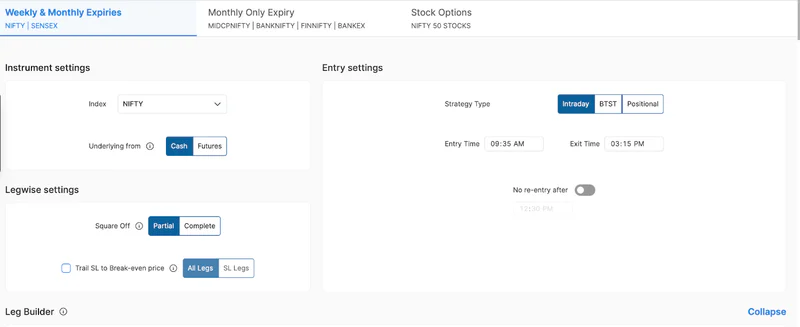
After backtesting, use AlgoTest Paper Trading to observe entries, exits and risk controls with live market data without placing real orders.
Conclusion
The best intraday trading strategy is one that matches the market condition and can be followed consistently. Trend following, breakouts, VWAP pullbacks, range trading, momentum, reversals and scalping each behave differently.
Choose one setup, define its complete rules and test it across different conditions. Risk control, execution costs and discipline matter more than the number of indicators on your chart.
Test Your Intraday Trading Strategy on AlgoTest
Create clear entry and exit rules, backtest them on historical data and paper trade the setup before considering live deployment.