Reading a Sensex option chain is less about finding a single “buy” or “sell” signal and more about understanding how traders are positioned across different strikes. By tracking open interest, change in OI, volume, implied volatility and price action, you can identify important support and resistance zones and assess whether a move has conviction.
Used correctly, the BSE Sensex option chain can support better entries, exits, and position sizing.
What does the Sensex option chain actually show?
The Sensex option chain shows available call and put options across different strike prices and expiries, along with data such as premium, open interest, change in open interest, volume, and implied volatility.
In simple terms, it helps you see where traders are building positions and how option prices are reacting as the index moves.
SEBI’s equity derivatives resource page lists the official BSE options chain source, making it a useful starting point for checking live market data rather than relying only on screenshots or forwarded views. (sebi.gov.in)
For practical trading, focus less on staring at every number and more on identifying clusters. A single strike with high open interest may matter, but a zone with high open interest, strong volume, and repeated price reaction is more meaningful.
This is where sensex oi data becomes useful: it turns a crowded page of numbers into a map of likely support, resistance, and risk.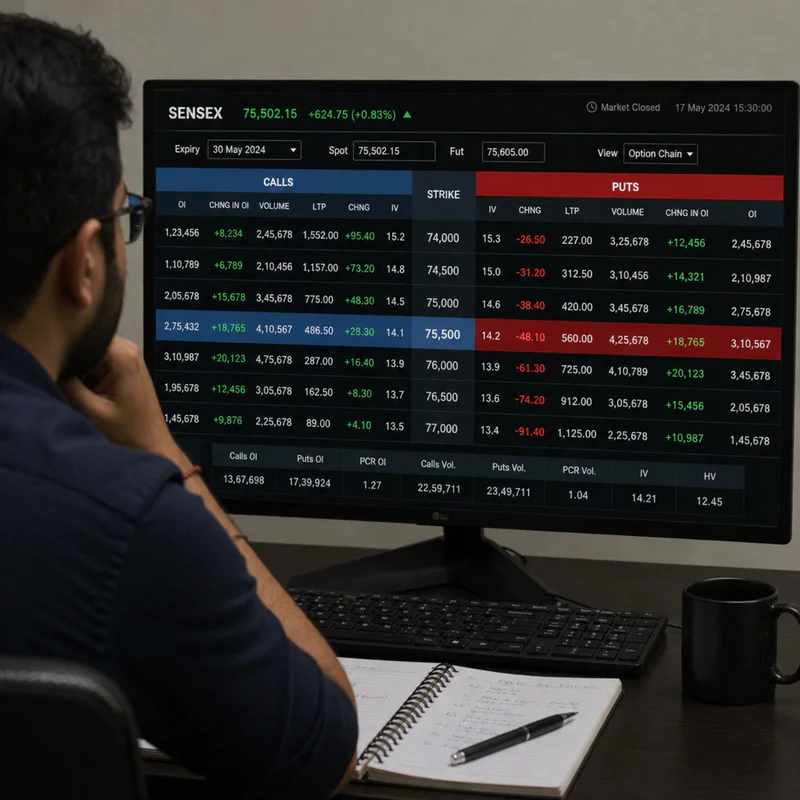
The core data points that matter most
A clean analysis starts with knowing what each column is trying to tell you. You do not need to use every metric, but you should understand the few that influence option prices most directly.
Key fields to track:
Strike price: The price level at which a call or put option becomes relevant for payoff calculations. Nearby strikes usually attract the most attention because they are closest to the current Sensex level.
Open interest: The number of outstanding option contracts. Rising OI often signals fresh position build-up, while falling OI may suggest unwinding.
Change in OI: This helps you see whether traders are adding or reducing positions during the session.
Volume: High volume confirms that a strike is actively traded, but volume alone can be temporary. Pair it with OI.
Premium: The traded option price. Premium reacts to index movement, time decay, volatility, and demand.
Implied volatility: Higher IV generally makes options more expensive; falling IV can hurt option buyers even when direction is correct.
When these fields line up, the option chain becomes more actionable. For example, if call OI is rising sharply above the current index level while put OI is building below it, the market may be defining a short-term range.
Reading open interest like a market map
Open interest is most useful when read comparatively. Look at where call writers appear active, where put writers are defending, and whether fresh OI is being added or removed as price approaches those zones.
A simple approach is to divide strikes into three groups:
At-the-money strikes: Closest to the current Sensex level. These are sensitive to intraday movement and often show the clearest battle between buyers and sellers. (Learn more - ITM vs ATM vs OTM Options)
Out-of-the-money calls and puts: These help identify expected resistance and support zones.
Deep out-of-the-money strikes: These can reveal extreme expectations, hedging, or speculative positioning, but they are less reliable on their own.
If the index rises and call OI at higher strikes keeps increasing, sellers may be trying to cap the move. If the index rises and call OI starts falling, short covering may be supporting momentum.
Similarly, rising put OI below the market may suggest traders are comfortable defending that lower zone, while put unwinding can warn that support is weakening.
Suppose Sensex is trading near 82,000. If 82,500 Call OI is significantly higher than nearby strikes while Put OI is concentrated around 81,500, these levels may act as important reference zones. But don't treat them as fixed resistance and support. Watch what happens to OI as Sensex approaches them.
Track Live SENSEX PCR
The SENSEX Put-Call Ratio, or PCR, compares total Put Open Interest with total Call Open Interest for the selected expiry.
SENSEX PCR = Total Put OI ÷ Total Call OI
A PCR above 1 means Put OI is higher than Call OI. A PCR below 1 means Call OI is higher. However, the ratio should not be treated as a direct bullish or bearish signal.
Use the live SENSEX PCR with:
SENSEX spot-price movement
Call and Put OI
Change in OI
Volume across important strikes
Max Pain
Previous PCR readings
Select an expiry on the SENSEX Option Chain to check its current PCR. Weekly and monthly expiries can show different ratios because each contract has a separate Open Interest structure.
Watch how PCR changes as SENSEX moves. A rising or falling PCR can show a shift in Call and Put positioning, but price, OI and volume should confirm your interpretation.
Read More: Undеrstanding thе Put Call Ratio: A Kеy Indicator for Options Tradеrs
How can Sensex max pain help your analysis?
Sensex max pain is the strike price where option buyers, in theory, would face the maximum combined loss at expiry, based on open interest distribution.
Traders use it as a reference point, not as a guaranteed expiry target. It can be helpful when price is range-bound near expiry, but it becomes less dependable during strong trending moves, event days, or sudden volatility spikes.
The practical way to use max pain is to compare it with live price, OI build-up, and market trend. If the current Sensex level is close to the max pain strike and OI is concentrated around nearby calls and puts, the market may remain sticky. But if price moves far away with strong volume and OI shift, do not assume it must return to max pain.
Use this checklist before acting on max pain:
Is the expiry close enough for max pain to matter?
Is the index trading near the max pain strike, or far away from it?
Are OI shifts confirming the same zone?
Is there a major event, policy announcement, or global cue that could override positioning?
Are premiums already too inflated for a fresh entry?
Related: Sensex Expiry Day: Date, Timing & 2026 Trading Guide
Building a practical Sensex option chain routine
A routine keeps analysis disciplined. Instead of reacting to every premium jump, follow a repeatable process before entering a trade.
Start with the broader trend. Check whether Sensex is above or below important intraday and daily levels. Then open the sensex option chain live view and mark the strikes with the highest call OI and put OI. After that, track whether fresh positions are being added or unwound as price moves toward those levels.
A practical workflow:
Choose the right expiry. Weekly expiries can move quickly, while monthly expiries may give more time but require different premium management. SEBI’s 2024 framework allows each exchange to offer weekly derivatives contracts for only one benchmark index, effective November 20, 2024, so traders should always verify the available expiry before planning a trade. (bseindia.com)
Mark the key strikes. Identify the highest call OI, highest put OI, and the at-the-money strike.
Watch change in OI. Fresh build-up matters more than stale open interest.
Compare price with OI zones. A breakout is stronger when OI unwinding supports it.
Check premium behavior. Avoid chasing options when IV is elevated and risk-reward is poor.
Define exit levels first. Know where your view is wrong before entering.
Related: How to Use Option Greeks in Trading: A Practical Guide for Options Traders
Risk control turns analysis into profitability
The biggest mistake traders make is treating the option chain as a signal generator instead of a decision-support tool. Even a strong setup can fail. Profitability depends on controlling losses, avoiding overtrading, and not increasing size just because a strike looks “obvious.”
Expiry sessions deserve extra caution. SEBI highlighted heightened speculative activity around expiry and introduced an additional 2% extreme loss margin for short options on expiry day from November 20, 2024. (bseindia.com) That is a reminder that expiry trading can be fast, volatile, and unforgiving.
Good risk habits include:
Risk only a fixed percentage of capital per trade.
Avoid illiquid strikes with wide bid-ask spreads.
Do not buy far out-of-the-money options only because they look cheap.
Exit when OI data contradicts your original view.
Reduce size before major events or during sudden volatility expansion.
Common mistakes to avoid
Many traders read the Sensex option chain correctly but still lose money because execution is weak. One common error is assuming high call OI always means the market cannot rise.
If call writers start covering, the same zone can fuel a sharp move upward. Another mistake is using Sensex max pain as a fixed magnet, even when price action and OI shifts clearly disagree.
Also avoid analyzing only one side of the chain. Calls and puts must be read together because the real story is in the balance between resistance, support, and momentum. A single strike price rarely tells the full story.
Analyse the Option Chain, Then Test Your Strategy

The Sensex option chain can help you understand where traders are positioned, but OI, max pain, and other option-chain data should be treated as inputs, not guaranteed trading signals. The real value comes from turning that analysis into a defined strategy and testing whether it works across different market conditions.
With AlgoTest's Options Simulator, you can use historical option chain data to study how a strategy would have performed in real market conditions. Build the setup in Strategy Builder, backtest different variations, and forward test the strategy before risking real capital.
AlgoTest helps options traders move from market analysis to strategy testing and execution. Whether you're studying Sensex OI, evaluating support and resistance zones, or building a multi-leg options strategy, you can test and refine your ideas without writing code.