The Law of One Price
The world of options trading is governed by a set of fundamental relationships, none more critical than the Put-Call Parity principle. This concept establishes a theoretical link between the prices of puts, calls, and the underlying instrument, ensuring that the market remains efficient and free from risk-free profit opportunities.
If you trade options, you need to understand put-call parity. It's a fundamental concept that acts as a simple rule to ensure that the prices of options are fair and consistent. This Law of One Price is what connects the price of a call option, a put option, and the underlying asset (like a stock or a future).
What is Put-Call Parity?
Put-call parity is a simple arithmetic equation. It states that for a call and a put option that share the same underlying asset, the same expiration date (T), and the same strike price (K), their prices must be related in a specific way.
The principle is based on the idea that two portfolios with identical payoffs at expiration must have the same price today to prevent arbitrage. The two portfolios that form the basis of the put call parity formula are:
Portfolio A (Fiduciary Call): A call option plus a zero-coupon bond that pays the strike price (K) at expiration.
Portfolio B (Protective Put): A put option plus share equivalent of the underlying asset.
If the underlying asset does not pay dividends, the relationship is expressed by the following equation:
C + PV(K) = P + S_0
Where:
C = Price of the call option
PV(K) = Present value of the strike price (K), discounted at the risk-free rate (r) for the time to expiration (T). PV(K) = K e^{-rT}.
P = Price of the put option
S_0 = Current price of the underlying asset (stock)
A more practical and often cited form of the equation, particularly in the context of futures or forward contracts, is the Put-Call Forward Parity. This variation replaces the spot price (S_0) with the present value of the forward price (F_0) for the underlying asset.
The simplest way to look at the put call forward parity formula is:
Call Price + Strike Price = Put Price + Future Price
This equation shows that the value of a call option plus the strike price is equal to the value of a put option plus the price of the future contract for the same asset.
This simplified version, which is a direct consequence of the no-arbitrage principle, highlights a key takeaway: the combined value of a call and a cash amount (or its present value) must equal the combined value of a put and the underlying asset (or its future/forward price).
Why does this matter? Because the prices of options and futures are set by supply and demand in the market. The put call parity rule says that even with all that buying and selling, the final prices must follow this equation.
Related: Explore the live Sensex Option Chain on AlgoTest to track call writing, Open Interest, Max Pain, PCR, and strike-wise positioning in one place.
The Big Consequence: Same Implied Volatility
One of the most important things that comes from put call parity is how it affects Implied Volatility (IV).
For a call and a put with the same underlying, same expiry, and same strike, they will always have the same IV.
If you ever see a trading platform that shows a different IV for a call and a put with the exact same details, it means their pricing model is flawed.
What is k in put call parity? The parity principle dictates that the strike price (K) is the common point that forces the IVs to be identical. If they were different, it would create a guaranteed, risk-free profit opportunity.
Put-Call Parity Arbitrage: The Risk-Free Profit
The entire reason this formula exists is to prevent put-call parity arbitrage. Arbitrage is a way to make a risk-free profit by exploiting a price difference.
If the market prices of the options and the underlying asset violate the parity equation, a risk-free profit opportunity is created. For example, if:
C + PV(K) < P + S_0
You can:
Buy the cheaper portfolio (Portfolio A: Buy Call, Buy Zero-Coupon Bond).
Sell the more expensive portfolio (Portfolio B: Sell Put, Sell Underlying Stock).
The combined position is a synthetic short put and a synthetic long call, which locks in a guaranteed profit with zero risk, regardless of the underlying asset's price movement.
In modern, highly liquid markets, such violations are extremely rare and short-lived. High-frequency trading (HFT) algorithms monitor the market for these discrepancies in milliseconds, instantly executing trades to exploit the arbitrage. This rapid action brings the prices back into alignment, which is why the equation holds true in practice.
An Example of Arbitrage
Imagine the equation is violated because the put option is suddenly trading at a much higher price (say, 100 rupees) than it should be. This is a put call parity violation.
A smart trader could execute a three-part trade to lock in the profit:
Buy the Call
Sell the Put (at the inflated price of 100 rupees)
Sell the Future
This combination creates a position where your maximum loss is actually a gain. You've essentially created a beautiful, flat payoff diagram where you profit regardless of the market's direction.
However, for a retail trader, trying to capture this arbitrage is nearly impossible. Today, these opportunities are instantly captured by ultra-low latency software used by High-Frequency Trading (HFT) firms. They see the price difference and execute the trade in the order of nanoseconds.
Related: Call Writing Meaning Explained: How Writing a Call Option Works for Beginners
What Do I Do With Put-Call Parity?
While retail traders cannot realistically capture the nanosecond-level arbitrage opportunities, the parity principle offers valuable insights and practical trading strategies.
1. Synthetic Positions
The parity equation allows traders to create synthetic positions, which replicate the payoff of one instrument using a combination of others.
Example:
Long Call = Long Put + Long Future
Long Call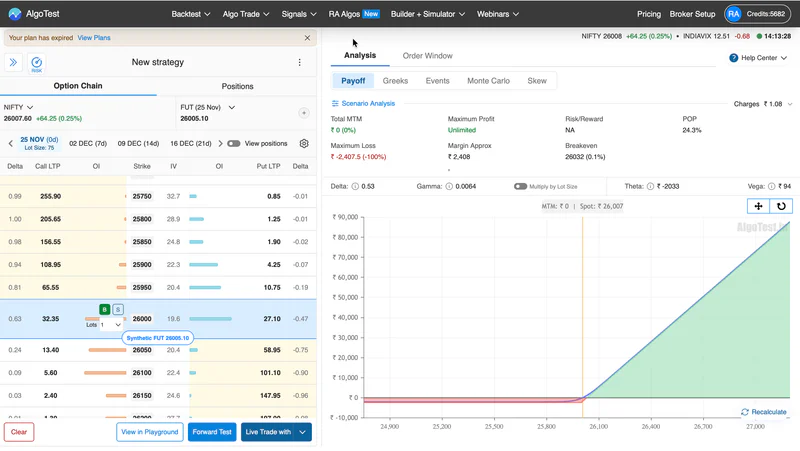
=
Long Put
+
Long Future
2. Managing Illiquid Options
The most practical use for a retail trader is managing positions in illiquid options, especially those that are deep in-the-money and have wide bid-ask spreads.
Imagine you have a deep in-the-money call option that you want to sell, but the bid-ask spread is huge. Selling it at the bid price means you lose a lot of money to the spread.
Instead of selling the illiquid call, you can use put call parity to close your risk by creating a synthetic short position:
Sell the Put (The corresponding put will be deep out-of-the-money and usually much more liquid, with a tiny bid-ask spread).
Sell the Future
By doing this, you have essentially closed your original long call position. Your risk is now flat, and you have avoided paying the huge bid-ask spread on the call. You used the more liquid put and future to exit your risk, which is a massive benefit for a retail trader.
Related: Max Pain in Options Trading: What It Means & How It Works
Conclusion:
The call and put option are intrinsically linked.
What is parity? It is the state of balance where the market is priced correctly, and no risk-free profit exists.
The points of parity definition refers to the specific strike and expiry where this balance must hold true. Understanding this simple rule is key to understanding how options are priced and how you can manage your trades more efficiently.
A live Sensex Option Chain lets you monitor Max Pain, Open Interest, PCR, and strike-wise positioning together, giving you a more complete view of market sentiment before expiry.
Put these concepts into practice with the live Sensex Option Chain on AlgoTest.