A lot of retail traders are turning to algo trading in India, a method where your trades happen automatically based on a fixed set of rules. Instead of sitting and watching the screen all day, you define your conditions upfront: maybe when a price level breaks, an indicator gives a signal, or a specific time in the market hits, and the system does the rest.
Some of the most popular strategies among Indian traders include moving average crossovers, opening range breakouts, VWAP reversion, and options plays like the 9:20 short straddle.
Each of these follows a clear logic, which is exactly what makes them well-suited for automation
What is an Algo Trading Strategy?
An algorithmic trading strategy is simply a set of rules that tells a system when to enter and exit trades.
Instead of manually watching charts and deciding every trade, the strategy follows predefined conditions.
These conditions may include:
technical indicators
price breakouts
time-based entries
volatility conditions
When those rules are met, the system automatically places the trade.
You can also use tools like Signals AI to turn indicator-based ideas into automated strategies without manually coding every rule.
In simple terms, algo trading removes the constant question traders face:
"Should I take this trade right now?"
The strategy already has the answer.
Why Traders Use Algo Trading Strategies
Many traders struggle with emotions while trading.
They hesitate before entering a trade.
They exit profitable trades too early.
Or they hold losing trades longer than they should.
Algo trading strategies solve this by enforcing clear and consistent rules.
Some key advantages include:
disciplined execution
faster order placement
consistent strategy rules
ability to run multiple strategies simultaneously
This is why systematic trading is becoming increasingly popular among retail traders in India.
6 Top Algo Trading Strategies
Let’s look at some strategies that traders commonly automate using algorithmic trading platforms.
1. Moving Average Crossover Strategy
The moving average crossover strategy is one of the simplest strategies to automate.
The idea is to identify trend changes using two moving averages.
Example rules
Entry
Buy when the 9 EMA crosses above the 20 EMA.
Exit
Sell when the 9 EMA crosses below the 20 EMA.
Example
Imagine Nifty is trading around 22,000.
If the shorter moving average (9 EMA) crosses above the longer moving average (20 EMA), the strategy assumes a new upward trend may be starting.
The system automatically enters a trade.
Why traders like it:
simple logic
easy to automate
effective in trending markets
However, during sideways markets, it can generate false signals, so traders often test different moving average combinations.
2. Opening Range Breakout Strategy
This strategy focuses on the first few minutes after the market opens.
The idea is simple: if price breaks the early range, momentum often continues in that direction.
Example rules
Entry
Buy when the price breaks above the first 15-minute high.
Exit
Exit at the target or end of the day.
Example
Suppose Bank Nifty trades between 48,000 and 48,150 during the first 15 minutes.
If price breaks above 48,150, the system enters a long trade automatically.
Many intraday traders automate this strategy because it captures early market momentum.
3. VWAP Mean Reversion Strategy
VWAP stands for Volume Weighted Average Price.
It represents the average price at which an asset has traded throughout the day based on both price and volume.
Prices often move away from VWAP and later return toward it.
This creates opportunities for mean reversion trades.
Example rules
Entry
Sell when the price moves significantly above VWAP.
Exit
Close the trade when the price returns to VWAP.
Example
Suppose a stock suddenly rallies far above VWAP due to short-term momentum.
The strategy assumes the move may be temporarily stretched, so it enters a short trade expecting the price to return toward VWAP.
This strategy works best in range-bound markets.
4. Iron Condor Options Strategy
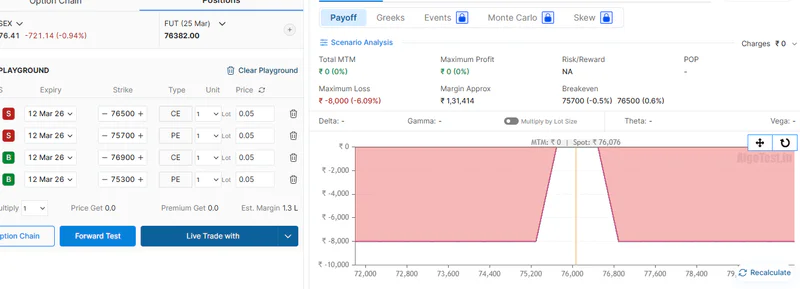
Theiron condor is a popular options strategy used when traders expect the market to remain within a range.
It involves selling both a call and a put while buying further out-of-the-money options to limit risk.
Example structure
Sell OTM call
Sell OTM put
Buy further OTM call
Buy further OTM put
Example
Suppose Nifty is trading around 22,000.
A trader might create an iron condor like this:
Sell 22,300 Call
Sell 21,700 Put
As long as the market stays between these levels, the trader benefits from option premium decay.
Because this strategy involves multiple legs, many traders prefer automating it to ensure accurate execution.
5. Short Straddle Strategy (Popular 9:20 Strategy)

The short straddle is one of the most widely used options strategies among retail traders in India.
The idea is simple: sell both the ATM call and ATM put option at the same strike price and benefit from time decay if the market stays relatively stable.
Example rules
Entry
Sell ATM call, and ATM put at a fixed time (many traders prefer 9:20 AM after the market stabilizes).
Exit
exit at predefined stop loss
exit when profit target is reached
exit before market close
Example scenario
Suppose Bank Nifty is trading at 48,000 at 9:20 AM.
The strategy sells:
48,000 Call
48,000 Put
If the market stays within a reasonable range during the day, both options gradually lose value due to time decay, allowing the trader to capture premium.
Related Read: How to Backtest Rolling Straddles with Indicators
Why the 9:20 entry is popular
The first few minutes after the market opens can be extremely volatile.
By waiting until 9:20, traders allow the initial market noise to settle before entering positions.
Because of this, the 9:20 straddle strategy has become very popular among systematic options traders.
Many traders automate this strategy so the system can:
Identify the ATM strike automatically
Execute both option legs simultaneously
Manage stop losses consistently
Automation helps ensure the strategy executes quickly and without manual delays.
However, like all options selling strategies, proper risk management is essential.
Read More: 920 Straddle Strategy Defined
6. Bollinger Band Mean Reversion Strategy
Bollinger Bands help traders identify overbought and oversold conditions.
When the price moves too far away from its average, it often returns toward the middle.
Example rules
Entry
Sell when the price touches the upper Bollinger Band.
Exit
Close the trade when the price returns to the middle band.
Example
Suppose a stock suddenly spikes and touches the upper Bollinger Band.
The strategy assumes the price may be temporarily stretched, so it enters a short trade expecting the price to revert toward the average.
This strategy works best in sideways or range-bound markets.
Read More: Best Intraday Trading Strategies, Rules and Tips
Benefits of Using Algo Trading Strategies
Algo trading strategies offer several advantages for traders.
Key benefits include:
removing emotional decision-making
executing trades instantly
maintaining consistent trading rules
trading multiple strategies simultaneously
This structured approach is why many traders are shifting toward systematic trading methods.
Read More: Effective Buying Strategies with AlgoTest’s Option Strategy Builder
Limitations of Algo Trading Strategies
While algorithmic trading offers many advantages, it’s important to understand the limitations.
Some challenges include:
strategies may stop working when market conditions change
Poor risk management can lead to losses
Execution delays, or slippage, which may impact results
Successful traders constantly monitor and adapt their strategies.
Build, Backtest, and Deploy Trading Strategies with AlgoTest
AlgoTest allows traders to build, analyze, and deploy trading strategies in a structured way. Traders can define clear rules, study how strategies behave under different market conditions, and automate execution to maintain discipline.
For traders looking to move beyond discretionary trading, the goal is simple:
Move away from emotional decisions and toward structured, rule-based trading.
That’s the foundation of long-term systematic trading.
Additional Resources
🛠️ Trading Tools
Read More: Trading Strategies that Don't Work
A Step-by-Step Guide to Backtesting Trading Strategies
How AI is Changing Algo Trading in India
Disclaimer
This article is for educational purposes only and should not be considered financial or investment advice. The strategies discussed are examples used by traders to understand how algorithmic trading works.
Traders should conduct their own research, testing, and risk management before implementing any strategy in live markets.
Please refer to our Product doc to master the AlgoTest platform.