If you are a beginner or a manual trader wondering how to do algo trading, start with the fundamentals and a clear step-by-step checklist.
In algorithmic trading, a computer automatically places trades based on rules you define.
Traders set key parameters, such as price levels, entry and exit conditions, timing, and position size (which we’ll cover in the next sections), and the system executes them consistently.
However, many traders make the mistake of relying fully on automation without understanding market behaviour, costs, and risks.
This blog explains how to do algo trading step by step, using a practical checklist that beginners can follow to start trading more systematically and efficiently.
AlgoTrading Step by Step
Algo trading removes emotional decisions and brings in logic and speed, but it still requires a strong strategy and proper planning. Automation does not create profits on its own; it simply executes the logic you define.
Step 1: Start by Creating a Strategy Based on Market Understanding
First, try to understand how the market behaves to create a strategy that suits your trading goals and style.
For example, some traders build strategies around price movements, others focus on volatility, while some follow longer-term trends. You may use strategies like short straddles, long straddles, spreads, or directional setups depending on market conditions.
AlgoTest provides ready-to-use templates that can help you convert your ideas into structured strategies. 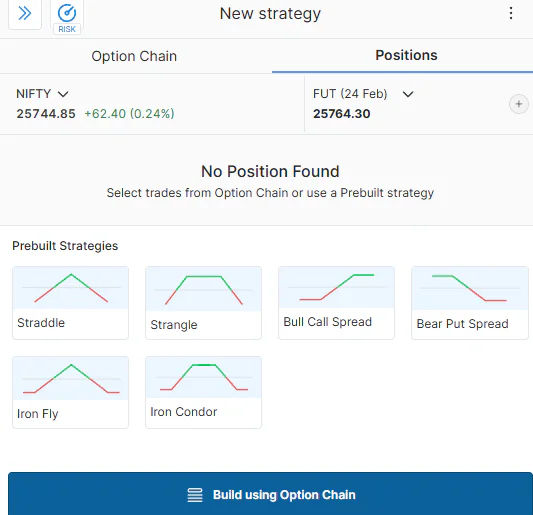
Once you have a strategy idea, define the following clearly:
Trading Style (Intraday, Positional, or BTST)
Your trading style defines how long positions are held and how quickly your system needs to execute trades.
Intraday: Trades open and close within the same day. Example: a 9:20 breakout strategy or intraday options selling setup. Requires faster execution and active monitoring but avoids overnight risk.
Positional: Trades are held for several days or weeks to capture bigger market trends. For example, a trend-following futures trade or an options strategy based on a longer-term view. These don’t need very fast execution but carry overnight market risk.
BTST (Buy Today Sell Tomorrow): Trades are taken today and usually exited the next trading day. For example, buying based on strong momentum with the expectation that the price will continue moving the next day.
Choosing the right trading style helps define risk exposure, execution speed, and overall strategy structure.
Market Focus (Options or Futures)
Decide which instruments you want to trade.
Options: Suitable for volatility-based strategies like straddles, iron condors, or hedged directional trades.
Futures: Often used for directional or trend-following strategies due to simpler price movement structure.
Each market behaves differently, so your strategy logic should match the instrument.
Check out all AlgoTest features here.
Capital Allocation
Define how much capital you will dedicate to the strategy.
Example:
Allocate ₹1 lakh for a single options strategy instead of using your entire trading capital.
Split capital across multiple strategies to reduce risk concentration.
Clear capital allocation prevents overexposure and helps maintain disciplined risk management.
Acceptable Drawdown
Decide the maximum loss you are willing to tolerate during losing periods.
Example:
If your capital is ₹2 lakh, you may define a 10–15% maximum drawdown limit.
Once this limit is reached, the strategy pauses or is reviewed.
This helps avoid emotional decisions during temporary losses.
Trading Frequency
Determine how often your strategy should trade.
High-frequency: Multiple trades per day (requires strong execution and cost control).
Daily: One or a few structured setups per day.
Occasional: Trades only when specific market conditions appear.
Step 2: Convert Your Idea Into Rule-Based Logic
To automate your trading idea, you need to convert it into specific rules that a computer can understand and execute without confusion.
Think of it this way: when you trade manually, you might say, “I feel this is a good trade.” But an algorithm needs exact conditions like what to do, when to do it, and how much to trade.
Entry rule example:
Enter a trade when the 20-period moving average crosses above the 50-period moving average, and the price is above the day’s opening price.
Exit rule example:
Exit the trade when either:
a 10% profit target is reached, or
the price falls below the 20-period moving average, or
at 3:15 PM before market close (time-based exit).
Stop loss — A preset level where the trade automatically closes if the market moves against you. This helps protect your capital and removes emotional decisions.
Position sizing — Decide how much money or how many lots to trade each time. Proper sizing prevents you from risking too much on one trade.
Time filters — Rules that control when your strategy can trade. For example, only after market open, avoiding low-volume periods, or closing trades before expiry.
Step 3: Execution Logic
In Algo trading, execution rules ensure orders are placed correctly.
Order type — Decide how the trade should be placed, such as instantly at market price or at a specific price using a limit order.
Fill confirmation — Make sure the system checks that an order is actually executed before moving to the next step.
Duplicate order protection — Prevent the system from placing the same order multiple times by mistake.
Timeout logic — Automatically cancel or adjust an order if it is not executed within a set time.
Execution settings at AlgoTest let you customise your orders to help reduce technical risks during live trading.
Step 4: Backtesting (Where Beginners Make the Biggest Mistakes)
Backtesting means testing your strategy on historical market data.
It helps identify strengths, weaknesses, and risks before trading with real money.
When backtesting your strategy, focus on these points:
Test in different market conditions — Check how your strategy performs in trending markets, sideways markets, and high-volatility periods. A strong strategy should not depend on only one type of market.
Include transaction costs — Always add brokerage fees, slippage, and other charges. Ignoring these costs can make your results look better than they actually are.
Avoid overfitting — Do not keep changing settings just to make past results look perfect. Strategies that are too optimised for past data often fail in live markets.
Check drawdown and consistency — Do not look at profits alone. Check the biggest losses (drawdown), risk levels, and whether the performance is steady over time.
Remember, backtesting is a validation tool and cannot guarantee future results.
AlgoTest allows you to backtest your strategy with over 7 years of data, with multiple features to optimise your trading strategies.
Step 5: Forward Testing (Paper Trading Before Going Live)
After backtesting, the next step is forward testing.
Forward testing means testing your data with virtual money( paper trading) in conditions mimicking the live market. It helps you check if the strategy performs well in real-time markets as well.
Why this is important:
Markets change constantly.
Live prices move differently from historical data.
Slippage and execution delays become real factors.
During forward testing, focus on:
Execution accuracy — Are trades getting executed at expected prices?
Strategy behaviour — Is it following the rules exactly as designed?
Emotional discipline — Can you trust the system even during small losses?
Forward testing acts like a final safety check. Once your strategy performs consistently in both backtesting and forward testing, you can move to live trading with controlled capital.
Read more: Difference between backtesting, forward testing, and algo trading results.
Step 6: Choose Your Algo Trading Setup
After defining your rules and validating them through backtesting, you need the right setup to automate execution. Today, traders can choose between coding-based systems and no-code algo trading platforms depending on their experience and technical skills.
Coding Route
APIs — Connect directly with brokers using APIs to automate order placement and strategy execution
Python or programming languages — Many traders use Python to build custom strategies and automation workflows.
Infrastructure setup — Requires servers, monitoring systems, and technical knowledge to maintain reliability.
This offers flexibility but usually requires coding skills.
No-Code Platforms
Visual strategy builders — Create strategies using simple logic without writing code.
Faster deployment — Reduce setup time by using pre-built tools and integrations.
Beginner-friendly interface — Ideal for traders who want to focus on strategy rather than technical setup.
AlgoTest makes algorithmic trading more accessible to retail traders by simplifying strategy creation, backtesting, and execution into one workflow.
Step 7: Risk Management & Compliance (India Context)
Even the best trading strategy can fail without proper risk management. Since algo trading executes rules automatically, it is even more important to define risk controls before going live.
Key risk management elements include:
Position sizing— Decide how much capital to risk on each trade. Avoid allocating too much to a single position. AlgoTest allows you to define lot sizes and capital exposure within your strategy rules.
Maximum daily loss — Set a daily loss limit where trading stops automatically after reaching a predefined level. This helps prevent emotional decisions during drawdowns.
Stop-loss rules — Every strategy should include predefined exit levels to control downside risk. Automated stop-loss settings ensure disciplined exits without manual intervention.
Diversification — Avoid relying on just one strategy or one instrument. Running multiple strategies or setups can improve stability over time.
Kill switch or emergency stop — Define conditions where trading automatically pauses if unusual behaviour or risk thresholds are triggered.
AlgoTest includes built-in risk management controls and execution safeguards so traders can follow structured, rule-based trading while staying aligned with regulatory standards.
AlgoTest is NSE and BSE-empanelled and follows SEBI guidelines, helping traders operate within compliant algo trading practices.
Read more: Top Tradetron alternatives in India
Step 7: Trading Filters — When NOT to Trade
A strong algo system also defines when to avoid trading:
News events
Low liquidity
Volatility spikes
Daily drawdown limits reached
Avoiding bad conditions is as important as finding good setups.
AlgoTest provides DTE and budget day filters to help you create optimised strategies.
Step 8: Deploy, Monitor & Improve
Algo trading is not “set and forget.”
Even after going live, your strategy needs regular monitoring and improvement.
Once deployed, focus on:
Performance metrics — Track key numbers like profit and loss, win rate, drawdown, and risk-reward ratio. Make sure the strategy is performing close to your backtest expectations.
Market regime changes — Markets do not stay the same. A strategy that works well in trending markets may struggle in sideways or highly volatile conditions. Watch how your strategy behaves when market conditions change.
Strategy decay — Over time, some strategies stop working as market behaviour evolves. If performance drops consistently, review and adjust your rules instead of blindly continuing.
Regular monitoring helps you stay in control. The goal is not just to automate trades but to continuously improve and adapt your system for long-term success.
Make Algo Trading Journey Easy with AlgoTest
At AlgoTest, our mission is to make algorithmic trading simple and accessible by providing tools and features for systematic rules-based trading.
Here’s why starting algo trading is easier now:
No-code strategy builder — Traders can build rule-based strategies using visual tools instead of writing complex code.
Built-in backtesting tools— Platforms allow quick testing using historical data without needing external software.
Visual workflow builders — Clear interfaces help traders convert ideas into structured logic step by step.
Faster deployment — Strategies can move from testing to live execution quickly through integrated systems.
Multi-leg strategy support — Complex options strategies can be automated without manual calculation or monitoring.
Integrated broker connectivity — Direct broker integration reduces setup complexity and technical errors.
Real-time analytics dashboards — Traders can track performance, risk, and execution from one place.
Built-in risk controls — Features like stop-loss automation and capital limits improve safety.
Unified workflow — Strategy creation, testing, and execution can now happen within a single platform.
Sign up today and get 25 backtests/week free.
Today, with modern tools and simplified platforms, getting started with algo trading is more accessible than ever. By following a clear checklist and focusing on strong fundamentals, traders can build systems that are logical, repeatable, and scalable over time.
Start simple, test thoroughly, and improve gradually, because successful algo trading is built on consistency, not complexity.