Is Options Trading Actually Profitable in India?
Yes, options trading can be profitable, but only for a small minority. SEBI’s study found 91% of individual F&O traders lost money in FY25, while proprietary traders and FPIs, who mostly use algorithmic strategies, earned most of the profits.
How Is Options Trading Different from Buying Stocks?
Options are not stocks. Treating them the same is the fastest way to lose money.
When you buy a stock, you own a piece of a company. Time is on your side.
With options, you are buying a contract. It gives you the right (not the obligation) to buy or sell an asset at a fixed price, called the strike price, before a fixed date called theexpiry. You pay a fee called the premium for this right.
Three forces make options work differently from stocks.
What Is Time Decay and Why Does It Hurt Option Buyers?
With each passing day, your option loses a small amount of value. Even if the market does not move.
This daily erosion is called Theta. Think of it like ice melting in your hand. The longer you hold, the less you have left.
If you buy a weekly Nifty call on Monday and the market stays flat, by Thursday, you have lost a meaningful portion of your premium. Not because the market moved against you. Just because time passed.
This is the number one reason beginners lose money in options. Understanding how to read premium behavior before entering a trade can save you from this trap. A straddle chart is one practical way to track whether time decay is dominating the market on a given day.
Replay any past market day in the AlgoTest Option Simulator and see how your trade would have played out, free and without risking a rupee.
What Is Implied Volatility and What Is an IV Crush?
Implied Volatility (IV) tells you how much movement the market is expecting. When IV is high, options are expensive. When it drops suddenly, option values fall fast.
This sudden drop is called an IV Crush. It usually happens right after a major event like an RBI policy announcement or quarterly earnings.
A trader buys a call before the Budget expecting a big move. The stock moves 1.5% in the right direction. The option still loses value. Why? Because the market had already priced in a 3% move. Once the event passed, IV collapsed and took the premium down with it.
This surprises most beginners. Now it will not surprise you. For a full breakdown of how IV works and how to read it, this guide on implied volatility covers ATM IV, interpretation, and calculation.
How Does Leverage Work in Options?
Options give you high leverage. A 2% move in Nifty can mean a 40 to 70% change in your option's value.
This is why people love options. And why accounts get wiped out fast. Leverage amplifies everything, including mistakes.
Learn more about options here.
Who Actually Makes Money in Options Trading?
Mostly option sellers, not buyers.
SEBI's FY24 data shows that proprietary traders who mostly sell options using algorithmic strategies were profitable in over 97% of cases. Individual retail buyers were largely losing.
The logic is simple. When you sell an option, you collect premium upfront. Time decay works in your favor. You profit as long as the market does not make a large move before expiry.
Buyers need three things to go right at the same time: direction, size of move, and timing. Get one wrong and you lose.
This does not mean buying options never works. High-conviction directional trades with tight timing can work well. But the default lean of profitable retail traders is toward selling, with defined risk on the other side.
Here is a deeper look at how to optimize selling strategies with options.
What Options Strategies Actually Work?
The right strategy depends on what you expect the market to do. Using the wrong strategy for the market condition is like wearing a raincoat in a desert.
Here is a simple breakdown.
Bull Call Spread: Good for Beginners with a Bullish View
This is one of the cleanest beginner strategies because you know your maximum loss before you enter.
Say Nifty is at 22,000. You buy the 22,000 Call at Rs. 200 and sell the 22,500 Call at Rs. 80. Your net cost is Rs. 120. If Nifty crosses 22,500 at expiry, your maximum gain is Rs. 380. If it falls below 22,000, you lose Rs. 120 and nothing more.
Clean, defined, no surprises. You can explore more strategies like this across different market views in this overview of options trading strategies.
Iron Condor: For Sideways Markets
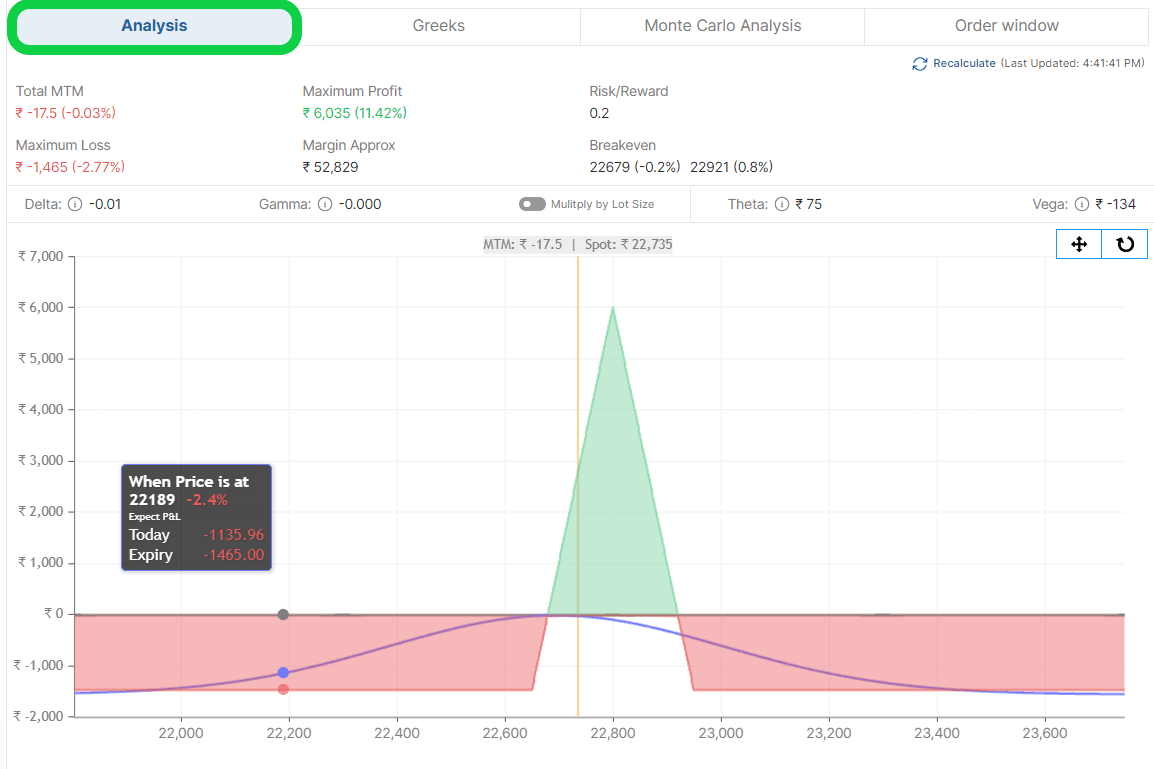
The Iron Condor works best when you expect the market to stay within a range till expiry.
You sell an out-of-the-money call and an out-of-the-money put, then buy further out-of-the-money options to cap your risk. You collect net premium and profit as long as the market stays inside your defined range.
On Indian indices like Nifty or Bank Nifty, this can generate consistent returns during low-volatility periods. But it needs active monitoring. If the market breaks out hard, you need a clear exit plan. For a step-by-step walkthrough of building this on a real platform, see how to set up a monthly Iron Condor using AlgoTest's Strategy Builder.
Bear Put Spread: For a Moderately Bearish View
Use this when you expect a measured decline, not a crash.
You buy a put at a higher strike and sell a put at a lower strike. The sold put reduces your net cost and makes it easier to reach breakeven.
Options Chart: How to Read Nifty, NSE & Sensex Option Chain Chart
Why Do Most Options Traders Lose Money?
Most losses are not bad luck. They are the same mistakes made repeatedly.
Buying cheap out-of-the-money options hoping for a big payoff. These expire worthless most of the time. The low price reflects the low probability.
Ignoring India VIX before entering a trade. Most beginners never check it before placing a trade.
Oversizing positions. Because options need less upfront capital, traders put far more at risk than they realize. One bad day can cause serious damage.
No exit plan. Every trade needs a predefined stop-loss and a target before you enter. "I will exit when it feels right" is not a plan.
Trading around events without understanding IV crush. Buying options before Budget day, RBI policy, or earnings results without knowing how IV collapse works has cost thousands of retail traders real money.
Start with a tested strategy
Building a strategy from scratch is where many traders go wrong. Explore RA Algos to pick a ready-made strategy from a SEBI-registered research analyst, backtest it, then deploy it with your broker.
What Returns Can You Realistically Expect?
Skip the promises of 10x monthly returns. Here is what consistent, disciplined traders actually achieve.
Beginners in their first year should focus on not losing big. Treat it as paid learning. Intermediate traders with one to three years of experience can realistically target 15 to 30% annualised returns on their options capital. Advanced full-time traders sometimes achieve more, but that requires large capital and years of structured practice.
For context, the Nifty 50 index has historically returned around 12 to 14% annually. Beating that consistently through options requires real skill, not just activity.
Is Options Trading Right for You?
Options are not for everyone. Knowing this before you start saves you real money.
You are probably ready if you already understand how stock markets work, you can absorb potential losses without financial stress, and you have at least Rs. 2 to 3 lakhs in capital. Smaller amounts make position sizing impractical.
Wait if you are completely new to investing, if you need this money to work urgently, or if you cannot actively monitor positions around weekly expiry.
If you want to practice strategies risk-free before going live, this roundup of the best paper trading websites in India compares the top platforms you can start with today.
Should You Backtest Your Options Strategy Before Going Live?
Yes, always. Skipping this step is one of the most expensive mistakes new traders make.
Backtesting means running your strategy on historical data to see how it would have performed in the past. It does not guarantee future results, but it helps you spot obvious weaknesses before they cost you real money.
Many traders also paper trade their strategies in live market conditions before committing capital.
Trade like the profitable minority
SEBI’s data shows the winners use rule-based, tested strategies. Backtest your options strategy on 7.5+ years of market data to see its real win rate and drawdown before you trade it live.
How Is Options Trading Taxed in India?
Options profits are treated as business income in India and taxed at your applicable income tax slab rate.
You file ITR-3 as an active F&O trader. Losses can be offset against other business income in certain cases. STT applies on options contracts at the time of sale. Keep a detailed trade log throughout the financial year.
If your trading income is significant, a CA who understands F&O taxation is worth the cost.
Options Trading on AlgoTest
While the industry average sat at 9% profitable traders in FY24, 45% of AlgoTest users ended the same year in profit. Not because the platform trades for you, but because it forces you to build, test, and validate a strategy before putting real money on the line.
That edge is learnable. Here is where to start:
Learn the basics: calls, puts, strike price, expiry, and the key option Greeks
Start with defined-risk strategies like spreads before touching naked options
Check India VIX before every trade
Never risk more than 2 to 3% of your capital on a single trade
Backtest your strategy and paper trade it before going live
Track every trade with notes on what worked and why
The market will always be there. The capital you protect while learning is what funds the trades that actually make you money.
Start with free backtests on AlgoTest and see how your strategy would have actually performed before risking a single rupee.
Sources:
SEBI Study on F&O Traders (2024): sebi.gov.in
India VIX Data: NSE India (nseindia.com)
Nifty 50 Historical Returns: NSE India
F&O Taxation Guidelines: Income Tax Department (incometaxindia.gov.in)
Disclaimer: This article is for educational purposes only. Options trading involves substantial risk. Please consult a SEBI-registered investment advisor before making financial decisions.