Implied vs Realized Volatility
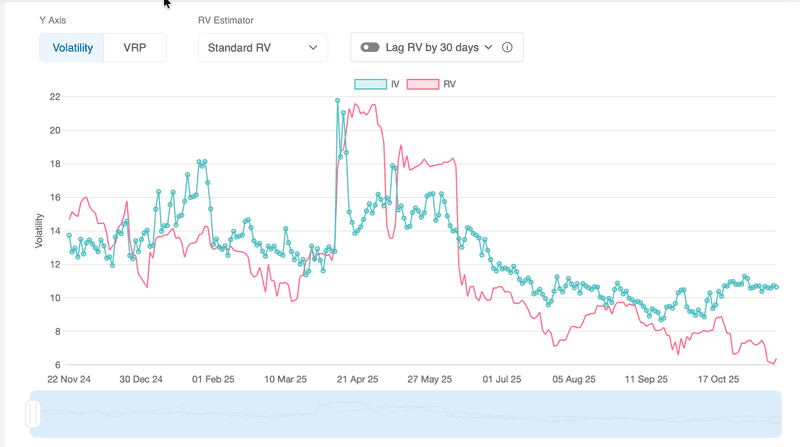
Term | Definition | Context |
|---|---|---|
A forward-looking metric that represents the market's expectation of the future volatility of an underlying asset's price over the life of the option contract. | IV is not directly observable; it is derived by plugging the current market price of an option into an options pricing model (like Black-Scholes) and solving for the volatility variable. Higher IV generally leads to higher option premiums. | |
Also known as historical volatility, it is a measure of the actual price fluctuations of an underlying asset over a specified past period. | RV is a backward-looking measure, in contrast to the forward-looking nature of IV. Traders often compare IV to RV to determine if an option is relatively cheap or expensive. | |
Options Premium | The price paid by the buyer to the seller (writer) for an option contract. | The premium is composed of two parts: Intrinsic Value (the option's in-the-money value) and Extrinsic Value or Time Value (which is heavily influenced by Implied Volatility and time until expiration). |
Moneyness and Implied Volatility
The terms ITM, OTM, and ATM describe an option's moneyness, which is the relationship between the underlying asset's current price and the option's strike price.
At-the-Money (ATM)
Term | Definition | Context |
|---|---|---|
At-the-Money (ATM) | An option where the underlying asset's current price is equal to or very close to the option's strike price. | ATM options have the highest Time Value (Extrinsic Value) because the probability of the option moving in-the-money is highest. |
ATM IV | The Implied Volatility of an At-the-Money option. | This is often used as a benchmark for the general volatility expectation of the underlying asset. |
In-the-Money (ITM)
Term | Definition | Context |
|---|---|---|
In-the-Money (ITM) | An option that has Intrinsic Value and would result in a profit if exercised immediately. | Call Option: Underlying Price > Strike Price. Put Option: Underlying Price < Strike Price. |
ITM IV | The Implied Volatility of an In-the-Money option. | ITM call strike (put strike) is the same as OTM put strike (call strike). So IV tendency is the same as OTM options due to put-call-parity |
Out-of-the-Money (OTM)
Term | Definition | Context |
|---|---|---|
Out-of-the-Money (OTM) | An option that has no Intrinsic Value and would expire worthless if the underlying price remained unchanged. Its value is purely Extrinsic Value (Time Value). | Call Option: Underlying Price < Strike Price. Put Option: Underlying Price > Strike Price. |
OTM IV | The Implied Volatility of an Out-of-the-Money option. | In equity markets, OTM Puts typically have a higher IV than ATM options (Skew), while OTM Calls may have a lower IV. In currency markets, both OTM Calls and Puts may have higher IVs (Smile). |
IVP vs IVR

Term | Definition | Context |
Implied Volatility Percentile (IVP) | IVP tells you where the current Implied Volatility (IV) stands compared to its own historical IV values over a selected period (typically 1 year). Example: If IVP = 80, it means current IV is higher than 80% of the IV values from the past year. | High IVP → Options are historically expensive. Low IVP → Options are relatively cheap. Traders use IVP to compare IV against itself, not against other stocks. |
Implied Volatility Rank (IVR) | IVR measures the current IV relative to the range of IV in the past year (highest IV vs. lowest IV). Example: If the IV range for a year is 10–30 and current IV is 25: IVR = (25 – 10) / (30 – 10) = 75% | IVR shows where the current IV lies within the 52-week high–low band. Useful when historical IV distribution is uneven (e.g., lots of extreme events). |
|
|