Most traders learn what "square off" means after they make a mistake with it. Let's make sure that's not you.
Whether you just opened your first F&O account or you've been trading for a while but never fully understood this term, this guide breaks it down simply. No jargon overload. No fake data. Just what you actually need to know.
Square Off Meaning in Trading
Square off means closing an open trade by executing the opposite transaction of the same quantity.
That's the whole definition. If you bought, you sell to square off. If you sold (shorted), you buy back to square off. Once done, your position becomes zero and your profit or loss is realized.
Think of it like a parking ticket. You took the spot (opened a trade). Squaring off means you've paid up, packed up, and driven away. The spot is no longer yours.
In the share market, square off applies across intraday trades, futures, and options. But in options trading specifically, it carries a lot more weight, because options have expiry dates and the consequences of not squaring off can get expensive fast.
How Square Off Works in Options Trading
Options work differently from stocks. Every position you take has a direction and a lifespan. Squaring off reverses that direction with the same strike price, same expiry, and same quantity.
Here is a simple breakdown:
The rule is straightforward: same strike, same expiry, same quantity, opposite direction.
On NSE, this process happens through your broker's trading terminal. You find your open position, click sell (or buy), and the position closes. Most brokers also show your realized P&L the moment you square off.
Related: What is Basket Trading
Why Square Off Matters More in Options
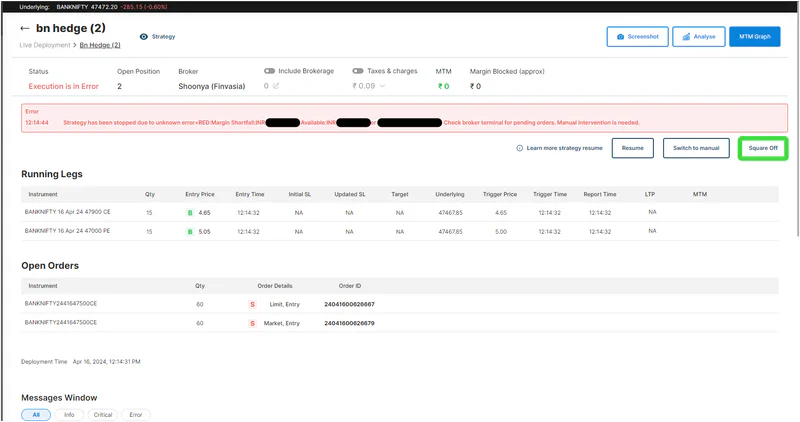
People often treat square off as a boring formality. It is not. In options trading, it directly affects how much money you keep or lose. Here is why.
Theta Eats Your Premium Every Single Day
Options lose value daily because of time decay, which traders call theta. If you buy an option and hold it without a clear exit plan, theta quietly reduces your premium even when the stock price does not move.
Squaring off at the right time locks in your profit or caps your loss before theta does further damage. According to NSE's options education material, time decay accelerates significantly in the last week before expiry. Holding options without a plan in that window is a fast way to watch value disappear.
Related Read:5 Expert Tips for Mastering Expiry Day Trading
Expiry Risk Can Actually Cost You Shares
If you hold a stock option that expires in the money and you do not square off, physical settlement kicks in. SEBI mandated physical settlement for stock F&O contracts through a circular in 2018, which means you either deliver shares or receive them, depending on your position.
This catches a lot of traders off guard. You thought you were just trading premium, and suddenly your broker is asking for full delivery margin. Squaring off before expiry avoids this entirely.
Index options like Nifty and Bank Nifty are cash settled, so expiry there is not a physical delivery risk. But the P&L is still final at expiry price, and you lose control of your exit if you wait until then.
Related Read:How to Choose the Right Expiry Date for Options
Liquidity Gets Thin and Spreads Widen
Options near expiry or deep out of the money have very few buyers and sellers. When liquidity drops, the bid-ask spread widens, which means you end up selling cheaper or buying more expensive than the fair price. Traders call this slippage.
Squaring off during active market hours, when volume is healthy, gives you a cleaner exit at a better price.
Related Read:How to Read Nifty Option Chain Like a Pro
It Frees Up Your Margin Immediately
For option sellers, a large chunk of capital sits blocked as margin for as long as the position is open. The moment you square off, that margin is released and becomes available for new trades. This matters a lot for traders who work with limited capital.
Related Read:How Margin Works in Options Trading
Types of Square Off in Options Trading
Not all square offs look the same. Here are the main types you will come across:
Intraday Square Off: You open and close an options position within the same trading day. Common for traders taking short-term directional bets on index options based on news, levels, or price action.
Positional Square Off: You hold the options position for multiple days or weeks, then square off when your target or stop-loss is hit. Common in swing trading and hedging strategies.
Partial Square Off: You close only part of your position. For example, you bought 5 lots of Nifty options and square off 3 lots at your profit target, letting the remaining 2 lots run. This is a practical risk management tool.
Auto Square Off: If you do not close your intraday position yourself, your broker closes it for you, automatically, near market close. This is called auto square off.
Related Read:Build and Test Your Options Strategy Before Going Live
Auto Square Off: What Every Options Trader Must Know
Auto square off is where many new traders get surprised. And not in a good way.
On NSE, the market closes at 3:30 PM. Most brokers in India execute auto square off for open intraday F&O positions between 3:20 PM and 3:25 PM. If you have not closed your position by then, the broker closes it at whatever market price is available at that moment.
Two problems come with this. First, you have no control over the execution price. In a volatile session, this can result in a significantly worse exit than if you had squared off ten minutes earlier yourself. Second, brokers charge an auto square off penalty, typically between Rs. 20 and Rs. 50 per order, on top of normal brokerage.
You pay more. You get a worse price. Both at once.
The fix is simple: always square off your own intraday positions before 3:15 PM. Do not hand that control to your broker.
Related Read:How to Backtest Your Exit Rules Before Trading Live
What Happens If You Don't Square Off an Options Position?
This is the question most options guides skip. Let's answer it clearly.
If the option expires Out of the Money (OTM): The option expires worthless. Buyers lose the premium they paid. Sellers keep the premium they collected. The position closes automatically. No action needed.
If the option expires In the Money (ITM) and it's a Nifty or Bank Nifty option: These are cash settled. NSE calculates the intrinsic value at expiry and settles your P&L directly in your account. You still do not need to square off, but you also lose the ability to choose your exit price.
If the option expires ITM and it's a stock option: Physical settlement applies as per SEBI's circular. As a call buyer, you receive shares. As a call seller, you deliver shares. If you do not have the shares or the capital, your broker may levy penalties and handle the short delivery, which is expensive.
The clear takeaway here: for stock options, always square off before expiry unless you specifically want physical settlement.
Related Read:Bank Nifty Expiry Day Explained: Date, Rules and Best Strategies
Common Square Off Mistakes Options Traders Make
Waiting until 3:25 PM to exit: Liquidity is thin, spreads are wide, and you end up with a worse price than you deserved. Exit when the market is still active.
No exit plan before entering: Many traders plan their entry carefully and forget about the exit entirely. Know your take-profit level and stop-loss before you buy the first lot.
Averaging a losing options position: This works sometimes in stocks. In options, it rarely works because of time decay. Adding to a losing options position hoping for a reversal is how traders go from a small loss to a large one.
Ignoring auto square off charges: These charges are small individually but add up over time. More importantly, the poor execution price that comes with auto square off hurts more than the fee itself.
Quick Practical Tips for Squaring Off in Options
Set price alerts on your broker app at your target level so you never miss an exit window.
For intraday trades, aim to square off between 3:00 PM and 3:15 PM at the latest.
If you bought an option and 50 to 60 percent of the premium has eroded but price has not moved, square off. Theta is doing the damage, and it will not stop.
Use Good Till Triggered (GTT) orders where your broker supports them. They help automate exits without you having to watch the screen constantly.
For option sellers near expiry, square off even if the option looks safely OTM. The gamma risk in the last few hours of expiry can cause violent price moves.
Related Read:Best Indicators to Time Your Options Exit Better
Related Read:Practice Squaring Off Without Risking Real Money
Square Off vs Exit: Is There a Difference?
Traders use both terms interchangeably, and for practical purposes, they mean the same thing.
Technically, "exit" is a broader term that can refer to closing any position in any asset. "Square off" specifically refers to offsetting a position with an equal and opposite trade in derivatives markets. In everyday options trading on NSE or BSE, both mean the same outcome: your position closes, your P&L is realized, and your margin is released.
Summary
The traders who last in options trading are not always the smartest ones in the room. They are usually the most disciplined about exits. Squaring off on time, with a plan, is the simplest discipline you can build.
Sources:
- NSE India, Options Trading and Expiry Settlement Guidelines: nseindia.com
- SEBI Circular on Physical Settlement of Stock Derivatives (SEBI/HO/MRD/DP/CIR/P/2018/167): sebi.gov.in
- NSE Market Timings and Trading Hours: nseindia.com/trade/trading-hours