Every options trade starts with one question: Is this premium worth it?
Whether you are selling covered calls on Nifty or buying puts before an event, the premium is the price you pay or collect. Get it wrong and you are trading blind. Understand it and you have an edge most retail traders never build.
This guide covers what option premium is, what moves it, and how to calculate it instantly using AlgoTest's Black-Scholes calculator.
What Is Option Premium?
Option premium is the price a buyer pays to get an options contract. It is also the amount a seller receives for taking on the obligation that comes with it. The buyer pays it upfront. It is non-refundable.
When you see Nifty 24,000 CE trading at Rs. 180, that Rs. 180 is the premium. The buyer loses it if the trade goes against them. The seller keeps it if the option expires worthless. Both sides are pricing the same risk, just from opposite sides of the trade.
The Two Components of Option Premium
Every option premium has two parts. Understanding each one separately is what separates informed traders from the rest.
1. Intrinsic Value
Intrinsic value is the in-the-money portion of a premium. It only exists when the option has real value right now, not just at expiry.
For a Call Option: Intrinsic Value = Spot Price minus Strike Price (if positive; otherwise zero)
For a Put Option: Intrinsic Value = Strike Price minus Spot Price (if positive; otherwise zero)
Example: Nifty is at Rs. 24,200. A 24,000 CE has intrinsic value of Rs. 200. A 24,500 CE has zero intrinsic value because it is out-of-the-money (OTM).
OTM and ATM options carry zero intrinsic value. Their full premium is made up of extrinsic value.
2. Extrinsic Value (Time Value)
Extrinsic value is what the market pays on top of intrinsic value. It is the price of possibility. It reflects three things:
Time remaining to expiry: More time means more chances for the market to move in your favour.
Implied Volatility (IV): Higher IV means a higher chance of a large move, so the premium goes up.
Interest rates: A smaller factor, but it matters for longer-dated options.
Extrinsic Value = Option Premium minus Intrinsic Value
An ATM option close to expiry with low IV might carry Rs. 20 of extrinsic value. The same strike with 30 days left during a high-volatility period could carry Rs. 150. Same strike, very different price. The market's expectation of movement has changed.
The 5 Factors That Drive Option Premium
1. Underlying Price (Spot)
This is the most direct driver. When the spot price rises, call premiums go up and put premiums go down. The speed of this change is measured by Delta.
2. Strike Price
The further OTM your strike, the cheaper the premium. But a cheaper premium also means a lower chance of expiring in-the-money (ITM). ATM strikes carry the highest extrinsic value because the outcome is the most uncertain.
3. Time to Expiry
Time works in the seller's favour. As expiry approaches, time value drops, and it drops fast in the final days before expiry. This decay is measured by Theta. For Nifty weekly options, Theta decay on ATM strikes speeds up sharply in the last 2 to 3 days.
4. Implied Volatility (IV)
IV is the most important factor after spot price. It shows the market's expectation of future movement, based on current option prices. When IV rises, all option premiums go up, even if the spot has not moved. This sensitivity is measured by Vega.
When you buy options before a Union Budget or RBI policy event, you are often paying for high IV. If IV crush hits after the event, the premium falls even if your directional view was right.
Implied volatility is derived from option prices and reflects what the market is already pricing in, not a forecast.
5. Interest Rates
Higher interest rates slightly increase call premiums and slightly decrease put premiums. For short-dated Indian index options, this effect is small. It matters more for longer-duration trades. This sensitivity is captured by Rho.
Check out How to Analyse and Read an Option Chain
How to Calculate Nifty Option Price Using the Black-Scholes Option Pricing Model
The Black-Scholes option pricing model is the standard formula used to price European-style options. You give it five inputs and it gives you the theoretical fair value of a call or put. All index options in India, including Nifty and BankNifty, are European-style, which makes Black-Scholes the right model to use.
The five inputs:
S: Current spot price of the underlying
K: Strike price of the option
T: Time to expiry, expressed in years
r: Risk-free interest rate (typically the 91-day T-bill rate, around 6.5% in India)
sigma: Implied volatility
The model outputs both the theoretical premium and all the Greeks (Delta, Gamma, Theta, Vega, Rho). This gives you a full picture of your risk, not just a price.
A quick example: Nifty is at Rs. 24,200. You want to price the 24,000 CE with 15 days to expiry, IV at 14%, and a risk-free rate of 6.5%. Plug these five inputs into the Black-Scholes formula and you get the theoretical call premium. You can then compare it to the market price to see if the option is overpriced or underpriced.
The math inside the formula is complex. But you do not need to do it by hand.
Use AlgoTest's Black-Scholes Calculator to Price Options Instantly
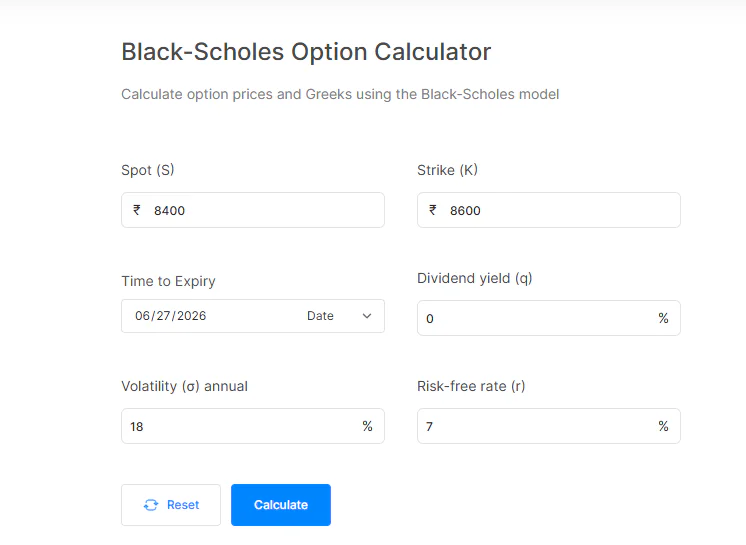
AlgoTest's Black-Scholes Calculator does the full calculation for you. Enter your five inputs, click calculate, and you get:
Theoretical Call and Put premiums: The fair value based on Black-Scholes inputs
Full Greeks table: Delta, Gamma, Theta, Vega, and Rho for both the call and the put
Instant sensitivity check: Change any input and see how the premium and risk metrics shift
This is the same approach professional options traders use to check whether a market price is rich or cheap before placing a trade.
Want to go deeper on the model first? Read AlgoTest's full guide to the Black-Scholes model. It covers the formula, the assumptions behind it, its limitations, and how to read the outputs correctly.
Open the Black-Scholes Calculator on AlgoTest
Intrinsic vs. Extrinsic Value: A Quick Reference
Why Mispriced Premiums Cost Traders Money
Many retail options buyers overpay for premium, especially around events. High IV before a news event can make options look cheap on a directional basis. But if IV collapses after the event (IV crush), the premium falls even if the spot moves the way you expected. You can be right about direction and still lose money.
Knowing what is inside the premium before you trade it is the difference between a good trade and a losing one.
AlgoTest's Black-Scholes calculator lets you test this before you enter a position. Plug in a lower IV to simulate what the premium might look like after the event. Most retail platforms do not make this kind of pre-trade analysis easy. AlgoTest does.
Sign up and try free backtesting.
The Bottom Line
Option premium is not complicated once you break it down. It has two parts: intrinsic value and extrinsic value. Five inputs drive it. And the Black-Scholes option pricing model can calculate it in seconds.
The traders who make consistent money in options know whether the premium they are paying or collecting is fair, too high, or too low before they trade.
Use AlgoTest's Black-Scholes Calculator to price your next Nifty or BankNifty trade correctly.